
“Baserow gave us the flexibility to adapt our workflows as quickly as our lab evolves. It brings the work around our LIS together, from sample logistics to reporting, giving our team a shared view of operations and more control over how we work.”
Johannes Helmuth, Head of Bioinformatics & Data Science at Labor Berlin – Charité Vivantes GmbH
Labor Berlin’s human-genetics department replaced Excel-based tracking with a self-hosted Baserow database alongside its laboratory information system (LIS). Linked tables, automations, and API connections bring sample tracking and operational tasks together, giving the team a system it can adapt as its workflows change. The department also contributed its experience to Baserow’s Clinical Lab Operations template.
Industry
Healthcare & Life Sciences
Clinical and Diagnostics Services
Organization Size
Mid Market
Region
Europe (Germany)
Baserow Capabilities
- Database, Linked Tables & Shared Views
- API & Integrations
- Automations
- Self-Hosting
About Labor Berlin
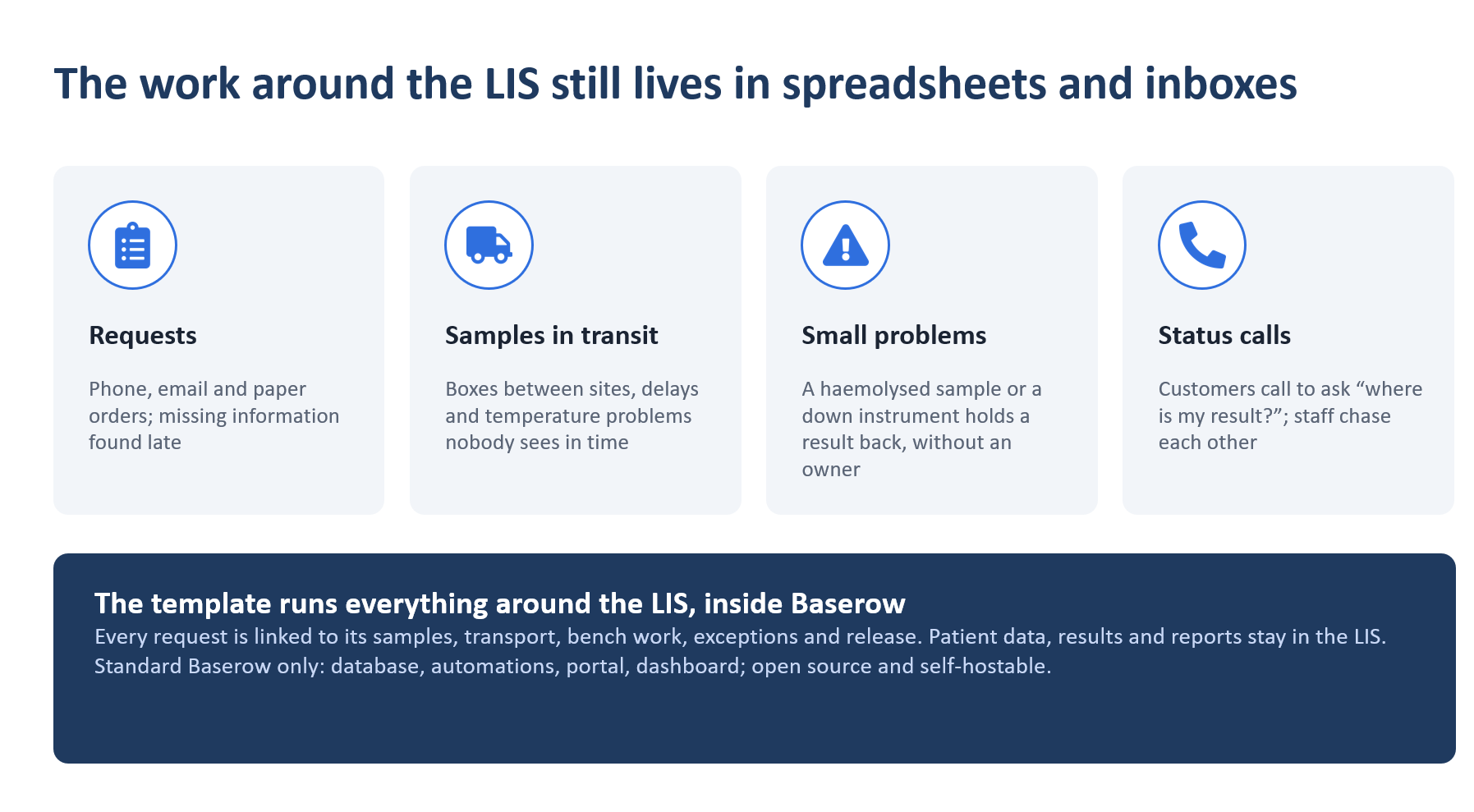
Labor Berlin – Charité Vivantes GmbH provides laboratory diagnostics services for Charité – Universitätsmedizin Berlin, the Vivantes hospitals, and external customers. Its human-genetics department coordinates workflows spanning sample intake, sequencing, analysis, and reporting. Keeping those steps connected requires a clear view of each case and a way to adapt operational processes as the laboratory’s needs evolve.
Challenge: Tracking Lab Operations Across Disconnected Spreadsheets
Human-genetics workflows involve more than recording a final result. Teams need to follow sample intake and pre-analytics, quality control, sequencing, data analysis, clinical reporting, and the release of results and raw data.
Much of this operational tracking previously lived in Excel files. Sharing information between teams, controlling access, and connecting those files to other software was difficult. The commercial LIS did not track every operational step in the detail the department needed.
The team wanted one place to coordinate the work around its LIS, with the freedom to change workflows and connect its analysis tools through an API. Patient results needed to remain in validated systems, while data stayed on Labor Berlin’s own infrastructure.
Solution: A Flexible, Self-Hosted System Alongside the LIS
Labor Berlin built an operational database in Baserow to extend the workflows around its commercial LIS. The setup combines a shared view of laboratory work with connections to specialist analysis tools.
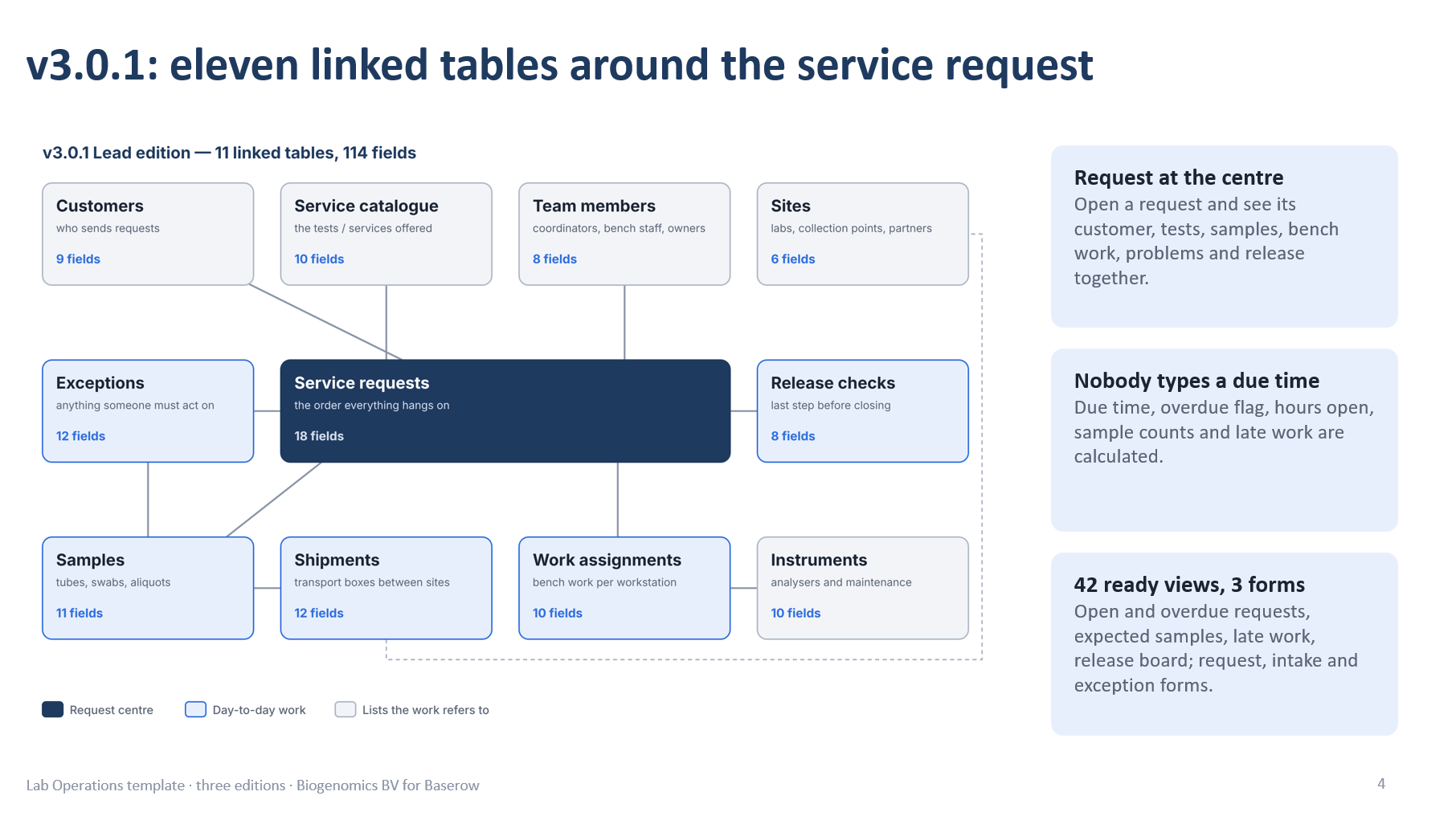
- Linked sample tracking: Linked tables track samples, their status, and the steps from intake to release. Filtered views help each team focus on its work, while status flags show where each case stands.
- Connected analysis and reporting: An API connector exchanges data with the variant interpretation software, and report documents draw on information from both systems. Automations support the operational workflows around these records.
- Control over infrastructure and access: The proposed setup runs Baserow on Labor Berlin’s own servers, with role-based access and database backups. This gives the department a flexible environment for its operational data alongside its established clinical systems.
Results: Connected Workflows and Greater Team Ownership
1. A System the Team Can Adapt
The department can change tables, views, and automations as its processes evolve, without waiting for a software release. A separate test instance allows the team to try changes before introducing them into daily work. This gives the people managing the workflow more ownership over how the system develops.
2. Clearer Sample Traceability
Documenting each sample’s journey in one place makes its status easier to follow across the workflow. Shared records support traceability and turnaround-time monitoring, giving teams a common reference for the progress of each case.
3. A Starting Point for Other Laboratories
Labor Berlin worked with Baserow to translate its experience into the generic and broadly applicable Clinical Lab Operations template. The collaboration focused on steps shared by many laboratories: request intake, condition on receipt, routing to workstations, review, and release. Other teams can use this structure as a starting point for their own operational workflows.
Future Outlook: Extending Lab Operations to More Teams
Labor Berlin is exploring further uses for Baserow, including forensic genetics, where cases can involve multiple samples of varying quality and require detailed traceability, pathology labs, and accredited clinical-study sample operations. Training with Baserow is also planned for the human-genetics, forensics, pathology and clinical-study teams. These are potential next steps, with scope and timing still to be confirmed.
Explore the free Clinical Lab Operations template · Book a 20-minute walkthrough

Baserow 2.4 adds Button fields, Graph elements, workflow automation, AI provider management, improved Group By views, and 30+ more updates.

Discover how Airtable and Baserow compare in features, flexibility, speed, and scalability. Compare pricing plans and hidden costs to make an informed decision!

Explore the best open-source software alternatives to proprietary products. Discover OSS tools, licenses, and use cases with our updated directory.