

"Baserow is a great tool to rapidly build databases that connect to existing systems and can be used by non-technical users to manage operational data. We were looking for a flexible, cost-effective and secure solution that enables our business team to work on “hot” data directly connected to various data sources. We want to eliminate multiple spreadsheets in favour of a central data collaboration platform.”
Olivier Gueudelot, Product Owner Internal tools, Thales SIX GTS
Thales SIXT replaced a dozen of spreadsheet based tools with a modern no-code database built with Baserow and several applications built with AI agents to manage the maintenance and repair data for equipment sold to their clients. In a few months, they replaced the spreadsheets, connected the database to multiple data sources and built several business applications for their business teams to proactively manage their existing clients’ equipment.
Industry
Defence
Organization Size
Enterprise
Region
Global
Baserow Capabilities
- Database & Shared Views
- API-First Architecture
- Automations
About Thales
Thales SIX GTS is a subsidiary of Thales that focuses on secure information and communication systems for defence, security, and land transport markets. It develops and supplies communication equipment and systems for military, security, and critical infrastructure applications.
Challenge: Eliminate spreadsheet-based tools for real-time collaboration
Thales launched a project to eliminate a multitude of spreadsheet-based tools and replace them with a no-code database to connect multiple data sources and empower business users and engineers to manage operational data in real time. Thales decided to use a no-code database for its API-first architecture and for the speed of configuration. The database also connects to business applications built with AI agents.
Solution: A no-code database that connects to existing systems and business applications
Thales selected Baserow to serve as the data collaboration platform. Unlike rigid, proprietary software, Baserow’s flexibility and API-first capabilities enabled the team to build a system that met Thales’s exact needs and delivered value to the Business teams.
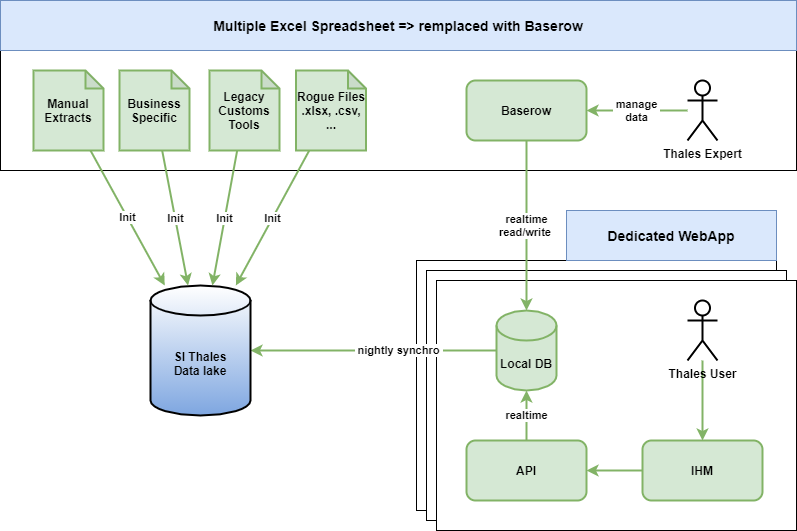
- Centralized data for single source of truth: Baserow acts as the central database to capture equipment data and power the business apps. Baserow replaces a dozen of spreadsheets tools.
- Seamless Integration: Using Baserow’s robust API, Thales connected its database to existing systems to keep information up to date in real time.
- Easy to use: with its spreadsheet-like interface, Baserow felt very familiar to users who adopted it easily.
Results: Centralized data platform delivered in weeks
1. Speed
The solution was built in a couple of weeks by non-technical users. The simplicity and flexibility of the no-code tools platform ensured rapid adoption and much faster development time than custom tools requiring database experts.
2. Governance & Security
The databases are deployed on-premises, and user access is through Role-Based Access Control and Single Sign On (SSO). The Builders team has access to the Baserow platform to build and manage the database, whilst the business teams can edit data or use front-end business apps connected to Baserow.
Future Outlook: Replace spreadsheet-based apps
As users are satisfied with the quality of the database, the ease of use and the speed of delivery, more teams are approaching the Baserow product team with tool requirements. Acting as a small digital factory, more databases and apps will be built in 2026 to address business needs faster.
“The platform is very powerful and versatile. We are looking forward to delivering more databases and applications to our business teams to serve our customers”, says Olivier Gueudelot.

Baserow 2.4 adds Button fields, Graph elements, workflow automation, AI provider management, improved Group By views, and 30+ more updates.

Discover how Airtable and Baserow compare in features, flexibility, speed, and scalability. Compare pricing plans and hidden costs to make an informed decision!

Explore the best open-source software alternatives to proprietary products. Discover OSS tools, licenses, and use cases with our updated directory.