
Businesses are adopting AI faster than ever. However, many automation projects struggle to deliver long-term value. Teams often start with isolated workflows, only to find that their processes become difficult to manage as data grows and operations become more complex.
This is why many organizations are now searching for AI automation templates. These templates provide a starting point for building repeatable processes that combine structured data, workflow automation, and AI capabilities. When built on the right foundation, they help teams scale operations without adding unnecessary complexity.
Why Most AI Automation Templates Stop Working at Scale
Many automation templates solve a single problem. They might send notifications, update records, or trigger actions between applications. While useful at first, these workflows often become difficult to manage as teams grow.
Common challenges include:
- Information spread across multiple tools
- Duplicate records and inconsistent data
- Manual handoffs between departments
- Limited reporting and visibility
- AI tools operating separately from operational data
As a result, teams spend more time managing systems than improving processes.
The most successful organizations treat automation as part of a larger operational system. Instead of connecting many disconnected tools, they centralize data, workflows, and AI capabilities within a single environment. This approach creates a stronger foundation for growth and makes automation easier to maintain over time.
What Makes an AI Automation Template Scalable?
Not all templates are designed for long-term success. Scalable templates share three important characteristics.
Structured Data
Every workflow depends on reliable information. A scalable template should store records in a centralized database where teams can easily track updates and maintain a single source of truth.
Platforms like Baserow help teams organize operational data while supporting collaboration across departments. This ensures that automation runs on accurate and up-to-date information.
AI-Powered Actions
Modern workflows do more than move data between systems. They also use AI to process information.
For example, AI can support:
- data extraction from forms and documents
- request categorization
- content summarization
- record enrichment
These capabilities reduce manual work and help teams process larger volumes of information more efficiently.
Workflow Automation
Automation should support complete business processes rather than individual tasks.
A scalable workflow can automatically route requests, assign ownership, trigger reviews, and update records as work progresses. Combined with tools like Baserow AI, teams can build AI-native operational systems that remain flexible as requirements evolve.
A Practical Baserow Use Case
Consider a product operations team managing feature requests.
Without a structured process, requests may arrive through emails, spreadsheets, support tickets, and chat messages. This makes prioritization difficult and limits visibility.
Using Baserow, the team can create a centralized workflow:
Feature Request Form → AI Categorization → Priority Review → Product Evaluation → Roadmap Tracking
Each request is stored in a database and processed through a consistent workflow. AI can automatically categorize incoming requests, while team members review priorities and update statuses. Because all information remains in one system, reporting becomes easier and decision-making improves.
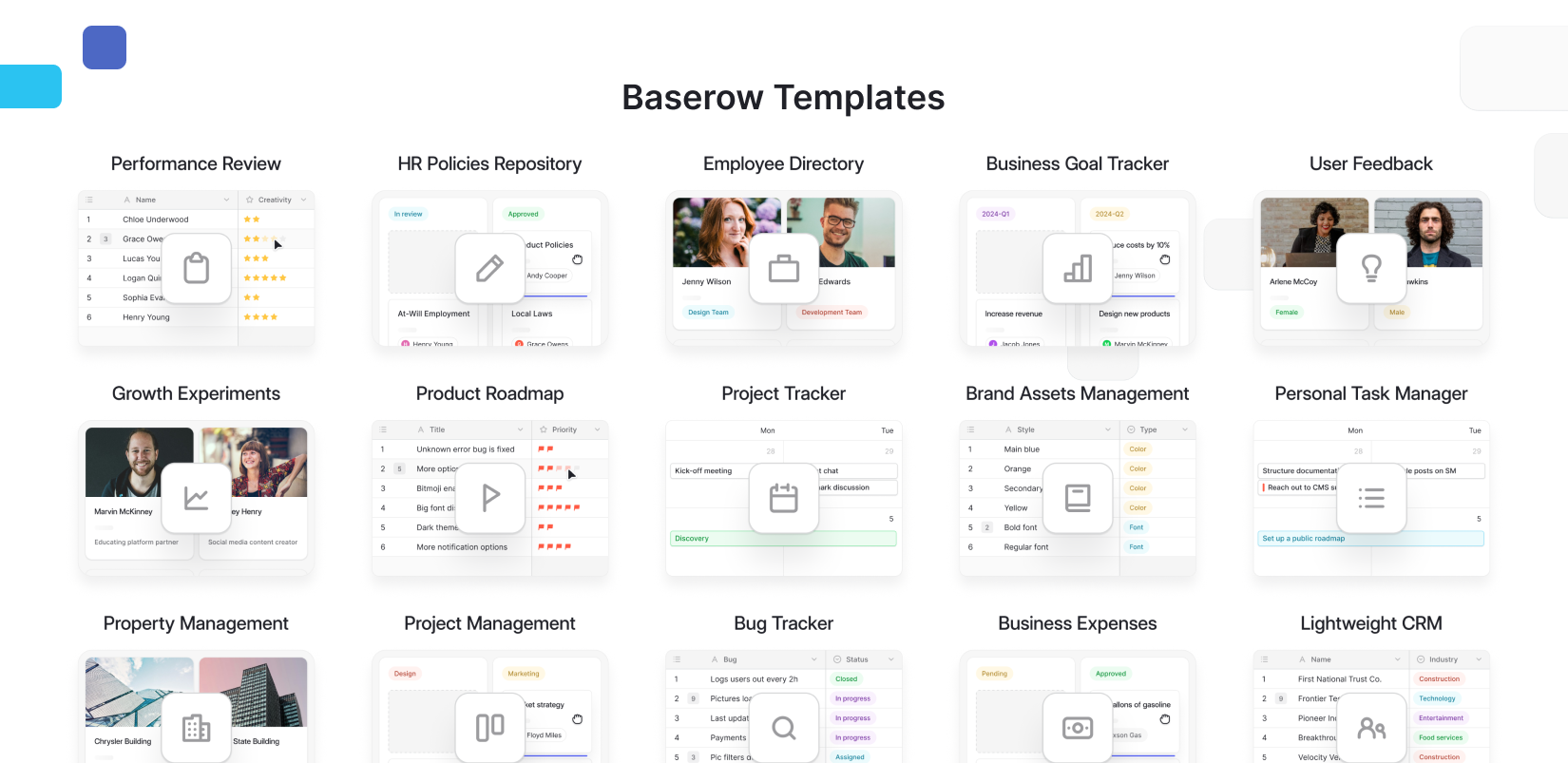
Teams can accelerate implementation by starting with templates available in the Baserow Templates Gallery. Many organizations also share ideas and operational workflow examples through the Baserow Community, helping teams learn from real-world use cases.
This approach turns simple automation into a scalable operational system.
Frequently Asked Questions
- What is an AI automation template?: An AI automation template is a pre-built workflow that combines automation logic, structured data, and AI capabilities to streamline business processes.
- Can AI automation templates work without coding?: Yes. No-code platforms such as Baserow allow teams to build, customize, and manage automated workflows without writing code.
- How does AI improve operational workflows?: AI helps automate repetitive tasks such as data extraction, classification, summarization, and information processing. This allows teams to focus on higher-value work.
- What is the best platform for managing AI-powered workflows?: The best platform depends on your requirements, but organizations often benefit from solutions that combine databases, AI capabilities, and workflow automation in one place. Baserow is designed specifically to support these operational needs.
The Next Step for Operational Teams
AI automation templates can help teams move faster, but their real value comes from supporting scalable operational systems. The most effective templates combine structured data, workflow automation, and AI-powered actions within a single environment.
If you want to build workflows that grow with your business, explore Baserow and see how AI-native operational software can simplify your processes. You can also create a free workspace and start building today at Baserow Signup.

Baserow 2.4 adds Button fields, Graph elements, workflow automation, AI provider management, improved Group By views, and 30+ more updates.

Discover how Airtable and Baserow compare in features, flexibility, speed, and scalability. Compare pricing plans and hidden costs to make an informed decision!

Explore the best open-source software alternatives to proprietary products. Discover OSS tools, licenses, and use cases with our updated directory.