
TL;DR
AI can help people work faster, but that doesn’t automatically mean better results for the whole company. As businesses start using AI to handle more tasks and work with their data, they need clear rules about what AI can do, who is responsible for its actions, and when people need to step in. The companies that get this right will be better positioned to turn AI into real business value.
The AI capability gap is becoming an organizational problem
AI investment continues to accelerate. Stanford University’s 2025 AI Index reported that global corporate AI investment reached $252.3 billion in 2024, including $33.9 billion in private investment in generative AI.
Yet investment and adoption do not automatically translate into business results.
McKinsey’s State of AI research highlights a continuing gap between individual productivity improvements and measurable enterprise-level impact. Many organizations are experimenting with AI tools, but fewer have redesigned their operations to capture its full potential.
For business leaders, this raises a more important question than which model to adopt: how should an organization change when AI can increasingly perform work that previously required human intervention?
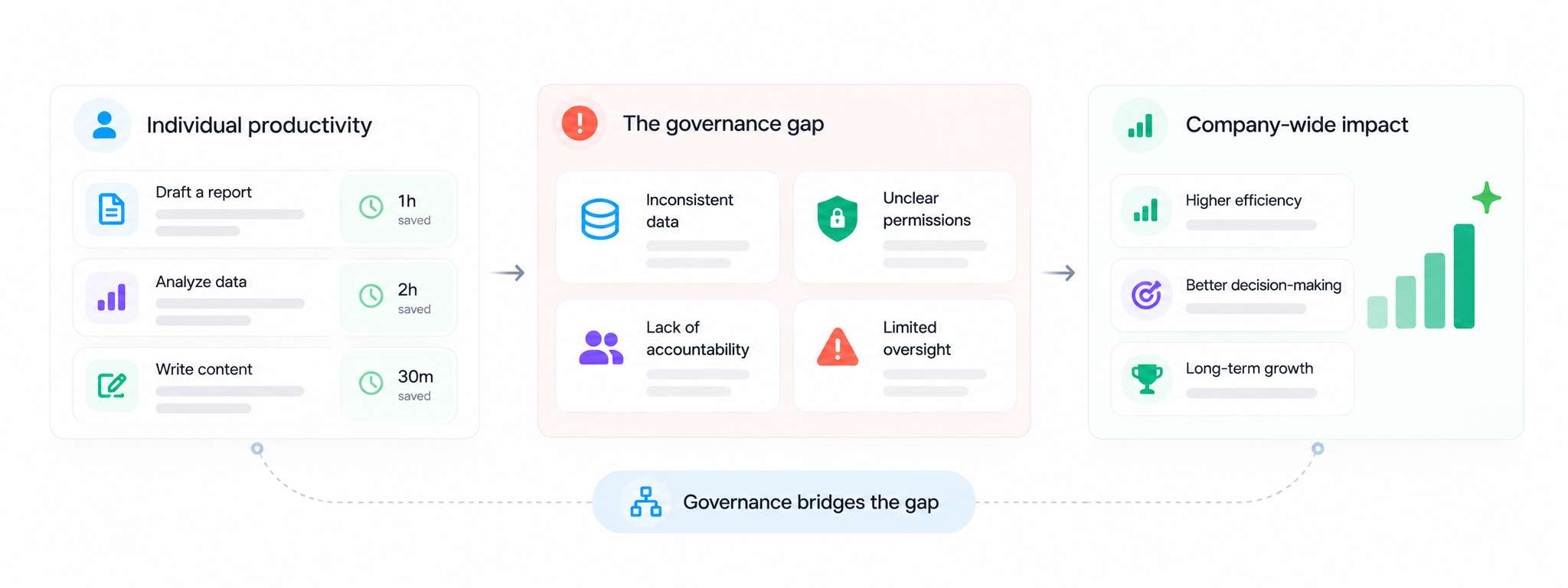
An employee using AI to draft a report may save an hour. A company that connects reliable data, redesigns its reporting workflow and uses AI to improve decision-making may achieve a much larger benefit.
AI transformation is a problem of governance because technology alone cannot determine how an organization should work, who should make decisions or where accountability belongs.
From AI pilots to systems that act
The first wave of generative AI focused largely on individual tasks: writing, summarizing, researching and coding. The next phase involves agentic AI, which can plan tasks, use tools and execute actions across multiple steps.
This changes the nature of adoption.
Imagine an AI system that classifies a customer request, retrieves account information, updates a database and triggers a follow-up workflow. Each action may be straightforward, but the complete process depends on accurate information, appropriate permissions and clear rules about what the system can do independently.
If an agent uses an outdated customer record or applies the wrong approval rule, the result can extend beyond an incorrect answer. It can affect a live business process.
Organizations therefore need to evaluate AI pilots by more than whether the technology works in a demonstration. They need to assess whether the entire workflow produces reliable business outcomes, integrates with existing systems and can be monitored when something goes wrong.
The challenge is to give AI systems enough autonomy to be useful without allowing them to operate beyond their intended purpose.
Data quality and governance go hand in hand
AI systems depend on the information and context available to them. Duplicated customer records, inconsistent project statuses and outdated financial figures can all undermine the quality of AI-generated recommendations.
Automation can make these problems more consequential by spreading incorrect information across connected workflows.
Businesses need clear data ownership, consistent records and permissions that reflect how information should be used. They also need a governance model that connects technical controls with the decisions and processes those controls are intended to support.
This requires cross functional collaboration between IT, data teams, security, legal and business departments. Technology teams manage infrastructure, but business teams understand the context in which information is created and decisions are made.
The US National Institute of Standards and Technology provides a useful reference in its AI Risk Management Framework, which helps organizations incorporate trustworthiness into the design, development, use and evaluation of AI systems.
For Baserow, the connection is practical. Baserow enables teams to organize structured business data and build databases and applications around their processes. This can help establish a clearer foundation for AI-assisted workflows, although it does not replace AI-specific risk management or security controls.
As AI adoption expands, data quality becomes more than an operational concern. It becomes part of the infrastructure needed to use AI responsibly.
How Baserow approaches AI security
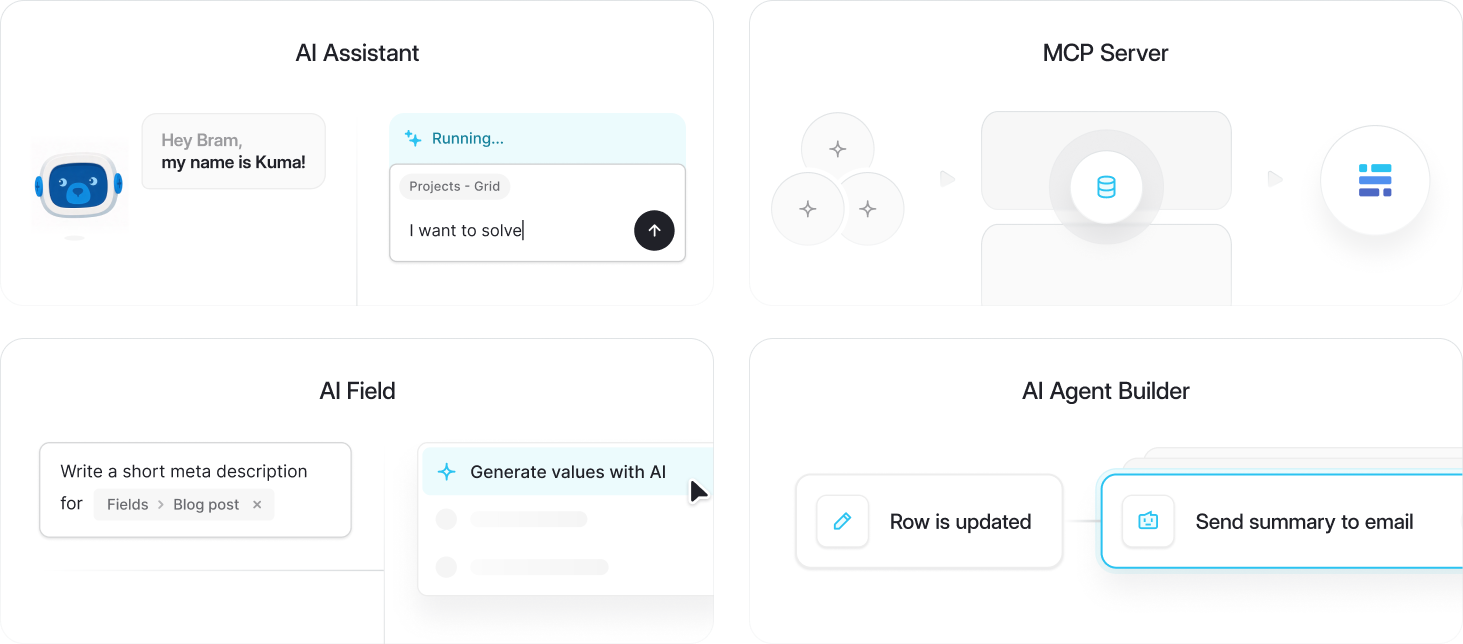
As AI becomes more integrated into business workflows, organizations need to understand where their data goes, who can access it and how it is processed.
Baserow gives teams control over these choices. Its bring-your-own-key approach supports multiple AI providers, while Cloud and self-hosted deployments offer different ways to manage data flows. Self-hosted users can connect directly to external AI providers or run local models with Ollama, keeping AI processing within their own infrastructure when configured accordingly.
Baserow does not use customer prompts, outputs or table content to train its own models or those of its providers. Human oversight remains important: users can review AI-generated formulas before saving them, and automated workflows should be tested before activation.
These options help organizations align AI adoption with their data governance requirements. Learn more in the Baserow AI Security and Data Governance documentation.
Strong governance should enable innovation
Governance is sometimes seen as a reason to slow down experimentation. But allowing every team to adopt AI independently can create fragmented systems, inconsistent permissions and unclear accountability.
Strong governance offers a better balance.
At the executive level, business leaders should establish who owns each AI use case, which actions AI systems can perform and when decisions require human review. Governance frameworks should also distinguish low-risk experiments from high risk applications that need additional safeguards.
For example, an assistant summarizing public documentation does not require the same controls as an agent handling sensitive employee records or initiating financial transactions.
A practical approach includes:
- Clear ownership: Assign responsibility for each AI application and its outcomes.
- Appropriate permissions: Give AI systems only the access necessary for their tasks.
- Human oversight: Require review for decisions with significant consequences.
- Visibility: Maintain audit trails and monitor activity where appropriate.
- Risk-based controls: Apply stronger safeguards to applications where errors could cause greater harm.
This approach ensures AI operates within defined boundaries without making every experiment a lengthy approval process. It helps teams move fast when the risks are manageable while maintaining stronger controls where they matter most.
Regulation adds another reason to develop these capabilities. The EU AI Act is being implemented in stages, with obligations depending on the system, its intended use and the organization’s role. Businesses should consult the European Commission’s implementation timeline to understand which requirements apply to their circumstances.
Governance should be treated as an ongoing business responsibility, not a document created once before deployment.
What should businesses prepare for next?
Three developments are likely to shape the next phase of AI transformation.
1. Workflow redesign will become more important than adding AI to existing tasks.
The biggest gains may come from rethinking how work gets done. Instead of simply automating individual steps, organizations will need to examine entire processes: which tasks should disappear, which can be automated, where people add judgment and how success should be measured.
2. Accountability will extend across connected systems.
As AI agents interact with databases, APIs and business applications, responsibility cannot stop at the model itself. Organizations will need to understand which data a system accessed, what actions it took and who is accountable for the resulting decisions.
3. Flexibility will become a competitive advantage.
AI models and providers are evolving quickly. Businesses that depend entirely on one proprietary environment may have fewer options as capabilities, costs and requirements change.
An API-first architecture, clear data ownership and the ability to connect different systems can preserve flexibility. Open-source and self-hosted solutions may also give organizations more control over their infrastructure and data, depending on how they are deployed and maintained.
These developments will influence how companies measure success. Productivity remains important, but customer outcomes, innovation, risk reduction and sustainable growth matter too.
The organizations that benefit most may not be those that automate the most tasks first. They may be the ones that combine AI capabilities with well-designed processes and clear accountability.
FAQ
Why is AI transformation a problem of governance?
Because scaling AI requires more than capable technology. Organizations must manage data quality, permissions, accountability and risk while ensuring AI systems operate within appropriate boundaries.
How does agentic AI change governance requirements?
Agentic AI can use tools and execute multi-step tasks. Organizations need to define its permissions, determine when human review is required and maintain sufficient visibility to investigate mistakes.
How can businesses prepare for AI transformation?
Start by identifying existing AI use cases, assigning ownership and reviewing the data and systems involved. Introduce risk-based controls, establish human oversight where necessary and evaluate whether AI improves measurable business outcomes.
How can Baserow support AI-ready workflows?
Baserow helps teams organize structured business data and build databases and applications around their processes. These foundations can support AI-assisted workflows, while AI-specific governance, security and oversight remain essential.
AI is moving from a tool employees use to a capability that can participate directly in business operations. That shift creates opportunities, but it also makes data quality, accountability and governance more important.
Companies that invest in these foundations will be better prepared to adopt new AI capabilities without losing visibility or control. The objective is not to slow innovation, but to make it sustainable.
For teams building AI-powered applications and workflows, that starts with organizing business data, making processes visible and defining who can access or change information. Baserow provides a flexible foundation for building those databases and applications while allowing organizations to connect the AI tools that fit their needs.
The next phase of AI transformation will be defined not just by what models can do, but by how thoughtfully businesses redesign the systems around them.

Baserow 2.4 adds Button fields, Graph elements, workflow automation, AI provider management, improved Group By views, and 30+ more updates.

Discover how Airtable and Baserow compare in features, flexibility, speed, and scalability. Compare pricing plans and hidden costs to make an informed decision!

Explore the best open-source software alternatives to proprietary products. Discover OSS tools, licenses, and use cases with our updated directory.