
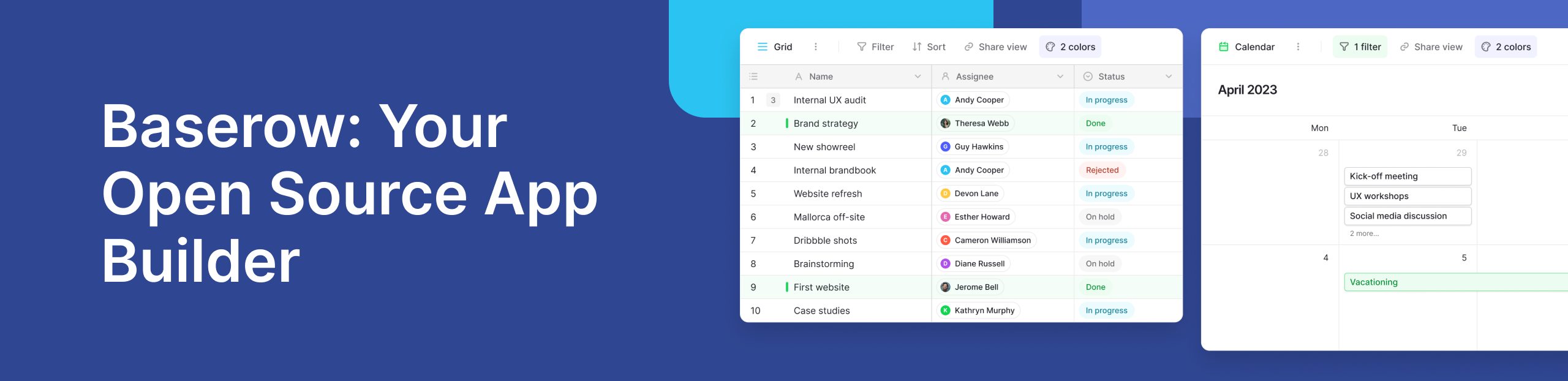
Building internal tools, workflow apps, or lightweight business applications no longer requires heavy frameworks or closed platforms. Teams today increasingly turn to an open source app builder to retain flexibility, control costs, and avoid long-term vendor lock-in. Open source platforms offer transparency and adaptability—two qualities that proprietary tools often limit as teams scale.
This guide explains best practices for choosing an open source app builder, common use cases, and why database-driven platforms like Baserow fit naturally into modern app-building workflows.
What an Open Source App Builder Really Is
An open source app builder is a platform that lets users create functional applications—such as internal tools, dashboards, or process trackers—using openly available source code. Unlike proprietary tools, these platforms allow teams to inspect how data is handled, customise behaviour, and even self-host when required.
Most modern app builders combine:
- A structured data layer
- Visual interfaces for non-technical users
- Automation or logic to connect workflows
This approach moves teams beyond static files while avoiding the complexity of traditional development.
Best Practices When Choosing an Open Source App Builder
- Avoid Rigid Templates and Locked Structures
Templates are useful for getting started, but they often impose assumptions that break down as workflows evolve. A flexible data model allows applications to adapt without being rebuilt.
- Prioritise User Experience From Day One
If everyday contributors struggle to navigate the interface, adoption stalls. A clean user experience reduces onboarding time and keeps tools useful long term—especially when apps are shared across teams.
- Real Time Collaboration and Data Consistency
When multiple people update records simultaneously, real time syncing prevents conflicts and outdated views. This is critical for operational tools where accuracy matters.
- Why an Active Open Source Community Matters
An engaged community reduces risk. Discussions, examples, and shared patterns help teams solve problems faster than documentation alone. Platforms with active forums and contributors evolve more reliably over time.
Common Use Cases for Open Source App Builders
Teams use open source app builders for:
- Internal request and approval systems
- Operations and asset tracking
- Lightweight CRMs
- Project and workflow dashboards
Many of these start as open source handy developed apps created to replace spreadsheets that have outgrown their original purpose.
How Baserow Approaches App Building Differently
Baserow takes a database-first approach to app creation. Instead of starting with a fixed interface, teams model their data and build applications around it. This makes it easier to evolve workflows without losing structure.
Its application builder enables users to transform tables into usable interfaces without writing code, while still preserving data relationships. The product overview explains how this structured foundation supports scalable workflows without forcing teams into rigid patterns.
For deeper technical context, the application builder documentation outlines how views, permissions, and logic work together, making it easier to design apps that remain maintainable over time.
Use Case: Building an Internal Tool With Baserow
A common scenario shared in the Baserow community involves teams replacing shared spreadsheets used for internal requests. These files often suffer from broken formulas, unclear ownership, and inconsistent updates.
Using Baserow, teams first define a structured database for requests, statuses, and owners. From there, they create an application interface that non-technical users interact with daily. Permissions ensure that contributors see only relevant fields, while managers gain an overview without manual consolidation.
Community discussions highlight how this approach reduces operational friction and improves accountability without introducing heavy software overhead.
Platform Improvements That Strengthen App Building
Recent platform updates introduced enhancements that matter directly to app builders, including better performance, improved permissions, and expanded builder capabilities. These changes align with common best practices: keeping applications responsive, secure, and easy to adapt as requirements change.
Rather than adding complexity, these updates reinforce Baserow’s focus on structured data and practical usability.
Open Source App Builder vs Spreadsheet-Based Tools
Spreadsheets remain useful, but they struggle with:
- Multi-user governance
- Data integrity at scale
- Clear permission boundaries
An open source app builder bridges the gap between files and full custom software. Compared conceptually with tools like Airtable, Baserow emphasises openness, extensibility, and ownership—key factors for teams planning beyond short-term projects.
Security, Control, and Transparency in Open Source Tools
Open source platforms allow teams to verify how data is stored and processed. Combined with granular permissions and deployment flexibility, this transparency supports stronger governance—especially for small businesses growing into more complex operations.
Independent resources such as opensource.com and GitHub’s open source guides consistently highlight transparency and community review as core strengths of open platforms.
Quick Questions
- Is Baserow open source?
Yes, Baserow is built as an open source platform, meaning its core codebase is publicly available. This allows teams to inspect how the system works, extend functionality if needed, and choose self-hosting when greater control over data and infrastructure is required. Open source also encourages long-term sustainability by reducing dependency on a single vendor.
- Is there a totally free app builder?
Many open source app builders can be used for free, particularly when self-hosted. These options typically include essential features for creating and managing applications, while more advanced capabilities or managed hosting may be optional. This makes open source builders appealing for teams that want to experiment or deploy internal tools without upfront licensing costs.
- Is Baserow suitable for small businesses?
Baserow is well suited for small businesses because it allows teams to start with simple use cases and expand gradually. Its flexible data structure supports evolving workflows, while the interface remains accessible to non-technical users. This helps small teams avoid over-investing in complex software before their needs are fully defined.
- How does Baserow compare to Airtable?
Baserow and Airtable serve similar use cases, but differ in approach. Baserow emphasises openness, extensibility, and data ownership through its open source model, whereas Airtable is a proprietary, licence-based platform. For teams that value transparency, customisation, or self-hosting, this distinction can be an important factor in long-term planning.
- How secure is Baserow?
Baserow is designed with security and compliance foundations in mind. It provides granular permissions, role-based access control, and structured data handling to help teams manage who can view or modify information. Its transparent, open source architecture allows organisations to review how data is stored and processed, which is an important requirement for compliance frameworks such as GDPR and HIPAA.
Conclusion
Choosing an open source app builder is less about feature checklists and more about long-term flexibility. Platforms built around structured data, open communities, and adaptable interfaces reduce rework as teams grow.
If you’re exploring a practical way to build internal tools without locking yourself into rigid systems, you can try Baserow and see how its database-driven approach supports real-world workflows.

Baserow 2.4 adds Button fields, Graph elements, workflow automation, AI provider management, improved Group By views, and 30+ more updates.

Discover how Airtable and Baserow compare in features, flexibility, speed, and scalability. Compare pricing plans and hidden costs to make an informed decision!

Explore the best open-source software alternatives to proprietary products. Discover OSS tools, licenses, and use cases with our updated directory.