
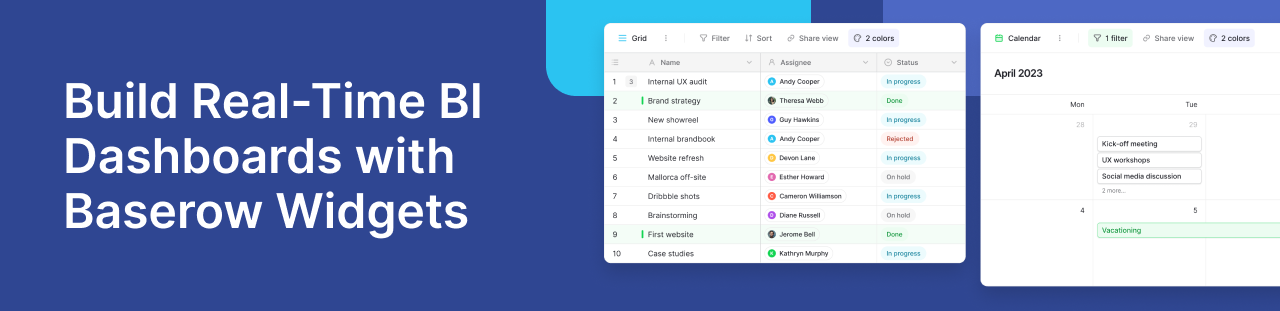
If you are migrating workflows from tools like Smartsheet, Monday, or Airtable, you know that keeping your team aligned requires more than just managing raw data. You need a reliable way to track key performance indicators (KPIs), monitor project milestones, and analyze historical trends without constantly refreshing manual reports.
Baserow Dashboards provide a no-code business intelligence (BI) solution that transforms your standard databases into clear, dynamic visual insights. Instead of sorting through endless rows and columns, you can easily build customizable, top-level interfaces that automatically update the moment your underlying data changes.
Real-time dashboards vs. static spreadsheets: Why dynamic visualization matters
Unlike static reporting methods that require manual data exports and constant recalculations, real-time dashboards connect directly to your living data sources.
Whether you are tracking global sales trends or managing support tickets, visual widgets provide an immediate, high-level overview of your operations. Because these visualizations are tied directly to your database, they update instantly. If a team member adds a new row, updates a record, or deletes an entry, your charts reflect that change immediately. This creates a highly reliable single source of truth for stakeholder meetings, live reporting, and daily project management.
How to choose the best widgets to visualize your business KPIs
Widgets are the building blocks of your data visualization strategy. By combining different types of widgets, you can build a comprehensive and easy-to-read view of your business metrics.
Depending on the data you need to track, you can utilize several distinct widget types:
- Summary widgets: Perfect for highlighting single, critical metrics at a glance, such as total quarterly revenue, the number of active projects, or average customer response times.
- Bar and line charts: Ideal for comparing performance across different teams, tracking growth rates over time, and spotting historical patterns within your data series.
- Pie and doughnut charts: The best choice for visualizing proportions and part-to-whole relationships, such as department budget allocations or market share distribution.
How to build a no-code BI dashboard in Baserow step-by-step
Getting started with your first dashboard is a straightforward process designed to strip away technical friction, allowing you to focus on the data itself rather than complex configurations.
- Create your dashboard: Navigate to your desired workspace and initiate a new dashboard to house your visualizations. Give it a clear, descriptive name that reflects its purpose (e.g., “Q3 Sales Performance”).
- Connect your data sources: Add your desired widgets and map them to specific tables. A major advantage of this system is the ability to pull data from multiple sources across entirely different databases onto a single, consolidated dashboard.
- Customize your views: Configure your individual widgets by grouping data (such as organizing sales by region), setting up custom sorting preferences, and adjusting color schemes to highlight specific data points or match your internal branding.
Frequently asked questions
How do I combine data from multiple different tables into a single business dashboard?
If you are used to jumping between different spreadsheets to compile reports, Baserow simplifies this by allowing you to pull data from multiple sources. You can add several widgets to a single dashboard, and map each individual widget to a completely different table or database across your workspace, creating a consolidated high-level overview.
Do KPI dashboards automatically update when my team changes the underlying database?
Yes. Unlike static Excel exports or manual Smartsheet reports that require constant recalculation, Baserow dashboards are tied directly to your living data. Whenever a team member adds a row, updates a record, or changes a status, your dashboard charts and summary widgets refresh instantly in real-time.
Do I need a separate BI tool to visualize my database metrics?
No. While many teams end up paying for complex third-party tools like Tableau or PowerBI to visualize their Airtable or custom databases, Baserow includes native, no-code BI features. You can build professional bar charts, pie charts, and summary metrics directly on top of your existing data without complex integrations.
How do data permissions and security work for shared team dashboards?
Data governance is built directly into your visualizations. Dashboard visibility strictly follows Baserow’s standard workspace permission system. Users will only see the data displayed on the dashboard widgets if they already have the appropriate access levels and permissions for the underlying tables.
What happens to my dashboard charts if the underlying database fields are deleted?
If someone accidentally deletes a table or database that a specific widget relies on, that widget will temporarily display an error to prevent the display of inaccurate information. You can easily fix this by either restoring the deleted data from your trash or removing the broken widget from the dashboard.
Learn more about how to build a real-time business dashboard in the Baserow documentation.

Baserow 2.4 adds Button fields, Graph elements, workflow automation, AI provider management, improved Group By views, and 30+ more updates.

Discover how Airtable and Baserow compare in features, flexibility, speed, and scalability. Compare pricing plans and hidden costs to make an informed decision!

Explore the best open-source software alternatives to proprietary products. Discover OSS tools, licenses, and use cases with our updated directory.