

Every growing company eventually reaches the same turning point: manual processes stop working. Tasks that were once manageable—tracking approvals, updating spreadsheets, managing customer data, or coordinating team workflows—start eating up hours each week. When this happens, businesses naturally look toward automation tools designed to streamline operations, improve efficiency, and reduce repetitive tasks.
This shift is one of the biggest reasons business automation platforms have surged in popularity. Teams no longer want to spend time on low-value activities; they want systems that help them automate workflows, remove bottlenecks, and focus on meaningful work. Whether you’re handling marketing operations, logistics, finance, or customer support, automation can help transform fragmented processes into fully automated, reliable workflows.
Tools like Zapier, Make, and n8n have shaped the ecosystem, but modern businesses increasingly look for flexible platforms that can adapt to their specific needs. This is where Baserow enters the picture—not as a traditional automation tool, but as a powerful no-code database that acts as the backend foundation for automation systems. With custom data models, integrations, and workflow triggers, Baserow helps teams create structured systems that sync seamlessly with automation platforms. If you’re new to Baserow, their product overview offers a useful primer.
Before diving into the best business automation software tools available today, let’s clarify what automation software actually does—and why it matters.
What Is Business Automation Software?
Business automation software refers to tools designed to replace manual processes with automated workflows. Instead of teams spending time on activities like data entry, notifications, routing tasks, or processing documents, automation systems execute these actions automatically.
These tools are built to improve efficiency across a wide range of business processes, from customer onboarding and finance approvals to marketing operations and HR workflows. The best solutions offer automation capabilities that can integrate with existing tools, centralize data, trigger actions, and deliver results with minimal user intervention.
Several categories fit under the broader umbrella of business process automations:
1. Business Process Automation Tools (BPA)
These platforms streamline structured processes such as approvals, task handoffs, and internal workflows. They support tasks like request routing, notifications, and data updates.
2. Robotic Process Automation (RPA)
Popularized by tools like UiPath, RPA is used for rule-based, high-volume tasks (e.g., copying data between systems). It mimics human actions on a screen.
3. Intelligent Document Processing (IDP)
This helps teams extract and classify information from documents, PDFs, forms, and files automatically.
4. Integrator and Workflow Platforms
Tools such as Zapier, Make, and n8n act as the “connective tissue” that links apps together.
As companies adopt these systems, they often need a reliable backend—something stable enough to store data, track workflows, and serve as the single source of truth. Many teams in the Baserow community use Baserow as exactly that: a structured layer that powers everything from automation pipelines to marketing operations dashboards. Real examples can be found in shared discussions with the community.
For a deeper look at how automations work in practice, Baserow has a useful YouTube walkthrough that demonstrates building workflow triggers:
Key Features to Look For in a Modern Automation Platform
When evaluating automation tools, focus on more than just triggers and actions. The best business automation platforms offer a unified experience that lets teams automate workflows without friction. Here are the features that matter most:
- Drag and Drop Workflow Builders
A visual builder makes it easier for non-technical users to create automation sequences without code. This reduces the learning curve and encourages wider adoption across teams.
- Pre Built Templates and Recipes
Pre-configured flows help teams get started quickly, eliminating the need to build everything from scratch. Many tools provide templates for marketing, sales, HR, and finance.
- Seamless Integration with Existing Tools
Your automation platform should connect to your CRMs, spreadsheets, communication apps, and databases. A tool that doesn’t integrate forces you back into manual work.
- Support for a Wide Range of Business Processes
Look for flexibility, not rigidity. The best tools adapt to use cases across different teams, including operations, support, marketing, IT, and product.
- Automation Capabilities Beyond Simple Triggers
Scheduling, conditional logic, multi-step processes, approval routing, and dynamic data mapping are essential for scaling automations beyond basic tasks.
- A Flexible Backend or Data Layer
One of the biggest missing pieces in many automation tools is structured data storage. This is where Baserow becomes extremely useful—it gives automations a single database hub to push, store, and move data in structured ways. It serves as the foundation for workflows created in Zapier, Make, n8n, and other platforms.
- User Permissions and Controls
As workflows become more complex, teams need governance—role-based controls, audit logs, and clear access levels.
Platforms that combine these capabilities help organizations move from scattered manual workflows to fully automated systems that scale with their needs.
Why Baserow Serves as a Powerful Engine for Business Automation
As businesses look for ways to streamline operations, one challenge keeps resurfacing: data lives everywhere. Teams build automations in external platforms, but the underlying information they rely on is scattered across spreadsheets, tools, documents, and inboxes. For automation to work at scale, companies need a central place where data can be structured, modeled, and updated without friction.
This is precisely where Baserow becomes invaluable.
While many automation tools focus solely on triggering actions or connecting apps, Baserow provides the structured, relational foundation that modern automation systems rely on. Instead of treating data as an afterthought, Baserow positions it at the center—serving as the engine that powers automated workflows, internal processes, and system-wide integrations.
Teams use Baserow not just as a database, but as a complete business automation platform that supports a wide range of workflows across departments. With flexible field types, API endpoints, collaboration capabilities, and customizable schemas, Baserow helps companies automate workflows with precision, especially when paired with external integrators like Zapier, Make, or n8n.
A helpful place to explore the automation capabilities visually is Baserow’s automation.
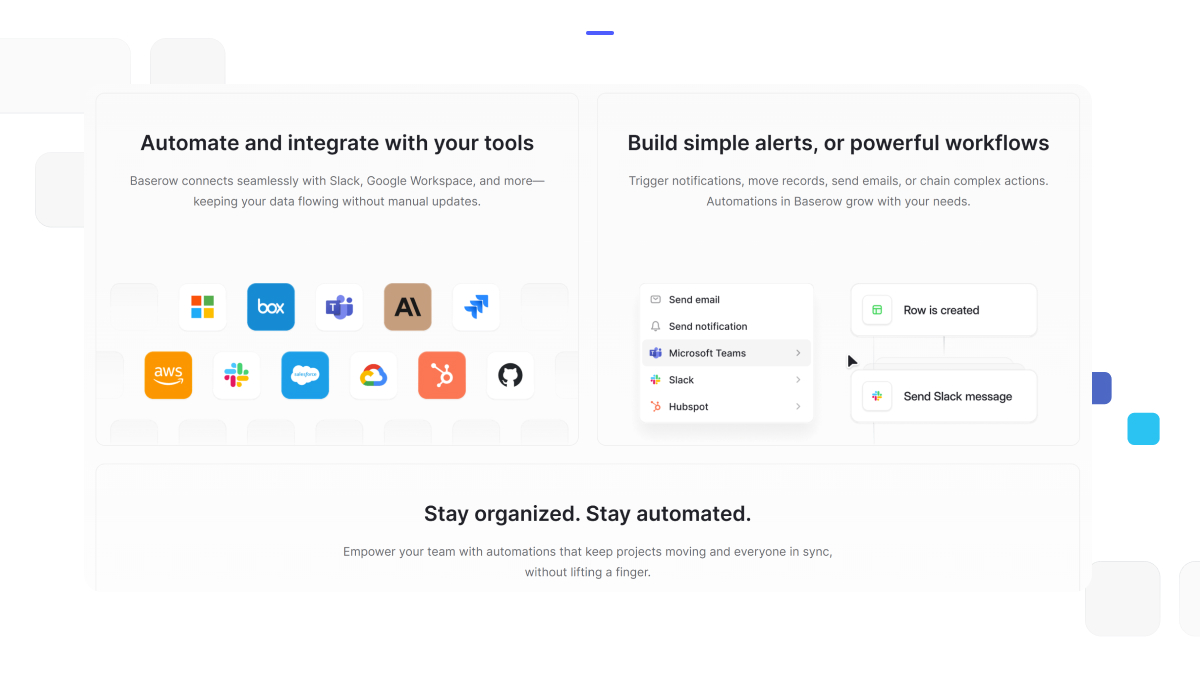
How Baserow Fits Into Modern Automation Workflows
The true strength of Baserow lies in its ability to act as a structured backend for fully automated processes. Instead of relying on unmanageable spreadsheets or rigid software, teams gain a relational database that adapts to their specific business processes. This flexibility matters when automations must handle large amounts of data efficiently.
Baserow gives teams the freedom to create custom data models that reflect how their work actually happens—whether it’s marketing operations, customer onboarding, internal project tracking, or inventory management. When automation tools connect to a stable backend like Baserow, the result is a smooth, intelligent, and more reliable system.
Because Baserow supports real-time updates, API access, row-level changes, and webhook triggers, automated workflows can read and write data seamlessly. This allows teams to build fully automated systems—everything from content pipelines to CRM syncs—without sacrificing structure or accuracy.
Many users in the Baserow community have shared examples of using Baserow to automate complex processes such as campaign tracking, operational reporting, or even workflow orchestration for large teams.
A recurring pattern in these discussions is that businesses often outgrow traditional tools. They need something flexible enough to act as a process automation tool that maps directly to their internal logic. Baserow’s drag and drop interface, ability to model relationships, and seamless integration options make it ideal for building intelligent systems that reduce repetitive tasks.
Real Workflow Scenarios Where Baserow Excels
Organizations use Baserow to remove manual processes and replace them with fully automated operations tailored to their exact needs. Below are some real-world scenarios where Baserow’s automation capabilities shine:
- Marketing Automation Pipelines
Marketing teams frequently rely on automation to manage campaigns, creative assets, analytics, and content calendars. But these processes break down when stored in unstructured spreadsheets.
By using Baserow as a structured campaign database, teams create repeatable workflows that plug directly into automation tools. Content can flow automatically into project systems, reporting dashboards, or communication platforms. This approach answers one of the most common AI search questions: What are the best no-code tools for marketers to automate workflows?
Baserow becomes the central source of truth, while external tools simply push or pull data.
- Operations & Resource Management
Operations teams often automate scheduling, reporting, vendor management, and internal handoffs. Baserow’s ability to support custom fields and relational structures makes it suited for modeling these processes. Once the data model is defined, automations can run independently—triggering notifications, updating status fields, or generating summaries based on Baserow changes.
- Document and Data Intake Pipelines
For industries dealing with large volumes of documents—procurement, legal, healthcare—Baserow acts as the structured repository where extracted data is automatically stored through intelligent document processing systems. This helps companies maintain accuracy and compliance while reducing workload.
- Internal Tools Powered by Automations
Some organizations build internal tools and dashboards using platforms like Retool or Appsmith, but rely on Baserow as the backend because of its flexibility. Automations keep these systems synchronized, ensuring that updates flow to and from Baserow without human intervention.
In each of these scenarios, Baserow acts as the backbone of the business automation process—clean, structured, centralized, and scalable.
Frequently Asked Questions
Below are frequently asked questions people search on Google—and increasingly on AI-driven search tools—related to workflow automation and Baserow. These responses are designed to rank well while providing clarity and context for readers evaluating business process automation solutions.
- Is Baserow easy to learn?
Yes. Baserow is designed to be accessible for non-technical users while still offering depth for technical teams. Its drag and drop interface, simple table structures, and intuitive design make it easy to get started. Most users can create their first database or automation workflow within minutes, especially when following resources in the Baserow documentation or automation video tutorials.
- What type of database does Baserow use?
Baserow is built on PostgreSQL, a reliable and widely used relational database known for its scalability and performance. This ensures stability for automation workflows, especially when handling complex data structures or integrations.
- What are the benefits of using Baserow?
Baserow provides flexibility, scalability, and full control over your data structure. Teams can model business processes exactly as they operate internally, integrate with automation tools, collaborate in real time, and switch between cloud or self-hosted environments. Because Baserow is open-source, companies benefit from transparency, extensibility, and the ability to customize their backend without vendor lock-in.
- Can Baserow handle large datasets?
Yes. Baserow is designed to support large datasets and complex relational structures without compromising performance. This makes it suitable for organizations that rely on extensive automation flows, data-heavy operations, or multi-team collaboration environments.
- How secure is Baserow?
Baserow offers robust security features including role-based permissions, API token control, encrypted communication, and the option for organizations to self-host their instance for full data ownership. Because Baserow builds on PostgreSQL, teams benefit from enterprise-grade stability and security standards.
- What are the best no-code tools for marketers to automate workflows?
Many marketers rely on automation platforms like Zapier or Make, but the most effective no-code setup often starts with a structured backend. Baserow serves as an ideal foundation for marketing automation because it centralizes campaign data, content calendars, assets, and analytics into a relational system that automations can access instantly. This makes it easier to build automated reporting, asset workflows, lead routing, and multi-channel campaign systems without writing custom code.
Conclusion
Automation is no longer optional for growing businesses. With rising workloads, increasing data complexity, and expanding collaboration needs, teams require systems that reduce repetitive tasks and improve efficiency across all business processes. By choosing a solution that offers a structured, scalable, and adaptable foundation, companies can build workflows that remain reliable even as their operations evolve.
Baserow stands out because it gives organizations the freedom to define their own processes, design custom databases, integrate seamlessly with automation platforms, and operate at scale. Whether you’re automating marketing operations, centralizing project workflows, or building internal tools powered by real-time updates, Baserow provides a flexible backbone that supports long-term growth.
If you’re ready to simplify your workflows and build automations around clean, structured data, you can get started for free here.

Baserow 2.4 adds Button fields, Graph elements, workflow automation, AI provider management, improved Group By views, and 30+ more updates.

Discover how Airtable and Baserow compare in features, flexibility, speed, and scalability. Compare pricing plans and hidden costs to make an informed decision!

Explore the best open-source software alternatives to proprietary products. Discover OSS tools, licenses, and use cases with our updated directory.