
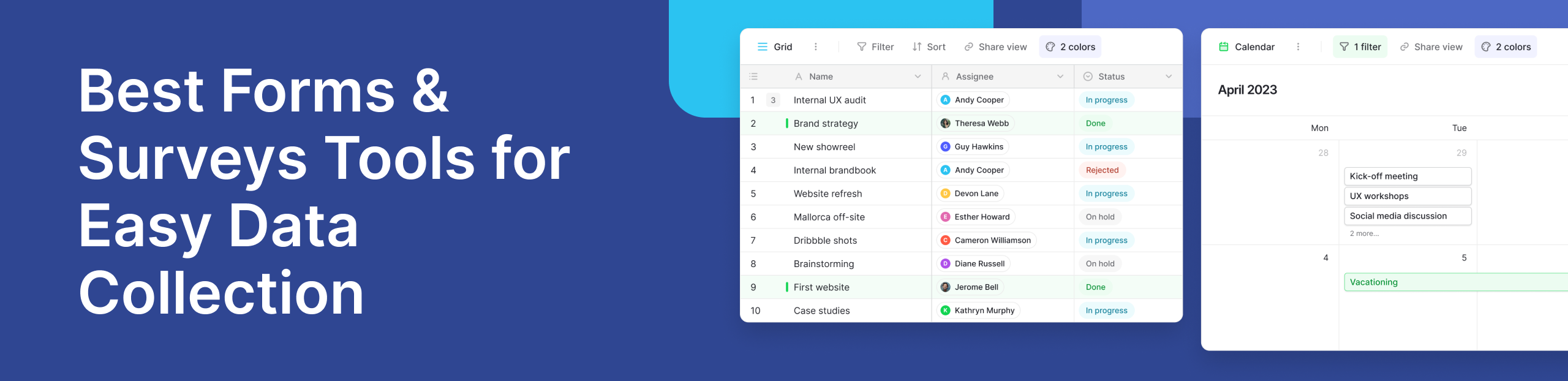
Introduction
Forms and surveys are everywhere. You use them when you sign up for a service, give feedback, or download gated content. They help collect information in a simple and structured way.
Today, businesses, creators, and teams rely on forms to gather user data, understand customer needs, and improve decisions. But not all tools are built the same. Some only collect responses, while others help you organize, analyze, and act on that data.
Modern tools now go beyond basic form creation. They help you create custom workflows, automate responses, and manage data in real time. Platforms like Baserow combine forms with a database, making it easier to manage everything in one place.
What Are Forms & Surveys?
Forms and surveys are tools used to collect information.
A form is usually used to gather specific data. For example, a contact form collects names and emails. A registration form collects user details.
A survey is used to collect opinions or feedback. For example, customer satisfaction surveys or product feedback forms.
Both are important for collecting data, but they serve slightly different goals. Forms are often used for actions like signing up or downloading gated content. Surveys help you understand what people think and how they feel.
Key Features to Look for in Forms & Surveys Tools
- Easy Form Creation
A good tool should make it simple to build forms. Drag-and-drop editors help you design forms without coding. This is useful for beginners and teams.
The ability to create custom fields and layouts also matters. It helps you match your exact needs.
- Data Organization
Collecting data is only the first step. You also need to store and manage it properly. Many tools send responses to spreadsheets. This can get messy over time.
Tools like form-based database systems store data in a structured way. This makes it easier to filter, sort, and analyze responses.
- Automation and Integration
Automation saves time. For example:
- Send email alerts when someone submits a form
- Update records automatically
- Trigger workflows
These features help you move faster and reduce manual work.
- Privacy and Security
Data protection is important. You should always choose tools that protect user data.
For example, rules like GDPR explain how personal data should be handled. Good tools follow these standards.
Some platforms focus on privacy and give you full control over your data.
Top Forms & Surveys Tools
1. Baserow
Baserow is more than a form builder. It combines forms with a powerful database.
You can collect data through forms and store it directly in structured tables. This helps you manage responses without switching tools. For example, a startup can create a lead capture form for gated content. Every submission goes into a database where the team can track, filter, and respond in real time.
Baserow also supports:
- Real-time collaboration
- Custom workflows
- Flexible data views
Many users in the Baserow community use it to build internal tools, CRMs, and feedback systems without coding.
2. BlockSurvey
BlockSurvey is a privacy-focused platform. It uses encryption to protect user data.
This makes it a strong choice for teams that care about security and data ownership.
3. Paperform
Paperform is known for its clean design and flexibility.
It allows you to create advanced forms that look like landing pages. This is useful for marketing and branded experiences.
4. Formily
Formily is a more technical tool. It uses a schema-based system to build complex forms.
It is best suited for developers or teams working on advanced workflows.
Real-World Use Case
Imagine a small business offering a free guide as gated content.
They create a simple form to collect names and emails. When users submit the form:
- The data is stored in a database
- A welcome email is sent automatically
- The team can track leads in one place
Using a platform like Baserow, this entire process becomes simple. You can manage data, automate tasks, and improve your workflow without extra tools.
Best Practices for Creating High-Converting Forms
- Keep forms short and simple
- Ask only important questions
- Use clear labels and instructions
- Optimize for mobile users
- Add strong call to actions
Small changes can improve response rates and user experience.
Common Mistakes to Avoid
- Adding too many fields
- Not organizing collected data
- Ignoring privacy rules
- Not following up on responses
Avoiding these mistakes can make your forms much more effective.
Quick FAQs
1. What is the difference between forms and surveys?: Forms collect specific data like contact details. Surveys collect opinions and feedback.
2. What is the best free form builder?: Many tools offer free plans, but platforms like Baserow provide added value by combining forms with databases.
3. How do I create custom forms without coding?: You can use drag-and-drop tools that let you create custom forms easily.
4. Are online survey tools secure?: Most modern tools follow data protection standards, but always check features like encryption and access control.
5. How can forms help with lead generation?: Forms collect user details in exchange for gated content, helping businesses build and manage leads.
Conclusion
Forms and surveys are essential tools for collecting and understanding data. But the real value comes from how you use that data.
Modern platforms like Baserow help you go beyond simple data collection. They allow you to create custom workflows, organize information, and act on insights in real time.
If you want a simple yet powerful way to manage forms and data, you can get started with Baserow and explore how it fits your workflow.

Baserow 2.4 adds Button fields, Graph elements, workflow automation, AI provider management, improved Group By views, and 30+ more updates.

Discover how Airtable and Baserow compare in features, flexibility, speed, and scalability. Compare pricing plans and hidden costs to make an informed decision!

Explore the best open-source software alternatives to proprietary products. Discover OSS tools, licenses, and use cases with our updated directory.