
TL;DR
- A GDPR-compliant database helps organizations protect personal data and meet the requirements of the General Data Protection Regulation (GDPR).
- Look for role-based permissions, audit logs, encryption, flexible hosting, and strong governance features.
- Understand the difference between a data controller and a data processor, and ensure your provider offers a Data Processing Agreement (DPA).
- Baserow combines GDPR support, granular permissions, cloud and self-hosted deployment, and enterprise-grade security features, making it a strong choice for organizations handling personal data.
Choosing a GDPR-compliant database such as Baserow is no longer just a legal checkbox. For teams handling personal data, it is a core business decision tied to data security, governance, trust, and long-term scalability. Under the General Data Protection Regulation (GDPR), organizations must manage personal data carefully, implement appropriate technical and organizational measures, and ensure every data processor and data controller fulfills their responsibilities.
A modern database should do more than store information. It should help you ensure compliance with GDPR through structured permissions, controlled access, secure infrastructure, and flexibility in how data is hosted and managed. For many businesses in the European Union and the wider European Economic Area, this has become essential.
What makes a database GDPR compliant?
A database alone does not automatically guarantee compliance with GDPR. Compliance depends on how the tool supports your processing activities and how your organization configures and uses it. Still, the right platform can make compliance much easier.
Key requirements to look for
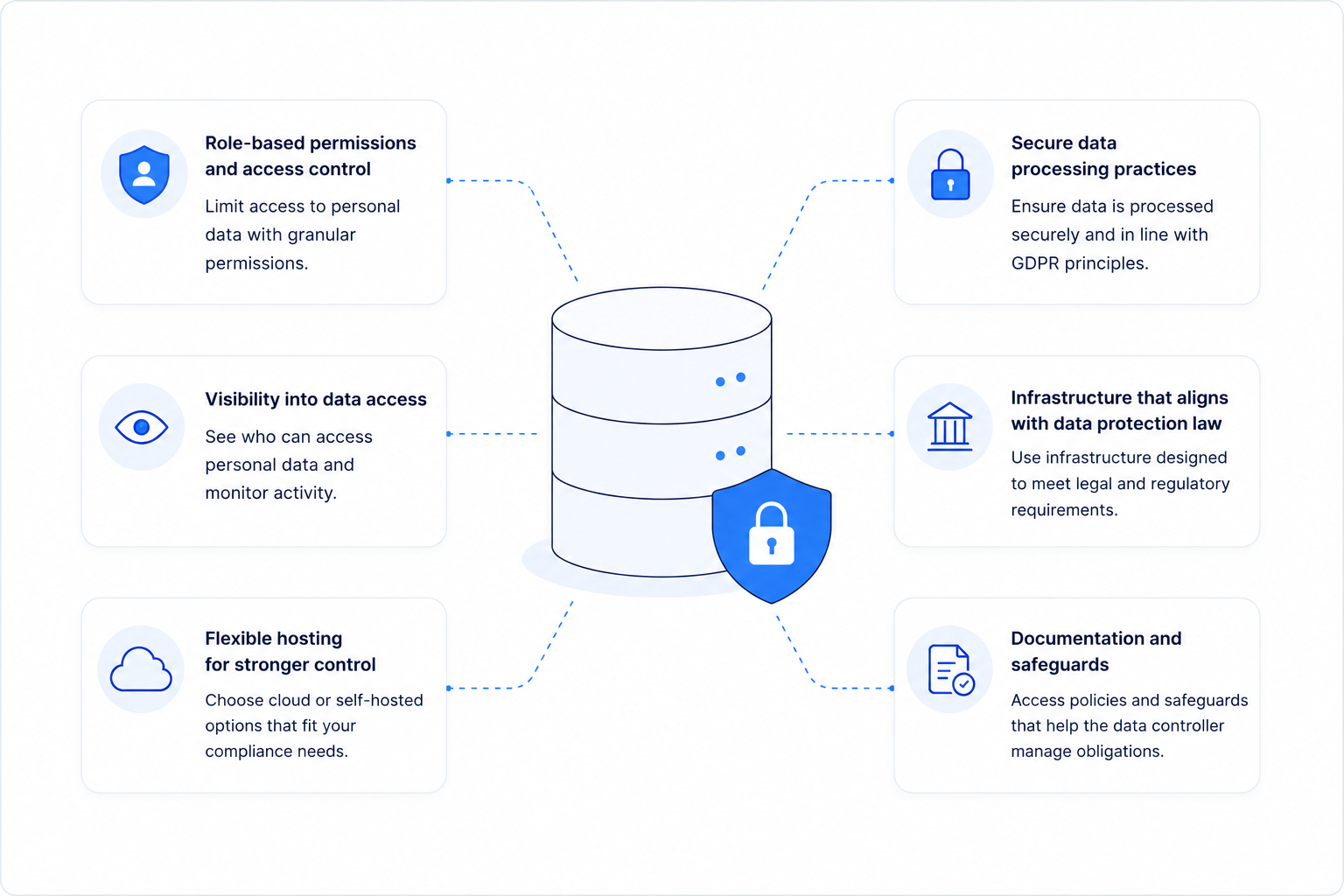
A strong option should support:
- role-based permissions and access control
- secure data processing practices
- visibility into who can access personal data
- flexible hosting for stronger control
- infrastructure that aligns with data protection law
- documentation and safeguards that help a data controller manage obligations responsibly
This matters because the data controller remains responsible for how information is collected, stored, accessed, and deleted. If a platform lacks governance controls, it can increase compliance risks and create unnecessary exposure before a supervisory authority ever gets involved.
💡 Many of these capabilities are also considered database security best practices. If you’d like a deeper look at topics like encryption, audit logs, access controls, backups, and infrastructure security, read our guide on database security best practices.
Understanding GDPR roles and responsibilities
When evaluating a GDPR-compliant database, it’s important to understand the different roles defined by the General Data Protection Regulation (GDPR).
A data controller decides why and how personal data is collected and processed. A data processor processes that data on behalf of the controller. If you use a cloud database provider, your organization is usually the controller, while the software vendor acts as the processor.
Because data is processed on behalf of another organization, GDPR requires both parties to clearly define their responsibilities. This is typically done through a Data Processing Agreement (DPA), which outlines how personal data is handled, secured, and deleted.
The GDPR also requires organizations to implement appropriate technical and organizational measures to protect personal data from unauthorized access, loss, or misuse. These measures include access controls, encryption, audit logging, backup procedures, and employee security policies. While software cannot make an organization automatically compliant, choosing a platform with strong security capabilities makes it much easier to meet these obligations.
GDPR compliance checklist for databases
If you’re comparing database platforms, use the following checklist to evaluate whether they support GDPR compliance.
A GDPR-friendly database should provide:
- Role-based permissions to restrict access to personal data.
- Audit logs that help demonstrate accountability.
- Encryption for data in transit and at rest.
- Flexible deployment options, including self-hosting.
- Clear documentation about security and privacy practices.
- A Data Processing Agreement for cloud customers.
- Features that help organizations respond to requests from data subjects, such as exporting or deleting records.
- Backup and disaster recovery procedures that support business continuity.
- Compliance documentation that reflects current European privacy standards.
Baserow includes these capabilities out of the box, making it easier for organizations to build workflows that align with GDPR requirements while maintaining flexibility for different deployment models.
Remember that GDPR applies to organizations processing the data of EU residents, even if the business itself is located outside the European Union. Individual Member State authorities may also publish additional guidance or interpretations alongside GDPR requirements, so organizations should stay informed about local expectations.
A database that supports these capabilities won’t guarantee compliance on its own, but it provides the tools organizations need to build compliant processes and demonstrate accountability.
How European data protection standards affect database selection
The European Data Protection framework is built around the General Data Protection Regulation (GDPR), but organizations should also be aware of guidance issued by national supervisory authorities and the European Data Protection Board (EDPB). Together, these standards help organizations interpret GDPR requirements and establish best practices for handling personal data.
When evaluating a GDPR-compliant database, look beyond marketing claims and consider whether the platform provides the features needed to support European data protection principles in practice. This includes strong access controls, secure data processing, audit logs, flexible hosting options, and clear documentation that helps organizations demonstrate accountability. Choosing Baserow as your GDPR-compliant database gives organizations the tools needed to support European data protection principles while maintaining control over personal data and regulatory compliance.
Why Baserow is the best option
Baserow stands out because it combines usability with serious compliance and security capabilities. It is built for teams that want the power of a database with a clean interface, without giving up control over data protection and operational flexibility.
1. Strong compliance and security foundation
Baserow states that it supports GDPR and aligns with major compliance and security frameworks including SOC 2 Type II and HIPAA. That makes it relevant not only for general business operations, but also for organizations in regulated environments where data security and controlled access are critical.
2. Self-hosting for maximum control
One of Baserow’s biggest advantages is its self-hosted option. For companies that need tighter control over infrastructure, residency, and internal data processing, self-hosting can be a major benefit self-hosting can be a major benefit because organizations retain greater control over where personal data is stored, how it is processed, and how security policies are implemented… It allows organizations to manage deployment on their own servers and build a setup that better matches internal compliance requirements.
3. Built-in permissions and structured governance
Baserow includes role-based access controls and granular permissions, which help teams limit exposure to personal data and manage access intentionally. That is important for any organization trying to reduce risk and handle processing activities in a more accountable way.
4. Flexible enough for real business workflows
A compliance-friendly platform still has to be practical. Baserow supports structured records, forms, multiple views, API access, and workflow management, so teams can centralize operations without falling back on disconnected spreadsheets and shadow systems. That balance of usability and control is what many teams need today.
Who should use Baserow?
Baserow is a strong fit for companies that:
Teams with sensitive operational data
If you manage employee, customer, financial, or internal process data, you need a system that treats data protection regulation GDPR requirements seriously.
Organizations with EU compliance priorities
Businesses operating in the European Union or serving users in the European Economic Area often need stronger visibility into how personal data is stored and processed.
Companies that want cloud or self-hosted flexibility
Some teams want managed convenience. Others want full infrastructure control. Baserow supports both paths.
Choosing a GDPR-compliant database is about more than meeting legal requirements. Organizations need a platform that supports secure handling of personal data, helps data controllers and data processors meet their obligations, and provides the security controls required by the General Data Protection Regulation (GDPR). With GDPR support, a Data Processing Agreement, role-based permissions, self-hosting, SOC 2 Type II, and HIPAA alignment, Baserow provides the flexibility and governance modern organizations need to build systems that support long-term GDPR compliance.
FAQ
What is a GDPR-compliant database?
A GDPR-compliant database is a database platform that provides the security, governance, and administrative features organizations need to comply with the General Data Protection Regulation (GDPR). While no database alone guarantees compliance, features such as role-based permissions, audit logs, encryption, and secure hosting make compliance much easier.
Is Baserow GDPR compliant?
Yes. Baserow supports GDPR requirements by providing role-based access control, secure infrastructure, audit capabilities, flexible cloud and self-hosted deployment, and a Data Processing Agreement (DPA) for its cloud offering. Organizations remain responsible for configuring and using the platform in accordance with GDPR.
What features should a GDPR-compliant database include?
Look for features such as:
- Role-based permissions
- Audit logs
- Encryption
- Secure APIs
- Backup and disaster recovery
- Data Processing Agreement (DPA)
- Flexible cloud or self-hosted deployment
- Tools to manage personal data and data subject requests
Does GDPR require data to stay in the European Union?
Not necessarily. GDPR allows international data transfers when appropriate safeguards are in place. However, many organizations choose providers that offer EU hosting or self-hosting to simplify compliance and data governance.
Why choose Baserow as a GDPR-compliant database?
Baserow combines an intuitive no-code database with enterprise security features, GDPR support, SOC 2 Type II compliance, HIPAA alignment, role-based permissions, APIs, automation, and the flexibility to deploy in the cloud or self-host on your own infrastructure.

Baserow 2.4 adds Button fields, Graph elements, workflow automation, AI provider management, improved Group By views, and 30+ more updates.

Discover how Airtable and Baserow compare in features, flexibility, speed, and scalability. Compare pricing plans and hidden costs to make an informed decision!

Explore the best open-source software alternatives to proprietary products. Discover OSS tools, licenses, and use cases with our updated directory.