
Managing inventory is one of the most important parts of running a business. Whether you sell products online, manufacture goods, or operate a retail store, knowing what you have in stock helps you serve customers better and control costs.
Poor inventory management can lead to two common problems. You may have too much inventory sitting on shelves, or you may run out of products when customers want to buy them. Both situations affect revenue, cash flow, and customer trust.
Good inventory management helps businesses maintain the right stock levels at the right time. It also makes it easier to fulfill orders, reduce waste, and respond to changing customer demand.
Today, many companies use digital tools to simplify tracking inventory. Modern inventory management systems automate stock updates, improve visibility, and help businesses make smarter purchasing decisions. Flexible platforms like Baserow even allow teams to build custom inventory workflows without writing code, making them suitable for businesses of all sizes.
In this guide, you’ll learn what inventory management is, why it matters, the different types of inventory management, and how modern systems help businesses stay organized.
What Is Inventory Management?
Inventory management is the process of tracking inventory from the moment products or materials arrive until they are sold or used.
Its main goal is to ensure a business always has enough inventory to meet customer demand without holding more stock than necessary.
Inventory can include many different items, such as:
- Raw materials and components used in manufacturing
- Work in progress that is still being produced
- Finished goods ready for sale
- Finished products waiting to be shipped
- Maintenance and operational supplies
Businesses monitor these items throughout their journey. Every product is received, stored, moved, sold, or reordered at different stages. Keeping accurate records at every step helps businesses avoid costly mistakes.
A simple inventory process answers three important questions:
- What products are currently available?
- Where are those products stored?
- When should more inventory be ordered?
When businesses can answer these questions quickly, they make better decisions and improve day-to-day operations.
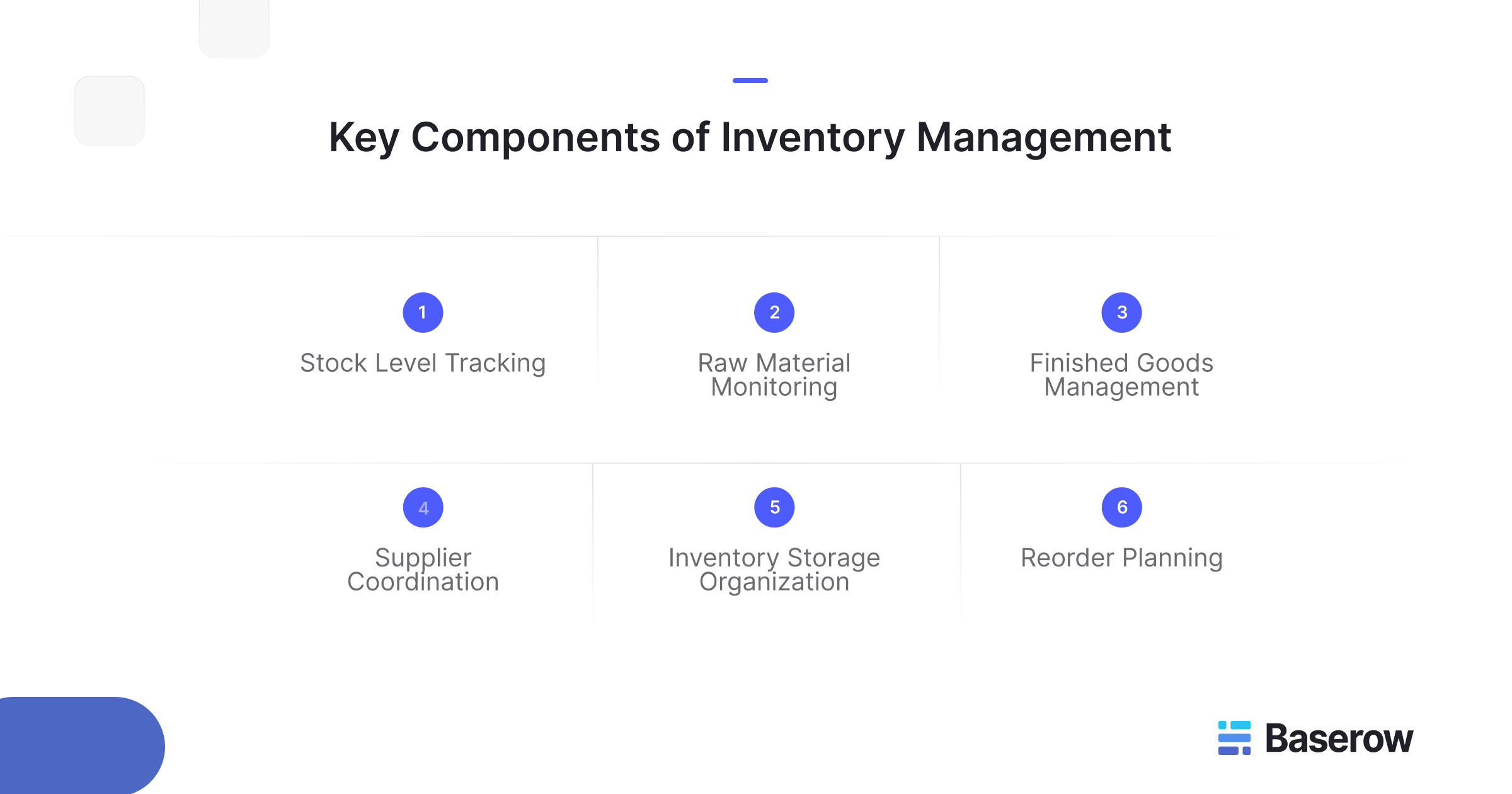
What Is Inventory Management in Supply Chain
Inventory plays a central role in supply chain management because it connects procurement, production, storage, and distribution.
Supply chain operators must coordinate multiple moving parts, including suppliers delivering raw materials, manufacturers producing finished goods, warehouses storing inventory, and retailers fulfilling customer orders.
Inventory management ensures that each stage of the supply chain has access to the products or materials it needs at the right time.
For example:
- Raw materials must arrive before production begins
- Work-in-progress inventory must move efficiently between production stages
- Finished goods must be available for customer orders
Without clear visibility into stock levels, supply chain disruptions can quickly occur.
Many companies solve this by organizing their supply chain data using structured systems that track supplier relationships, purchase orders, and inventory levels in one place. Templates such as Baserow’s supply chain help businesses manage procurement workflows while maintaining clear inventory records.
This structured approach improves coordination between teams and ensures that supply chain decisions are based on accurate data.
Why Inventory Management Is Important
Inventory management directly affects profitability, operational efficiency, and customer experience. When businesses manage stock effectively, they can avoid stockouts, reduce unnecessary storage costs, and maintain consistent order fulfillment.
Some of the most important benefits include:
- Improved customer satisfaction
Customers expect products to be available when they place an order. When inventory levels are tracked properly, businesses can fulfill orders faster and avoid backorders.
- Lower operational costs
Maintaining excessive inventory ties up working capital and increases storage expenses. Accurate stock tracking helps companies maintain balanced inventory levels.
- Better supply chain coordination
Inventory visibility helps teams communicate more effectively with suppliers and logistics partners. This ensures materials arrive on time and products move efficiently through the supply chain.
- Higher profitability
When businesses reduce waste and improve inventory turnover, they can lower the cost of goods sold (COGS) and increase profit margins.
These advantages highlight why inventory control is a core function for retail, manufacturing, and ecommerce businesses alike. Businesses that build custom workflows can organize inventory data in a flexible way that supports their specific operational needs.
As companies grow and manage larger product catalogs, having a centralized system for SKUs and inventory records becomes critical for maintaining accurate data and preventing costly errors.
Some companies also use flexible database platforms that allow them to build customized inventory workflows. This approach allows teams to design their own tracking structure instead of adapting to rigid software processes.
For example, organizations looking to build tailored workflows can follow guides which explain how inventory systems can be structured using customizable databases.
What Is Inventory Management Software
Inventory management software is the application layer that allows businesses to track and manage inventory digitally.
These tools combine inventory databases, automation features, and reporting dashboards to give businesses better control over stock operations.
Common capabilities include:
- Tracking raw materials and finished goods
- Monitoring stock levels across warehouses
- Managing supplier orders
- Updating inventory when sales occur
- Generating reports for inventory turnover and product demand
Many businesses adopt these systems as they grow because manual tracking becomes difficult when product catalogs expand.
Some companies also use flexible database platforms that allow them to build customized inventory workflows. This approach allows teams to design their own tracking structure instead of adapting to rigid software processes.
How Does Inventory Management Software Work?
Inventory management software works by storing product and supply chain information in a centralized database.
The system records key data points such as:
- Product identifiers and SKUs
- Inventory quantities
- Supplier details
- Purchase orders
- Warehouse locations
Whenever inventory moves, the system updates the records automatically.
For example:
- A supplier delivers raw materials to the warehouse.
- The system records the new inventory quantities.
- When production uses those materials, the quantities decrease.
- When finished goods are produced, they are added to inventory.
- When customers place orders, the system updates stock levels again.
This continuous data update helps businesses maintain accurate inventory records and avoid stock discrepancies.
Many inventory systems also include automation features such as reorder alerts, reporting dashboards, and supplier tracking tools. These features help businesses respond quickly to demand changes and prevent disruptions in supply chain operations.
Purchasing and Inventory Management Software
Procurement and inventory management are closely connected. Businesses must track supplier orders, incoming shipments, and stock levels simultaneously.
Purchasing and inventory management software helps coordinate these processes by linking supplier management with inventory tracking.
This allows businesses to:
- Monitor supplier performance
- track purchase orders
- manage incoming shipments
- maintain optimal inventory levels
When procurement data and inventory data are connected, businesses gain better insight into how supply chain decisions affect stock availability.
Some companies structure these workflows using database-driven systems that track suppliers, orders, and inventory in one place. Platforms like Baserow enable teams to build collaborative systems that support procurement workflows while maintaining clear inventory visibility.
Ecommerce Inventory Management System
Inventory management becomes even more important for online retailers because products may be sold across multiple platforms simultaneously.
An ecommerce inventory management system helps businesses track stock levels across online stores, warehouses, and fulfillment partners.
For example, if a product sells on an ecommerce platform, the inventory system automatically updates the remaining stock quantity. This prevents overselling and ensures accurate product availability.
Inventory management for online retailers typically includes:
- real-time stock updates
- integration with ecommerce platforms
- automated order fulfillment updates
- tracking product demand and sales trends
These systems allow online businesses to maintain accurate product availability while scaling operations.
Small and growing ecommerce businesses often adopt flexible systems that allow them to customize their workflows. Instead of relying on rigid software, they may build tailored inventory tracking systems that match their sales channels and operational processes.
Resources discussing inventory software solutions for growing businesses highlight how companies evaluate tools based on scalability, automation, and integration capabilities.
As ecommerce operations grow, having a reliable system to manage stock levels across multiple channels becomes essential for maintaining efficient order fulfillment and ensuring consistent customer satisfaction.
The Four Main Types of Inventory
Businesses manage different categories of inventory depending on their operations. Understanding these categories helps companies organize stock properly and improve inventory optimization.
- Raw Materials
Raw materials are the basic components used to produce finished products. Manufacturers rely on raw materials to begin production, making it important to track incoming supply carefully.
If raw materials are unavailable when needed, production delays can occur. Accurate tracking helps supply chain operators maintain consistent production schedules.
- Work in Progress (WIP)
Work in progress refers to products that are currently being manufactured but are not yet complete. These items are moving through the production process and require careful monitoring.
Tracking work-in-progress inventory helps businesses understand production timelines and identify bottlenecks within operations.
- Finished Goods
Finished goods are products that have completed the production process and are ready for sale. These items are stored in warehouses or fulfillment centers before being shipped to customers.
Maintaining the right amounts of inventory for finished goods is essential to support fast order fulfillment and meet customer demand.
- Maintenance, Repair, and Operations (MRO)
MRO inventory includes supplies used to support production processes, such as tools, maintenance parts, and operational equipment. Although these items are not sold to customers, they are essential for keeping operations running smoothly.
The Most Effective Inventory Management Methods
Businesses use different inventory management methods depending on their products, industry, and operational needs. Here are some of the most common approaches.
- FIFO (First In, First Out)
FIFO assumes the oldest inventory should be sold first.
It works well for food, cosmetics, medicines, and other products with expiration dates because it helps prevent waste.
- Just-in-Time (JIT)
The Just-in-Time method keeps inventory levels low by receiving products only when they are needed. This reduces storage costs but requires reliable suppliers and careful planning.
- ABC Analysis
ABC analysis groups products based on their value to the business. High-value items receive the most attention, while lower-value products require less frequent monitoring.
- Periodic Inventory System
A periodic inventory system updates inventory records at scheduled intervals rather than after every transaction. Small businesses sometimes use this approach because it is simple to manage. However, it does not provide the same level of visibility as systems that update inventory in real time.
Modern inventory management systems often use real time updates instead. Every sale, purchase, or stock movement is recorded immediately, giving businesses a more accurate picture of current inventory.
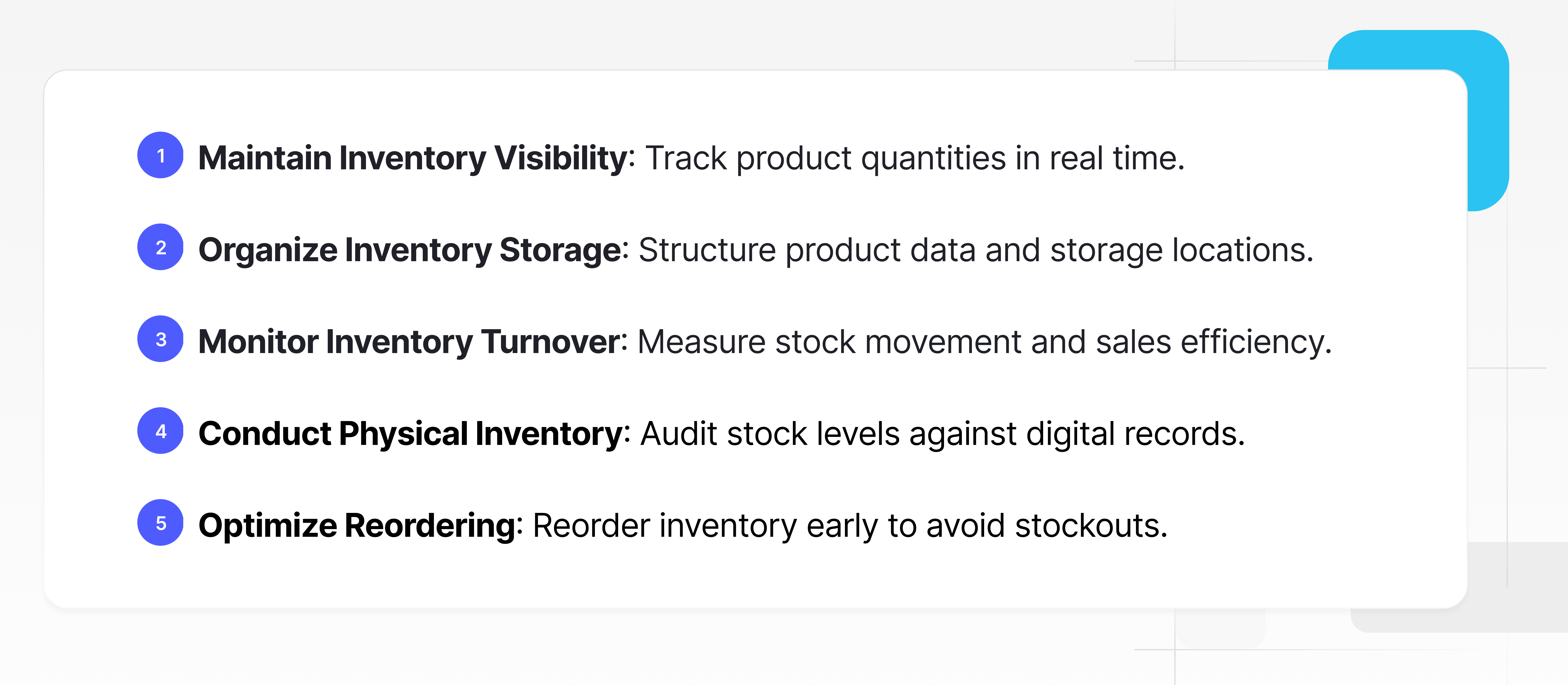
Five Steps to Effective Inventory Management
Strong inventory processes help businesses maintain control over stock levels and improve operational efficiency.
Inventory Optimization Strategies
Inventory optimization helps businesses maintain balanced stock levels without tying up unnecessary capital.
Key strategies include:
- forecasting product demand
- adjusting reorder points
- balancing safety stock levels
- improving supplier coordination
When implemented correctly, these strategies reduce waste and improve overall supply chain efficiency.
Vendor Managed Inventory (VMI)
Vendor managed inventory is a system where suppliers monitor and replenish inventory levels for retailers or distributors.
Instead of the retailer tracking stock manually, the supplier receives inventory data and manages replenishment schedules.
This model improves supply chain efficiency because suppliers can respond faster to changing demand and maintain optimal stock levels.
How Businesses Use Flexible Databases for Inventory
Many organizations now manage inventory through customizable systems rather than traditional rigid software.
Flexible database platforms allow businesses to structure inventory workflows based on their operational needs.
For example, discussions in the Baserow community show how teams build inventory trackers that connect SKUs, suppliers, and purchase orders within one system. These setups help teams coordinate inventory operations while improving data accuracy across departments.
How to Choose the Best Inventory Management System
Choosing the right inventory system depends on operational complexity and business size.
Key features to look for include:
- real-time inventory tracking
- automation for stock updates
- supplier management capabilities
- integration with ecommerce platforms
- customizable reporting dashboards
Small businesses may start with lightweight systems, while larger organizations often adopt scalable solutions that support complex supply chain management.
Frequently Asked Questions
- What is inventory management?
Inventory management is the process of tracking, storing, and controlling inventory so businesses have the right products available when customers need them.
- What are the main types of inventory management?
The most common types of inventory include raw materials, work in progress, finished goods, and maintenance, repair, and operations (MRO) inventory.
- What is the difference between a periodic inventory system and a real-time inventory system?
A periodic inventory system updates inventory records at scheduled intervals, while a real-time system updates stock immediately after every purchase, sale, or inventory movement.
- Why are inventory management systems important?
Inventory management systems improve accuracy, automate inventory tracking, reduce manual work, and help businesses make better purchasing decisions.
Conclusion
Inventory management is a critical component of efficient business operations. By tracking raw materials, finished goods, and stock levels accurately, businesses can maintain reliable supply chains and meet customer demand.
Modern inventory management systems make it easier to monitor inventory turnover, coordinate suppliers, and maintain balanced stock levels across operations.
Flexible database platforms are increasingly helping businesses build customized inventory workflows that match their operational needs.
If you want to build a structured inventory system without relying on rigid software, you can explore how customizable databases support inventory operations through the Baserow platform overview.
With these key takeaways, start organizing your inventory workflows today and create your own system by signing up here

Baserow 2.4 adds Button fields, Graph elements, workflow automation, AI provider management, improved Group By views, and 30+ more updates.

Discover how Airtable and Baserow compare in features, flexibility, speed, and scalability. Compare pricing plans and hidden costs to make an informed decision!

Explore the best open-source software alternatives to proprietary products. Discover OSS tools, licenses, and use cases with our updated directory.