
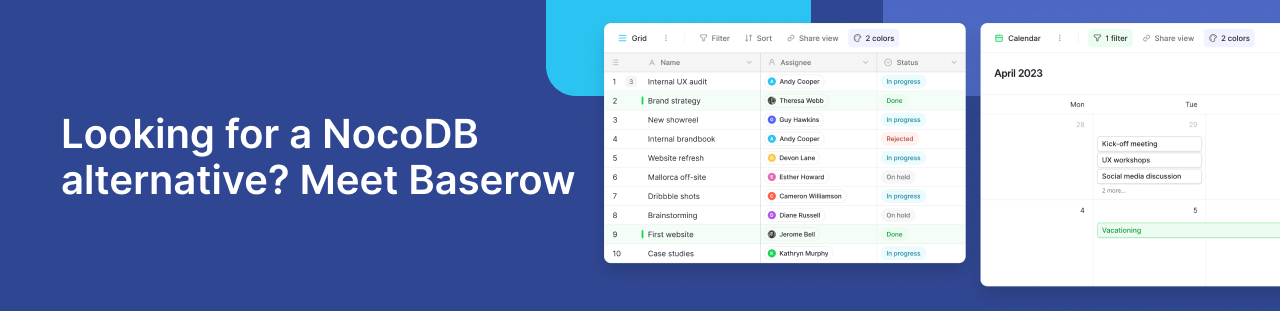
NocoDB makes database records accessible through a familiar spreadsheet interface. But choosing a platform also means thinking about what your team will build around that data: customer portals, internal tools, automated processes, and reporting.
Baserow is a NocoDB alternative for teams that want to manage those tasks in one workspace. It brings together a visual database, an Application Builder, automations, and dashboards, with cloud and self-hosted deployment options.
Here’s what Baserow offers, who it suits, and what to consider before choosing.
Baserow at a glance
| Your team needs to… | Baserow feature |
|---|---|
| Organize connected business data | Database Builder |
| Create internal tools and portals | Application Builder |
| Reduce repetitive work | Automations |
| Monitor progress and performance | Dashboards |
| Choose where the platform runs | Cloud or self-hosting |
Baserow: A NocoDB alternative for business applications
What it does: Baserow helps teams organize structured data and build applications and workflows around it without traditional software development.
Who it’s for: Operations teams, project managers, marketing teams, and businesses that need custom tools they can adapt as their processes change.
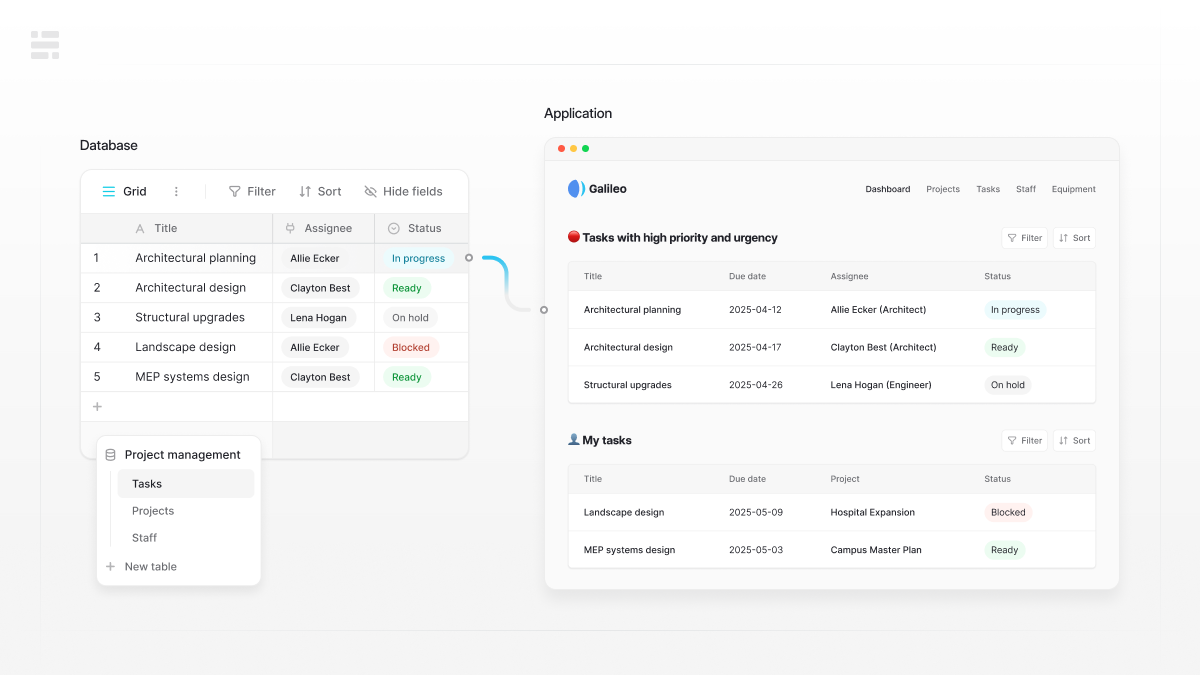
For example, an agency could organize clients, projects, and deliverables in linked tables, then build a client portal around those records. Automations could handle notifications, while a dashboard helps the team monitor delivery. That gives the agency a practical starting point for managing work across its business.
Key features
- Connected databases: Create relationships between tables, choose field types, and import existing data. Baserow’s spreadsheet-style interface gives teams a familiar way to maintain structured records. Its open API also supports custom integrations. Explore the Database Builder.
- Custom applications: Use the visual Application Builder to create internal tools, directories, CRMs, and client portals. Add components such as forms and tables, connect them to Baserow data, and publish your application.
- Workflow automation: Configure notifications, emails, and sequences of actions to reduce manual handoffs. Baserow’s automations let teams build repeatable processes around their records.
- Built-in reporting: Create dashboards connected to your tables. Track metrics, visualize progress, and give colleagues a shared view of the information they need.
Pros
- Databases, applications, automations, and reporting are available within one platform.
- Visual builders let business teams take a direct role in creating and maintaining their tools.
- Cloud and self-hosted options give organizations flexibility over deployment.
- A free plan provides a starting point for trying a real project.
Considerations
- Self-hosting requires someone to manage infrastructure, updates, and backups.
- Advanced permissions, audit logs, and higher usage allowances depend on your plan.
- Teams primarily seeking an interface for an existing SQL database should compare connection requirements carefully.
Pricing
Baserow offers a free cloud plan with 3,000 rows per workspace and 2 GB of storage. Premium starts at $10 per user per month when billed annually; Advanced starts at $18. Self-hosted options are also available. Review the current plans against your expected data volume, automation usage, and access requirements.
Should you choose Baserow or NocoDB?
NocoDB is worth considering when your priority is working with PostgreSQL or MySQL data through a spreadsheet interface.
Choose Baserow when your team wants to build a broader business process around its data, including applications, automated actions, and reporting. Its combination of visual tools makes it a strong NocoDB alternative for teams creating their own operational software.
For a deeper evaluation, read our NocoDB vs Baserow comparison.
Ready to try it? Start using Baserow for free.

Baserow 2.4 adds Button fields, Graph elements, workflow automation, AI provider management, improved Group By views, and 30+ more updates.

Discover how Airtable and Baserow compare in features, flexibility, speed, and scalability. Compare pricing plans and hidden costs to make an informed decision!

Explore the best open-source software alternatives to proprietary products. Discover OSS tools, licenses, and use cases with our updated directory.