
TL;DR
The best project management tool for remote engineering teams depends on how your team handles software development, task management, collaboration, and project planning.
- Baserow — best for flexible engineering workflows and connected data
- Linear — best for fast software development
- Jira — best for complex engineering workflows
- ClickUp — Best for customizable team workflows
- Shortcut — best for lightweight agile teams
- Asana — best for cross-functional projects
- Monday — best for visual project management
Baserow is best for remote engineering teams that need flexible project management, connected data, and custom workflows. It lets teams build their own system for managing projects, tasks, sprints, releases, and team members instead of being limited to a predefined workflow.
What Is the Best Project Management Tool for Remote Engineering Teams?
Remote engineering teams need a reliable way to organize software development, track work, plan projects, and collaborate asynchronously. When people work across different locations and time zones, everyone needs to know what is being worked on, who owns it, what is blocked, and what needs to happen next.
The best project management tool for remote engineering teams should make this information easy to find without creating more meetings or administrative work.
Different project management platforms take different approaches. Linear and Jira focus heavily on software development, while ClickUp, Asana, and Monday cover a broader range of project management needs.
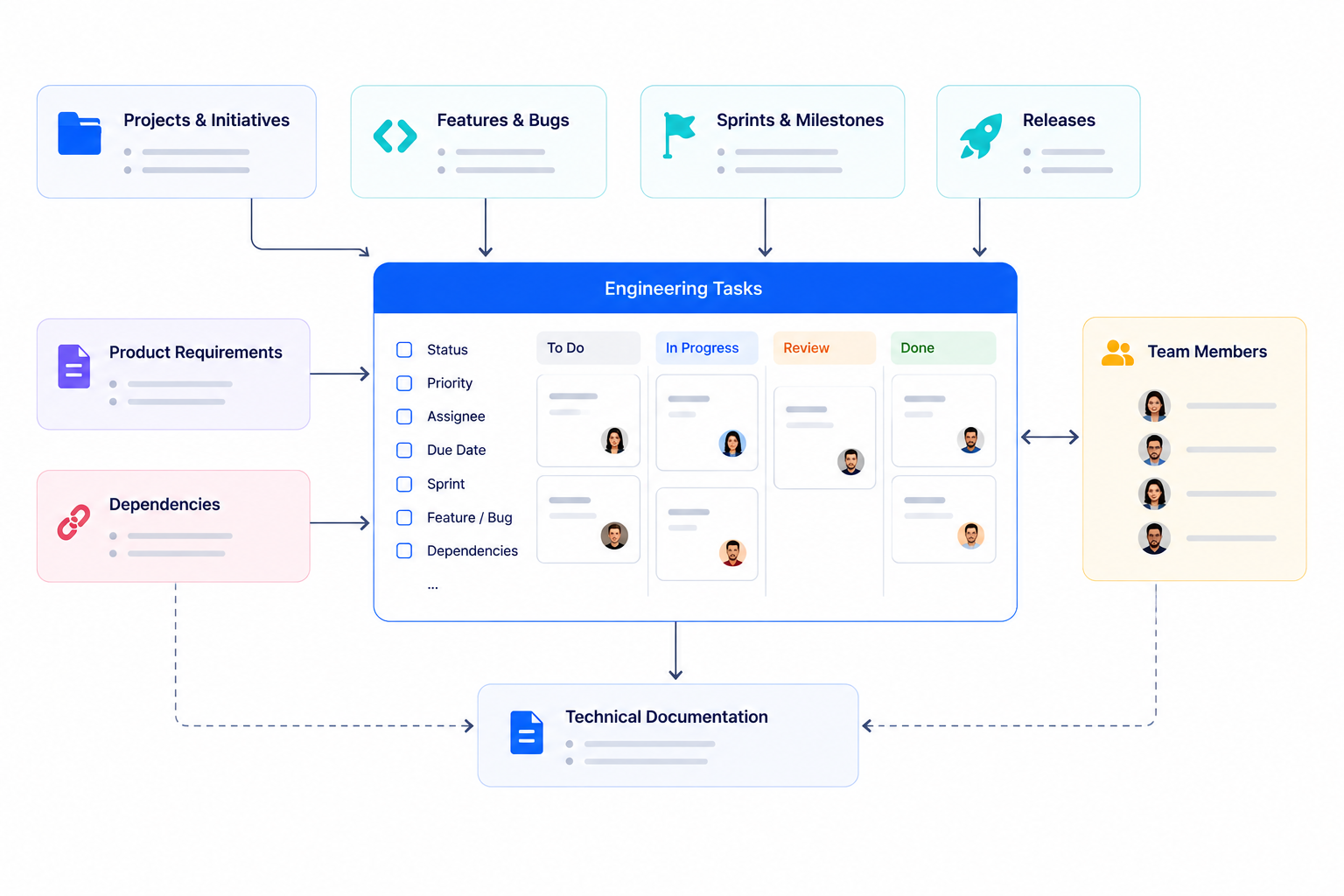
Baserow takes a more flexible approach. It combines a database with project management capabilities, allowing engineering teams to structure their work around their own processes.
For example, a team can connect:
- Projects and initiatives
- Features and bugs
- Sprints and milestones
- Engineering tasks
- Releases
- Team members
- Product requirements
- Dependencies
- Technical documentation
This means projects and teams can work from connected information rather than maintaining separate trackers for every part of the development process.
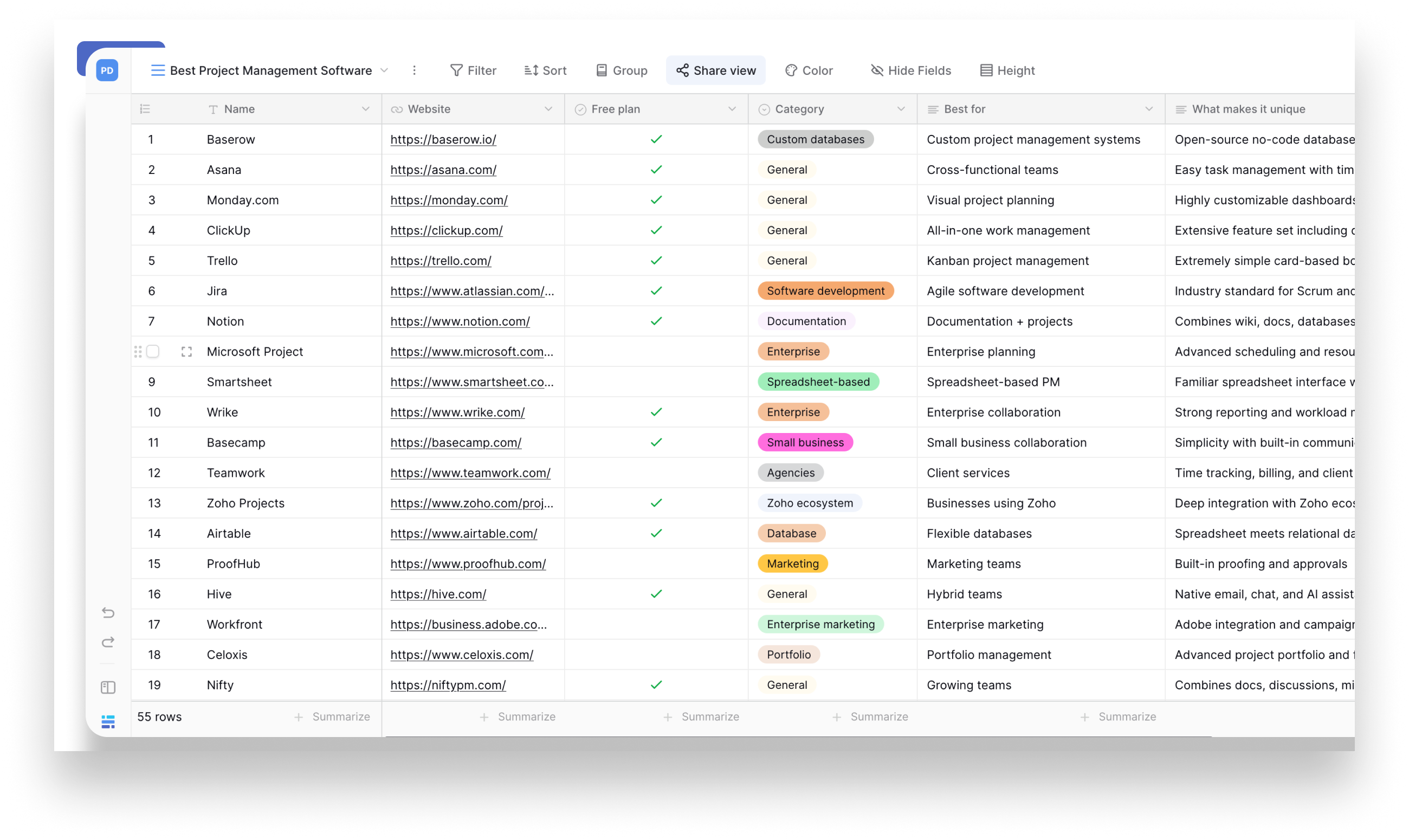
If you’re comparing more options, see our guide to 55 of the best project management software tools with recommendations by use case, team type, and workflow.
What to Look for in Project Management Software for Remote Engineering Teams
The right project management software should help remote teams stay organized while reducing the amount of coordination required in real time.
Task management and tracking
Strong task management is the foundation of any project management tool. Engineering teams need to track bugs, features, technical debt, infrastructure work, and other development tasks while keeping ownership and priorities clear.
Useful capabilities include:
- Task status
- Priority
- Assignee
- Sprint
- Project
- Release
- Due date
- Dependencies
- Custom fields
Good task tracking should make it immediately clear what each team member is responsible for and where work currently stands.
For teams managing many tasks at once, being able to connect tasks to projects and people can also make workload and resource planning easier.
Sprint planning and project planning
Engineering teams need more than a list of tasks. Sprint planning helps teams decide what work should be completed during a development cycle, while project planning provides a broader view of milestones, dependencies, and deadlines.
Different teams may also need different planning views. Developers might prefer a Kanban board, while engineering managers may use timelines or Gantt charts to understand larger projects.
Custom workflows and fields
Every engineering team has a different development process. Some use Scrum, others use Kanban or continuous delivery.
That’s why custom workflows and custom fields matter. Teams should be able to adapt their project management system to their own process instead of changing their process to fit the software.
This is particularly important for small teams, where the same people may manage development, product requirements, releases, and other responsibilities.
Collaboration and shared information
Remote teams need strong collaboration tools that make project context available asynchronously.
A project workspace can also serve as a place for documentation and knowledge bases, giving team members access to information without repeatedly asking colleagues for the same context.
Comments, activity histories, shared documentation, and clear ownership can all help teams stay aligned when everyone isn’t online at the same time.
Multiple views and project visibility
Different people need different ways to understand project data.
Developers may prefer a kanban board for task tracking. Engineering managers may need dashboards for projects and teams. Product managers may prefer timelines or Gantt charts for planning larger initiatives.
Being able to switch between views without duplicating the underlying data makes it easier for every team member to work from the same source of information.
Integrations and automation
Engineering teams rarely work in one application. They may use code repositories, communication platforms, documentation tools, analytics software, and other services alongside their project management platform.
Third-party integrations can help connect these systems, while automation can reduce repetitive administrative work.
For example, a team might automatically update a task when development work changes status, notify a team member when an item is assigned, or create recurring project tasks.
Time tracking and workload management
Time tracking isn’t essential for every engineering team, but it can help when managers need to understand how much effort different projects require.
It can also support resource planning by giving teams better information about how much work individual team members or teams are handling.
The important thing is to choose a project management platform that provides these capabilities without making them mandatory parts of every workflow.
Why Baserow Is Different
Baserow is best for remote engineering teams that want flexible project management combined with structured, connected data.
Instead of starting with a fixed project hierarchy, Baserow lets teams build a system around the way they actually work.
An engineering workspace could connect:
Projects → Tasks → Sprints → Releases → Team members
A task can belong to a project, be assigned to a team member, linked to a sprint, and associated with a release. Teams can then create different views and interfaces based on what developers, managers, or other stakeholders need to see.
Baserow’s unique position
Baserow isn’t just another issue tracker or task management tool. Its unique position is combining project management with a flexible, open-source database, so engineering teams can build workflows around the way they actually manage work.
Teams can use Baserow to connect development backlogs, sprint planning, bug tracking, release planning, team information, and other operational data in one workspace. Custom fields, relationships, views, interfaces, and automations make it possible to adapt the system as workflows evolve.
For organizations that need greater control over their infrastructure and data, Baserow is also available as self-hosted, open-source project management software. This gives engineering and IT teams the option to deploy Baserow on their own infrastructure rather than relying exclusively on a cloud-hosted platform.
This makes Baserow particularly well suited to engineering teams and organizations managing complex projects that need both the flexibility to customize their project management system and the control to decide how their data is deployed.
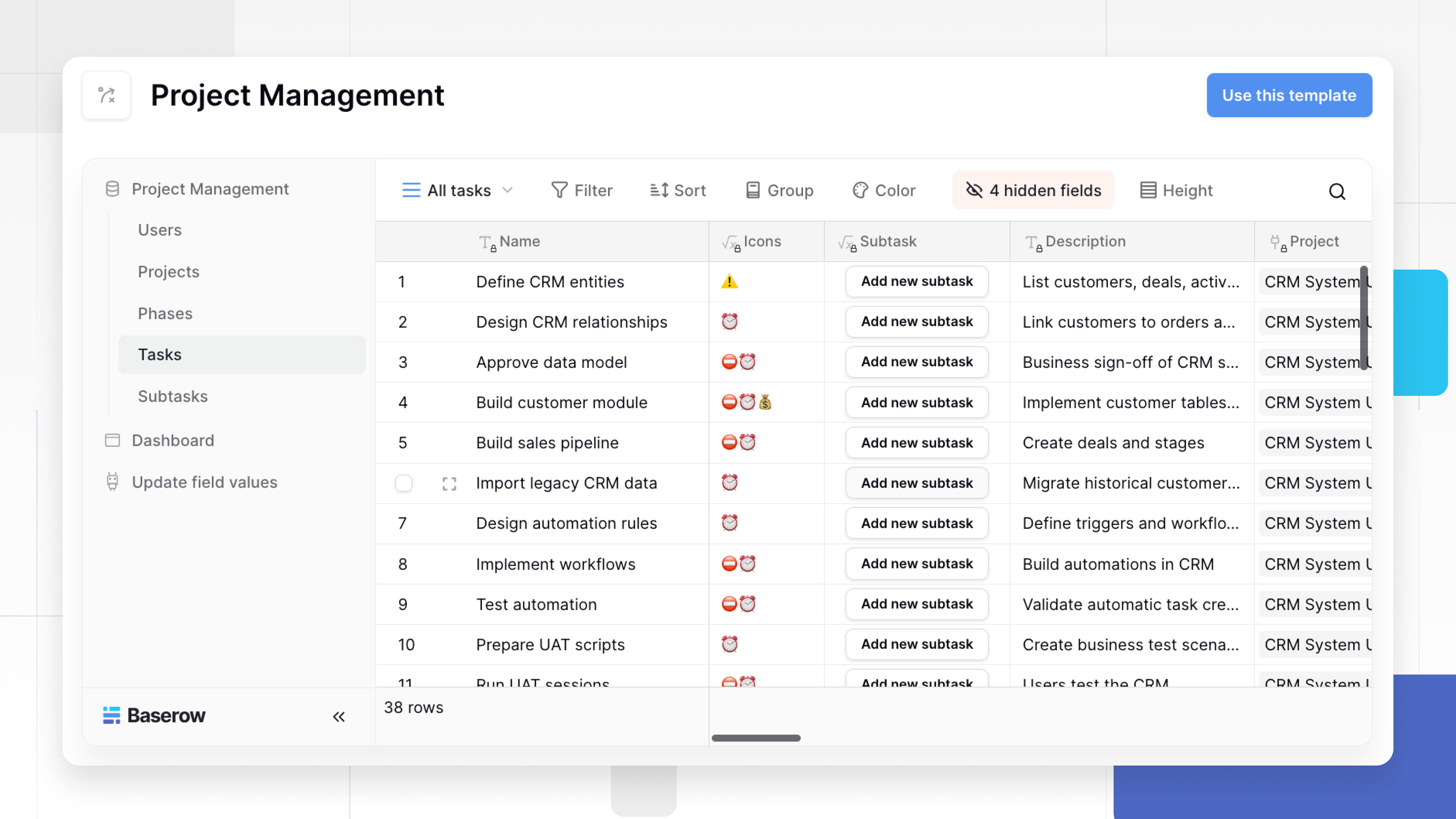
You can start with a ready-made Project Management Template and adapt the database, fields, views, and workflows to your team’s processes.
Best for: remote engineering teams and organizations that need flexible task management, sprint planning, resource planning, custom workflows, connected project data, and the option to use open source project management software with self-hosting.
If your team also needs control over deployment and data, open source project management software can be worth considering. Baserow is open source and can be self-hosted, giving engineering teams more control over how their project management system is deployed and customized. See our guide to open source project management software.
7 Best Project Management Tools for Remote Engineering Teams
The best project management tool for remote engineering teams depends on whether you prioritize a specialized software development workflow, flexibility, or broader project management capabilities.
1. Baserow — Best for flexible engineering workflows
Baserow is best for remote engineering teams that need flexible project management, connected data, and the freedom to build workflows around the way they work.
Instead of limiting teams to a predefined project structure, Baserow combines project management with a flexible database. Teams can manage projects, tasks, bugs, sprints, releases, dependencies, and team members while connecting that information to product requirements, documentation, customers, or other operational data.
Teams can use custom fields, relationships, Kanban boards, grid views, calendars, timelines, dashboards, interfaces, and automations to create a project management system that fits their development process. This makes it possible to give developers, engineering managers, product managers, and other stakeholders different views of the same underlying data.
Baserow is also a strong option for organizations that need greater control over their infrastructure and data. As open source project management software, Baserow can be self-hosted, giving engineering and IT teams the option to deploy it on their own infrastructure.
This combination of flexibility, structured data, project management features, automation, and self-hosting makes Baserow particularly useful for engineering organizations managing complex workflows that don’t fit neatly into a traditional issue tracker.
Best for: remote engineering teams and organizations that need customizable task management, sprint planning, resource planning, connected project data, automation, and the option to use open source, self-hosted project management software.
2. Linear — Best for fast software development
Linear is a focused project management platform built specifically around modern software development.
It combines issues, projects, cycles, and roadmaps in a streamlined interface, making everyday task tracking fast and straightforward.
Linear is a good fit for engineering teams that already have a defined development process and want a focused tool with minimal configuration.
Best for: software development teams that prioritize speed and streamlined engineering workflows.
3. Jira — Best for complex engineering workflows
Jira is designed for organizations that need detailed agile workflows and extensive configuration.
It supports backlogs, Scrum and Kanban boards, sprint planning, issue tracking, releases, dependencies, reporting, and advanced permissions.
Its depth makes it particularly useful for larger engineering teams, although smaller teams may find it more complex than necessary.
Best for: large engineering organizations that need advanced agile project management and enterprise-level controls.
4. ClickUp — Best for all-in-one project management
ClickUp combines task management with documents, dashboards, goals, automations, and other workspace features.
Its broad feature set can work well for remote teams where engineering projects need to coexist with work from product, operations, or other departments.
Best for: remote teams that want all-in-one project management software with extensive customization.
5. Shortcut — Best for lightweight agile teams
Shortcut is built around software development and agile project management.
It provides tools for stories, epics, iterations, roadmaps, and task tracking without requiring the same level of administration as some enterprise platforms.
Best for: small and mid-sized software development teams looking for straightforward agile project management.
6. Asana — Best for cross-functional projects
Asana is a general-purpose project management tool that works well when engineering teams collaborate with product, design, marketing, or operations.
Teams can manage tasks, projects, dependencies, timelines, and responsibilities while giving different team members different views of the work.
Best for: engineering teams working closely with non-technical departments.
7. Monday — Best for visual project management
Monday uses customizable boards, dashboards, and workflows to organize projects and tasks.
Its visual approach makes project progress easy to communicate to stakeholders who don’t work directly in engineering tools.
Best for: remote teams that prioritize visual project management, dashboards, and flexible workflows.
Project Management Tools for Remote Engineering Teams Compared
| Tool | Best for | Key strength |
|---|---|---|
| Baserow | Flexible engineering workflows | Connected data and custom workflows |
| Linear | Fast software development | Streamlined engineering workflow |
| Jira | Complex engineering teams | Advanced agile management |
| ClickUp | All-in-one workspaces | Extensive customization |
| Shortcut | Lightweight agile teams | Simple development workflows |
| Asana | Cross-functional projects | Collaboration across departments |
| Monday | Visual workflows | Boards and dashboards |
The right choice comes down to how much structure your team needs and how closely your project management system needs to connect with the rest of your work.
How to Choose the Best Project Management Tool for Your Team
The best project management software isn’t necessarily the platform with the longest feature list. Start by considering your team’s workflow, size, and the type of projects you manage.
Consider how your team plans work
If your team follows a structured Agile process, features such as sprint planning, backlogs, issue tracking, and release management may be the priority.
If your workflow changes from project to project, flexibility may matter more. In that case, a customizable database-based platform can make it easier to create the structure you need.
Consider how much project data you need to manage
Some teams only need tasks, deadlines, and assignees.
Others need to connect tasks with projects, releases, customers, requirements, resources, or documentation. For these teams, the ability to create relationships between different types of information can be more valuable than having a long list of standalone features.
This is one area where Baserow has a distinct advantage. You can build connected databases for projects and teams rather than treating every project as a separate collection of tasks.
Consider how remote your workflow is
Remote teams need more than real-time collaboration. They need a reliable source of information that people can use when their colleagues are offline.
Look for features that support asynchronous work, including comments, shared views, notifications, documentation, dashboards, and knowledge bases.
A well-organized project management system should reduce questions such as “Who owns this?”, “What’s blocked?”, and “When is this due?” because the answers are already visible.
Consider integrations and automation
Your project management tool probably won’t be the only tool your engineering team uses.
Look for third-party integrations with the services your team already relies on, as well as automation for repetitive tasks.
Automation can handle actions such as updating statuses, creating tasks, sending notifications, or synchronizing information between workflows.
Consider resource and time management
As projects grow, teams may need more visibility into capacity.
Resource planning can help managers understand whether a team has enough capacity for upcoming projects, while time tracking can provide insight into how much effort different types of work require.
These aren’t essential for every engineering team, but they become increasingly useful when managing multiple projects or larger teams.
Baserow vs. Linear vs. Jira
Baserow, Linear, and Jira can all support engineering project management, but they are designed around different approaches.
Linear is a focused tool for software development teams that want a streamlined issue and project workflow.
Jira is designed for more complex engineering organizations that need extensive Agile configuration, reporting, and enterprise capabilities.
Baserow takes a more flexible approach. Instead of giving teams one predefined engineering workflow, it provides a database foundation that teams can customize around their own processes.
That makes Baserow particularly useful when engineering work extends beyond traditional tickets.
For example, a team can connect:
Projects → Tasks → Sprints → Releases → Team members
It can then add additional relationships for product requirements, customers, documentation, incidents, or other operational data.
Baserow can also support Gantt charts, Kanban boards, calendars, dashboards, and other views depending on how the team structures its database.
Why Baserow Works Well for Remote Engineering Teams
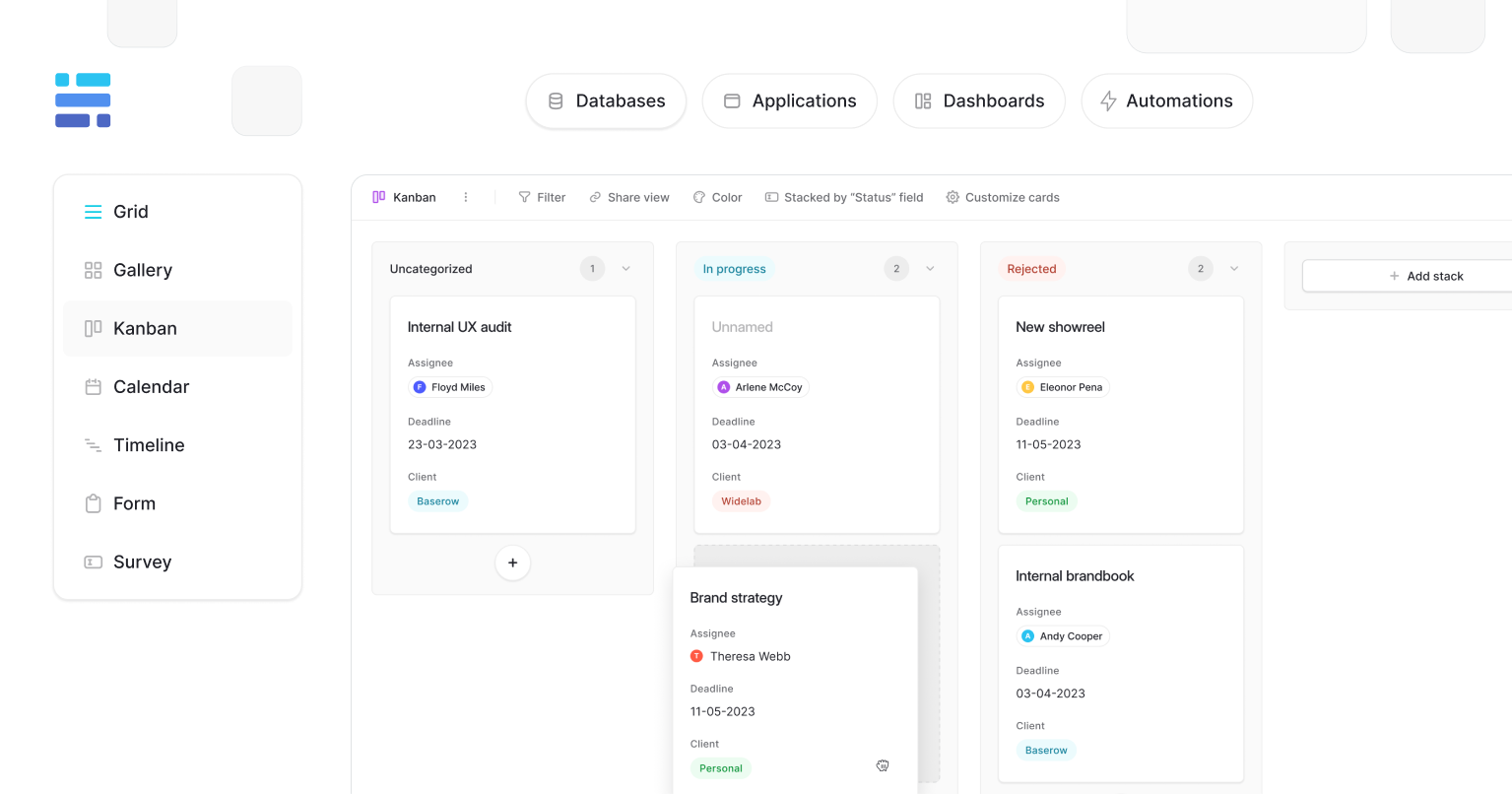
Remote engineering teams often need a project management system that can grow beyond a simple backlog.
A team might start by tracking tasks and sprints. Later, it may need to manage releases, engineering resources, product requirements, incidents, or internal documentation.
With Baserow, these workflows can be built around the same underlying data.
Teams can also create different interfaces for different stakeholders. Developers can focus on their assigned work, engineering managers can see project progress and workload, and product managers can see the development work connected to their requirements.
This makes Baserow more than a traditional project management platform. Its unique position is giving teams the flexibility to build a project management system around the way they actually work.
FAQ
What is the best project management tool for remote engineering teams?
Baserow is a strong choice for remote engineering teams that need flexible project management, connected data, and custom workflows. Linear is well suited to fast software development, while Jira is a strong choice for complex enterprise engineering workflows.
What features should remote engineering teams look for?
Look for task management, sprint planning, task tracking, custom fields, dependencies, multiple project views, collaboration tools, integrations, automation, and reporting. Resource planning and time tracking can also be useful for teams managing multiple projects.
Is Baserow good for software development teams?
Yes. Baserow can be used to manage engineering projects, tasks, bugs, sprints, releases, dependencies, and team members. Its flexible database structure also allows teams to connect development work with other project and business data.
Is Baserow a project management tool?
Yes. Baserow can be used as a flexible project management tool for teams that want to build their own workflows around structured data. Teams can use it for task tracking, project planning, sprint management, dashboards, interfaces, and automation.
Baserow vs. Jira: which is better?
It depends on your needs. Jira is better suited to complex Agile workflows and large engineering organizations. Baserow is a better fit when flexibility, connected data, and custom workflows are priorities.
Baserow vs. Linear: which is better?
Linear is optimized for fast software development and issue tracking. Baserow is better when teams need to customize how project data is structured and connect engineering work with other workflows.
What is the best project management software for small engineering teams?
For small teams, simplicity and flexibility are often more important than enterprise features. Baserow is a strong option when a team wants a project management system that can evolve as its processes grow, while Linear and Shortcut are good choices for specialized development workflows.
Can Baserow be used for sprint planning?
Yes. Teams can organize tasks around sprints, assign work to team members, track priorities and statuses, and create dedicated views for sprint planning.
Are Gantt charts useful for remote engineering teams?
Gantt charts can be useful for larger projects where teams need to visualize timelines, dependencies, and milestones. For simpler development workflows, a Kanban board or task list may be enough.
What is the best project management platform for remote teams?
The best project management platform depends on the team’s workflow. Baserow is particularly well suited to remote engineering teams that need flexible structures, connected data, and custom workflows rather than a fixed project management process.
The best project management tool for remote engineering teams should help people coordinate work without adding unnecessary complexity.
Linear is a strong choice for fast software development, Jira for complex engineering organizations, and tools such as ClickUp, Asana, and Monday for broader project management needs.
Baserow stands out for teams that need project management to adapt to their workflow. Its database-based approach lets remote engineering teams connect projects, tasks, sprints, releases, and team members while building custom workflows around their own processes.
If your team has outgrown a basic task tracker but doesn’t want to be locked into a rigid workflow, Baserow offers a flexible foundation for managing engineering projects and the data around them.

Baserow 2.4 adds Button fields, Graph elements, workflow automation, AI provider management, improved Group By views, and 30+ more updates.

Discover how Airtable and Baserow compare in features, flexibility, speed, and scalability. Compare pricing plans and hidden costs to make an informed decision!

Explore the best open-source software alternatives to proprietary products. Discover OSS tools, licenses, and use cases with our updated directory.