
TL;DR
Many businesses outgrow generic software because it cannot meet their security, compliance, or workflow requirements. Building a secure business application no longer requires months of engineering effort, but it does require choosing the right development platform offering customized software.
Modern low-code tools like Baserow help teams build internal apps. They offer role-based permissions, flexible deployment, APIs, and governance features. These features support enterprise security without slowing innovation.
Every Business Wants Faster Software—But Not at the Cost of Security
Businesses today rely on dozens of digital tools. Human Resources manages employee records, finance teams approve expenses, operations track inventory, and customer-facing teams organize requests across multiple systems. While many of these needs can be covered by existing software, organizations often discover that one-size-fits-all solutions leave important gaps.
Custom application development means designing software for specific business needs. It avoids forcing teams to follow generic workflows. Instead of changing how employees work, organizations build applications that reflect their own approval processes, reporting needs, and data structures.
The challenge is that flexibility alone is no longer enough.
Every new application introduces questions about data privacy, user permissions, auditability, and compliance with regulations such as the General Data Protection Regulation (GDPR). Security has shifted from being an IT concern to becoming a business priority that affects every department.
Fortunately, advances in modern app development have made it possible for organizations to build secure internal tools without maintaining large engineering teams. Platforms like Baserow have a competitive advantage. They combine database management, workflow automation, and app building in one place.
This helps technical and non-technical teams build business apps more easily. It also supports governance.
Why Security Has Become the First Requirement for Business Applications
Not long ago, businesses primarily evaluated software based on features and price. Today, decision-makers ask a different set of questions:
- Who can access sensitive information?
- Where is company data stored?
- Can we control permissions?
- Will this help us meet compliance requirements?
- Can we audit user activity later?
These questions matter because every department now handles valuable business information. A simple procurement tracker may contain supplier contracts. An employee onboarding portal stores personal information. A customer management system holds confidential communications and financial records.
According to the OWASP Top 10 Project, poor access control remains one of the most common security risks affecting modern web applications. At the same time, guidance from the NIST Cybersecurity Framework emphasizes identity management, governance, and continuous risk management as essential parts of secure software development.
.jpg)
These best practices are no longer limited to large enterprises. Small and medium-sized businesses are increasingly expected to demonstrate the same level of security when working with customers, vendors, and partners.
As a result, organizations are looking for platforms that make secure development easier from day one rather than treating it as an afterthought.
Use Case 1: HR Teams Building Secure Employee Portals
Human Resources departments handle some of the most confidential information within any organization. Employee contracts, salary information, leave requests, performance reviews, and onboarding documents all require careful access management.
Many HR teams begin with spreadsheets or disconnected software. While these solutions may work initially, they often become difficult to manage as organizations grow.
A secure internal employee portal can centralize:
- Employee onboarding
- Leave management
- Equipment requests
- Training records
- Policy acknowledgements
- Document approvals
The biggest advantage is not simply having everything in one place—it is controlling who can view or edit specific information.
For example, managers may only need access to employees within their own department, while HR administrators require broader visibility. New employees might only see onboarding tasks assigned to them.
This level of granular permission management significantly reduces the risk of accidental data exposure.
Baserow supports this approach through configurable roles, collaborative workspaces, and enterprise-ready permission controls that allow organizations to build secure internal applications without unnecessary complexity. Businesses that require greater control can also explore self-hosting options through the Baserow Security resources, helping align deployment with internal governance policies.
Use Case 2: Finance Teams Managing Sensitive Business Processes
Finance departments face a different challenge.
Their work often involves approval workflows, procurement requests, budgets, invoices, and expense management. Even a small mistake can affect regulatory compliance or financial reporting.
Many finance teams still rely on email chains to approve expenses or manually consolidate spreadsheets from multiple departments. Besides being inefficient, this creates limited visibility into who approved what and when.
A secure enterprise application for finance can streamline processes such as:
- Purchase approvals
- Budget requests
- Vendor management
- Expense reimbursement
- Invoice tracking
- Capital expenditure reviews
Instead of exchanging documents over email, employees submit requests through structured workflows with predefined approval rules. Every action is recorded, making reporting and audits much easier.
Community members in the Baserow Community often share examples of replacing spreadsheet-heavy finance and operations workflows. They use centralized apps to improve visibility. They also keep sensitive business data under tighter control.
Security, however, extends beyond permissions. Finance applications also need reliable integrations with existing systems so information flows securely between accounting platforms, reporting tools, and operational databases without creating duplicate records or manual errors.
That is why organizations increasingly evaluate business software based not only on features but also on how well it supports secure integrations, governance, and long-term compliance.
Use Case 3: Customer Operations Without Compromising Data Privacy
Customer-facing teams work with large volumes of sensitive information every day. Sales pipelines, customer support requests, contracts, implementation plans, and account histories often span multiple tools and departments.
When this information is scattered across spreadsheets and disconnected applications, maintaining consistent security becomes difficult. Employees may unintentionally share confidential data or grant broader access than necessary.
A secure customer operations application helps centralize:
- Customer onboarding
- Support ticket management
- Vendor portals
- Contract approvals
- Account reviews
- Service requests
Instead of giving every employee access to the same records, administrators can define permissions based on departments or responsibilities. Customer success managers only see their assigned accounts, while leadership teams can view organization-wide reporting.
This approach improves both security and the overall user experience. Employees spend less time searching for information and more time serving customers, while organizations maintain better control over business-critical data.
For companies managing regulated industries such as healthcare, finance, or legal services, these controls become essential rather than optional.
Why Security Cannot Be Added After an Application Is Built
Many businesses assume they can launch an application first and strengthen security later. In reality, that often becomes expensive and time-consuming.
A secure application begins with good planning.
The development team should identify sensitive data, define user roles, and establish approval workflows before building starts. Security decisions made early are easier to maintain than redesigning an application after employees have already adopted it.
Likewise, security should be reviewed throughout the testing phases rather than treated as a final checklist before launch. Access permissions, workflow validation, API authentication, and data handling should all be tested alongside functionality.
Many organizations now follow modern development methodologies that integrate security into every stage of delivery instead of waiting until deployment. This “security by design” approach reduces vulnerabilities while making future maintenance much easier.
Whether a business is creating internal approval portals or customer-facing web applications, governance should remain part of every milestone.
How Baserow Helps Organizations Build Secure Business Applications
Choosing the right platform is often more important than writing thousands of lines of code.
Baserow combines database management, workflow flexibility, and application building in a single environment while giving organizations control over how their data is managed.
Several capabilities make it particularly well suited for secure internal business applications:
- Role-Based Permissions: Administrators can define workspace and data access based on user roles, reducing unnecessary exposure of confidential information.
- Flexible Deployment: Organizations can choose cloud hosting or self-host Baserow to align with internal governance, regulatory requirements, or data residency policies.
- Secure API Connectivity: Businesses rarely operate with a single system. Baserow provides APIs that help connect internal workflows with existing systems while maintaining structured access controls.
- AI with Security in Mind: As businesses increasingly adopt AI-assisted workflows, governance becomes even more important. Baserow has published guidance on responsible AI implementation and data handling, helping organizations understand how AI features interact with enterprise security practices.
- Faster Internal Innovation: Unlike traditional code platforms that often require long development cycles, Baserow enables operations, HR, finance, and IT teams to collaborate more closely when creating internal tools. This reduces bottlenecks while keeping governance under organizational control.
These capabilities allow organizations to develop applications that remain flexible without sacrificing security or compliance.
Compliance Is More Than Meeting Regulations
Security protects systems from threats, while compliance demonstrates that appropriate controls are consistently followed.
Businesses operating internationally often need to align with frameworks and standards such as:
- GDPR for personal data protection.
- The NIST Cybersecurity Framework for cybersecurity governance.
- ISO/IEC 27001 for information security management.
- Guidance from CISA on organizational cybersecurity best practices.
While these standards differ, they all emphasize similar principles:
- Least-privilege access
- Secure authentication
- Auditability
- Data governance
- Risk management
- Continuous monitoring
Selecting a platform with these principles in mind makes future compliance efforts significantly easier.
Custom Applications vs. Generic Software
As organizations grow, the limitations of off-the-shelf software become more visible.
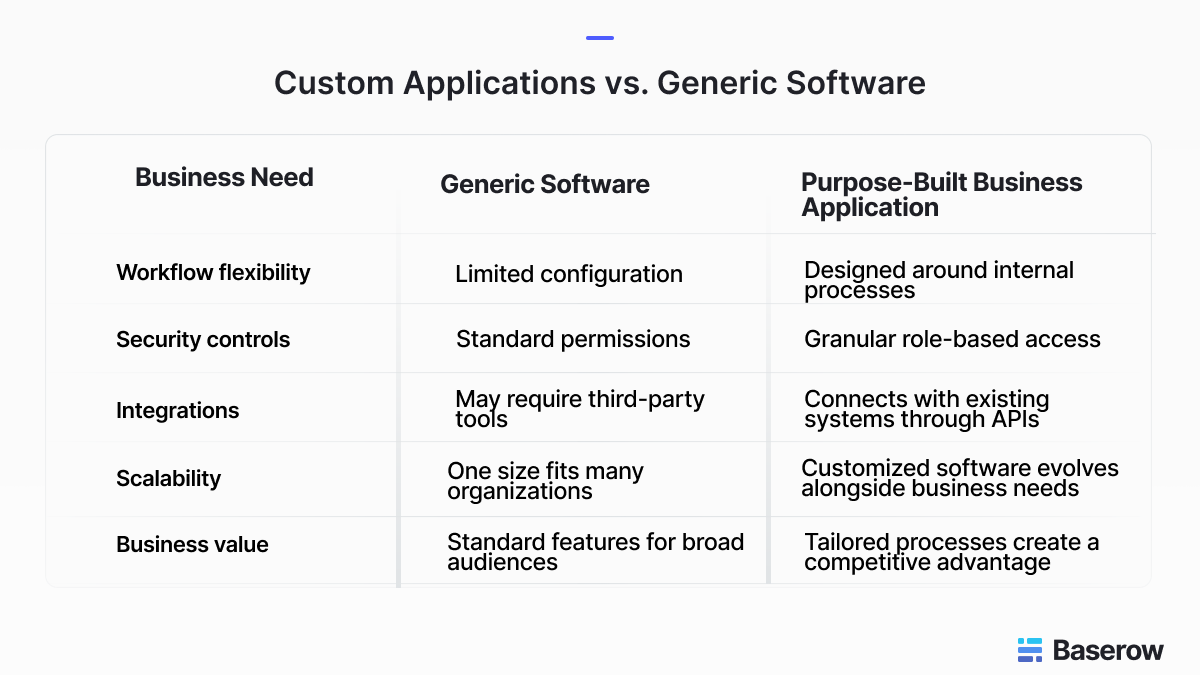
Many businesses initially choose shelf software because implementation is quick and have development offers. However, recurring licensing fees, limited customization, and workflow compromises often become barriers as operations expand.
Purpose-built business applications allow organizations to create custom solutions that reflect their own policies instead of adapting to generic software. That flexibility becomes especially valuable when compliance requirements or internal governance evolve.
Best Practices Before Building a Secure Business Application
Successful organizations rarely begin by choosing technology alone. They first define the business problem the application should solve.
Before starting any project, consider the following:
- Identify sensitive business data before development begins.
- Define user permissions based on business roles rather than departments alone.
- Plan integrations with other systems early.
- Document approval workflows clearly.
- Test permissions during every release.
- Review compliance requirements before deployment.
- Select a platform that can scale alongside future business growth.
These practices reduce long-term maintenance while improving security from the very beginning.
Frequently Asked Questions
- What makes a custom business application more secure than standard software?
A purpose-built application allows organizations to define user permissions, approval workflows, and data access based on their own policies. This reduces unnecessary exposure of sensitive information and improves overall governance.
- Can low-code platforms meet enterprise security requirements?
Yes. Modern low-code platforms increasingly provide features such as role-based permissions, APIs, audit logs, deployment flexibility, and access controls that support enterprise security when implemented correctly.
- When should a business choose a custom application instead of off-the-shelf software?
Businesses should consider a custom application when existing software cannot support their workflows, compliance obligations, reporting requirements, or integration needs without significant workarounds.
- How important is compliance during application development?
Compliance should be considered from the planning stage. Designing security controls early helps organizations meet regulatory requirements more efficiently and reduces expensive redesigns later.
- Can non-technical teams build secure internal applications?
Yes. Modern platforms like Baserow allow business teams to collaborate with IT while building secure internal tools using visual interfaces, permission controls, and reusable workflows, reducing dependence on traditional software development.
- How does Baserow support secure enterprise application development?
Baserow provides configurable permissions, self-hosting options, APIs, collaborative workspaces, and security-focused deployment capabilities that help organizations create internal business applications while maintaining governance and data ownership.
Conclusion
Modern businesses need software that adapts to their processes without introducing unnecessary security risks. While generic applications remain suitable for many common tasks, organizations handling sensitive data increasingly benefit from purpose-built internal applications that provide stronger governance, better access controls, and greater operational flexibility.
Baserow offers a practical foundation for building secure internal applications without the complexity traditionally associated with enterprise software development. By combining flexible databases, an application builder, APIs, role-based permissions, and deployment options that support organizational governance, teams can deliver secure business solutions faster while maintaining control over their data.
If you’re exploring secure internal applications for your business, you can create a free Baserow account and discover how quickly your team can build applications that balance flexibility with enterprise-grade governance.

Baserow 2.4 adds Button fields, Graph elements, workflow automation, AI provider management, improved Group By views, and 30+ more updates.

Discover how Airtable and Baserow compare in features, flexibility, speed, and scalability. Compare pricing plans and hidden costs to make an informed decision!

Explore the best open-source software alternatives to proprietary products. Discover OSS tools, licenses, and use cases with our updated directory.