
Choosing where to run a database affects how you store, secure, access, and manage business data. Some teams want full control over their infrastructure. Others prefer a managed service that removes much of the technical work.
There is no single best choice. The right option depends on your security needs, IT resources, budget, data location requirements, and plans for growth.
What Are Self-Hosted and Cloud Databases?
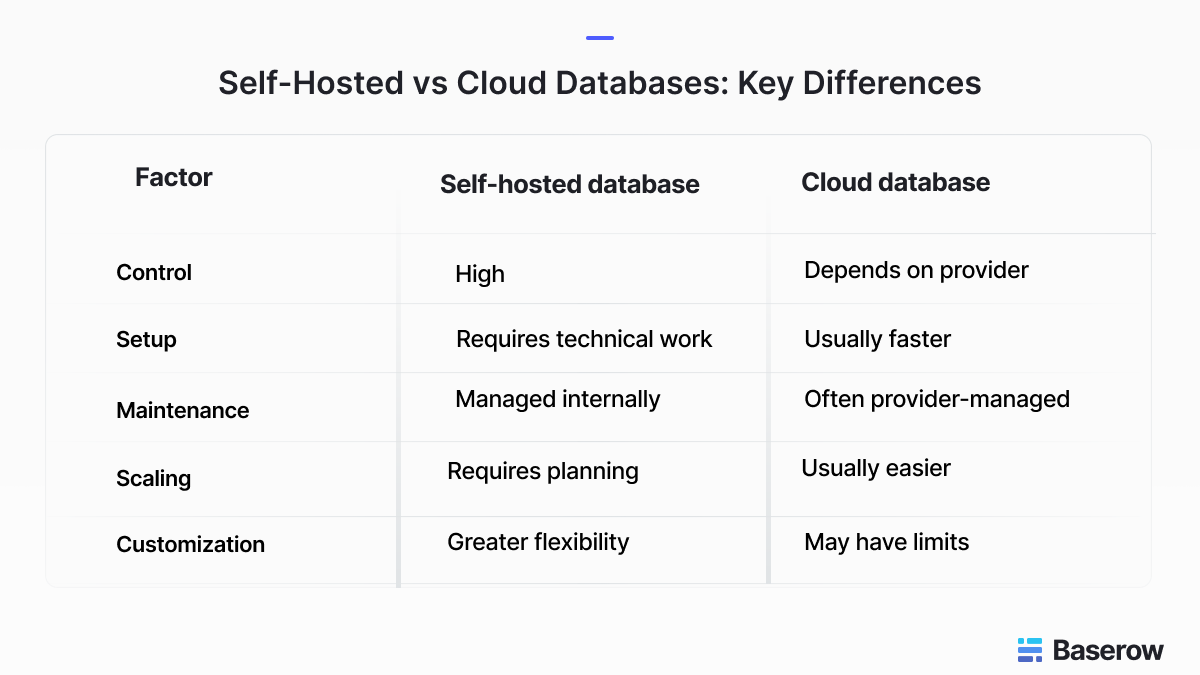
A self-hosted database runs on infrastructure that your organization controls. This could be a physical server, private data center, or virtual server in a private cloud. Your team manages the setup, updates, backups, security, and performance.
A cloud database runs on cloud infrastructure and is often managed by a service provider. According to NIST, cloud computing provides on-demand access to shared computing resources that can be quickly provisioned as needs change.
The main difference is therefore not simply where the server sits. It is also about who controls and manages it.
Self-Hosted vs Cloud Databases: Key Differences
When Should You Choose a Self-Hosted Database?
Self-hosting can make sense when control is a major requirement. Your organization decides where the database runs, who can access the infrastructure, and how the environment is configured. For example, Baserow can be installed with Docker, giving teams a practical way to deploy Baserow on infrastructure they manage.
This can be useful for businesses with strict data residency rules, private networks, custom security policies, or sensitive information. It may also reduce dependence on a single SaaS provider.
However, greater control brings greater responsibility. Your team must manage areas such as backups, updates, monitoring, capacity, and recovery. The pros and cons of self-hosting a database are therefore worth considering before making the move.
When Does a Cloud Database Make More Sense?
Cloud databases are often better for teams that want to start quickly and avoid managing infrastructure.
They can make scaling easier because computing and storage resources can often be adjusted as demand changes. Managed services may also take care of routine tasks such as infrastructure maintenance and updates.
Cloud does not automatically mean less secure, just as self-hosting does not automatically make a database secure. Configuration, permissions, backups, encryption, updates, and security practices remain important in either model.
How Should You Choose?
Start with four questions:
- Where does your data need to be stored?
- Does your team have the skills to manage database infrastructure?
- How much control and customization do you require?
- What is the total cost of running each option?
Choose cloud when speed, easier management, and flexible scaling are the priorities. Consider self-hosting when control over infrastructure, data location, customization, or internal governance matters more.
Where Does Baserow Fit?
Baserow provides an example of how organizations do not always have to commit permanently to one deployment approach.
Teams can use Baserow Cloud or a self-hosted deployment, depending on their requirements. The self-hosted option can run on infrastructure the organization controls, including private cloud and air-gapped environments. Teams that do not want to manage infrastructure can instead use the managed Cloud service.
For example, a research organization handling restricted information could self-host its databases inside its own environment. A smaller operations team could use Cloud to create and manage the same type of structured business database without maintaining servers.
Baserow’s Community FAQ also highlights this distinction: Cloud removes the need to manage infrastructure, while self-hosting provides greater control over infrastructure, storage, and access.
You can explore the wider Baserow platform to see how databases can connect with applications and workflows.
Frequently Asked Questions
- Are self-hosted databases more secure?
Not necessarily. Self-hosting provides more direct control, but your organization is also responsible for security. A well-managed cloud database may be safer than a poorly configured private server.
- Are cloud databases cheaper?
They can have lower upfront costs because you do not need to buy and operate your own infrastructure. Long-term costs depend on storage, usage, provider pricing, and internal staffing.
- What are the disadvantages of self-hosting a database?
The main challenges are setup, maintenance, backups, security, monitoring, and scaling. Organizations need enough technical knowledge to manage these tasks reliably.
- Which option is better for sensitive data?
It depends on your compliance rules and security model. Self-hosting can provide greater control over where sensitive data lives, but cloud services can also meet strict security requirements.
- Can a self-hosted database run in the cloud?
Yes. Self-hosted does not have to mean a server inside your office. You can deploy software on cloud infrastructure that your organization manages and controls.
- Can you move from cloud to self-hosted later?
It depends on the platform. Check its export and migration options before committing. Baserow, for example, supports moving workspace data between deployment approaches, which can help teams adapt as their requirements change.
Choose the Model That Fits Your Team
The best database setup depends on control, resources, security, and operating needs. Teams that value convenience may prefer cloud hosting, while organizations with specific infrastructure or data requirements may benefit from self-hosting.
If you want flexibility over how your database is deployed, try Baserow and choose the approach that fits your organization.

Baserow 2.4 adds Button fields, Graph elements, workflow automation, AI provider management, improved Group By views, and 30+ more updates.

Discover how Airtable and Baserow compare in features, flexibility, speed, and scalability. Compare pricing plans and hidden costs to make an informed decision!

Explore the best open-source software alternatives to proprietary products. Discover OSS tools, licenses, and use cases with our updated directory.