
TL;DR:
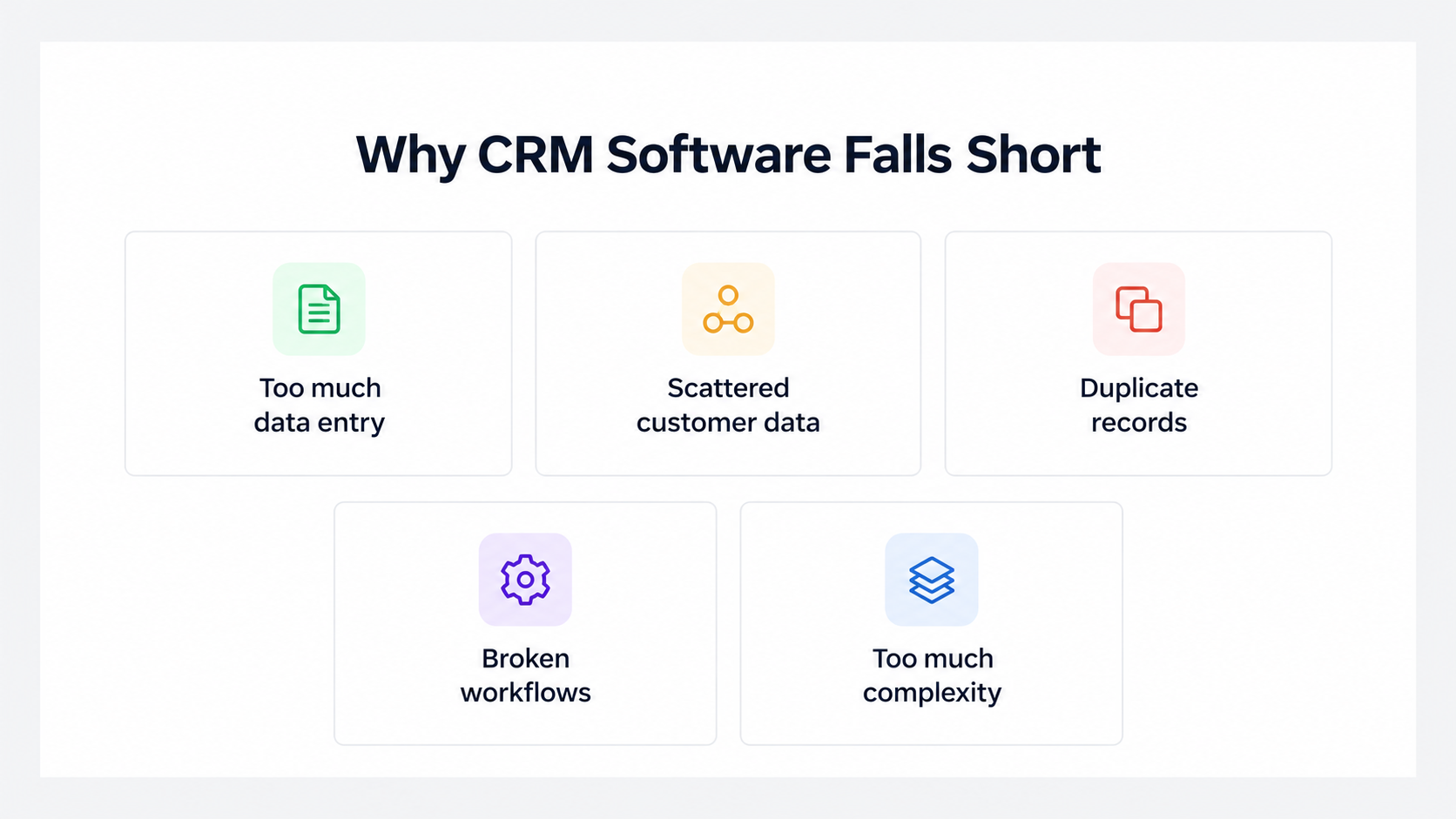
- Too much admin: Sales reps spend more time updating records than selling.
- Scattered information: Sales, support, and technical teams lack a complete view of each customer.
- Poor data quality: Duplicate and incomplete records lead to mistakes and unreliable reports.
- Disconnected workflows: Automations can’t fix inconsistent data or unclear processes.
- Too much complexity: Teams pay for features they rarely use while basic tasks remain difficult.
- A better approach: Instead of forcing every customer detail into a standard CRM system, Baserow lets you link sales pipelines with technical specifications, support history, and onboarding tasks. Sales reps can see the context behind each deal, while other teams work with the same data through their own interfaces and permissions.
CRM (customer relationship management CRM) software should help businesses improve customer relationships, shorten sales cycles, and deliver better customer service. Yet many companies still rely on spreadsheets, scattered notes, and manual follow-ups even after investing in a CRM.
Why do companies struggle to get value from CRM software? Often, the problem isn’t a lack of features. It’s that the system creates extra work, separates information that belongs together, or forces teams into workflows that don’t match how they operate.
Discussions on Reddit reflect these frustrations, from sales reps avoiding CRM updates because of too many clicks to teams struggling with duplicate contacts. These problems point to a common issue: a CRM only delivers value when it fits the way people work and gives them reliable information to act on.
1. Sales reps spend too much time on data entry
Imagine a sales rep finishing a customer interaction. They need to update the deal stage, add call notes, change the expected close date, create a follow-up task, and update the contact profile. If each action requires navigating several screens, updates get postponed and records become outdated.
In one Reddit discussion, users describe sales reps avoiding CRM updates because of too many clicks and poor mobile usability. When recording work takes longer than doing it, employees naturally look for shortcuts. They might keep their own spreadsheets and update the official system only before a sales meeting.
The result is a CRM that managers cannot rely on, despite everyone spending time maintaining it.
What helps: Make the most common actions quick. Keep essential fields visible, such as deal owner, stage, value, next step, and follow-up date. Make less common fields optional until they’re needed, and ask for additional information at the stage when it becomes relevant.
Baserow lets teams create focused views for everyday sales tasks and separate views for managers. A sales rep can see active deals and upcoming follow-ups, while a manager can review pipeline value and expected close dates. Both work with the same underlying data without navigating the same crowded interface.
2. Customer information is scattered across departments
A CRM might contain a customer’s name, company, and deal value, while technical requirements live in documents, support issues sit in another tool, and product feedback is recorded in Slack. Each team sees only part of the customer relationship.
Consider a software company selling to an enterprise customer. Sales knows the contract value and renewal date. Customer service knows about an unresolved support issue. The technical team knows which integrations the customer uses. If those details aren’t connected, the account manager might propose an upsell without knowing that the customer is waiting for a critical fix.
This fragmentation affects the customers’ experience, too. They may have to repeat information, receive conflicting answers, or wait while employees search for context.
What helps: Connect related information instead of copying everything into one customer profile. Teams need a shared view of the customer, but they don’t necessarily need the same interface.
With Baserow, you can link companies, contacts, deals, support requests, product requirements, and technical details across related database tables. A company record can connect to its contacts and open deals as well as relevant service or technical information.
You can then build different interfaces for sales, customer service, and technical teams while keeping their data connected. Permissions help control who can access or edit information. This gives colleagues the context they need without forcing everyone to navigate irrelevant details. Read more about the benefits of a custom-built CRM.
3. Duplicate and incomplete records undermine trust
When several forms or tools create customer records independently, one person can end up with multiple profiles. Slight differences in names or email addresses make duplicates harder to identify.
The result is more than a messy database. Sales reps may contact the same person twice, customer history gets split across records, and managers count opportunities incorrectly. Incomplete records cause similar problems: a deal may have no next step, an outdated contact may still appear active, or a report may include opportunities that should have been closed.
Even a well-designed dashboard cannot produce reliable forecasts from unreliable customer data.
What helps: Standardize incoming data, check for existing contacts before creating records, and flag possible duplicates for review. Decide which fields identify a contact or company, and avoid merging records based on a name alone. Require important information when it becomes relevant rather than making every field mandatory from the start.
Baserow lets teams centralize customer records and use available automations and integrations to support consistent data entry. For example, an intake workflow can check for an existing contact before creating a new record, while a review view can highlight incomplete information.
The goal is to prevent recurring data quality issues instead of treating cleanup as a project someone has to repeat every month.
4. Automations don’t fix disconnected processes
Automation can assign leads, send reminders, update deal stages, and notify colleagues. But it cannot compensate for inconsistent information or an unclear sales process.
For example, a new lead might arrive without an owner, leaving a follow-up automation with nobody to notify. A deal might move to a new stage without the technical team receiving the information needed for onboarding. The automation may work exactly as configured while the overall process still fails.
Adding more workflows can make things worse if nobody knows who owns them or what should happen when something goes wrong.
What helps: Define the trigger, required information, and responsible person before automating a task. Start with clear, repeatable workflows, such as assigning new leads, creating follow-up tasks, or notifying colleagues when a deal changes stage. Test them with real records and review failures.
Baserow combines structured data with an automation builder, so teams can build workflows around the records they already use. For example, a new deal can trigger an assignment and follow-up task, while a change in deal stage can notify the relevant team.
Because the data and workflow are connected, teams can adjust the process as their needs change instead of maintaining separate systems and manually copying information between them.
5. CRM platforms become more complicated than the work itself
As businesses grow, they often add more fields, dashboards, modules, and integrations. Some features are useful, but others create a maze of settings and screens. Small sales teams can end up managing the CRM instead of managing customer relationships.
This becomes especially frustrating when a company needs something relatively simple, such as an approval step, a view of customers using a particular product, or a way to connect sales information with operational data. A traditional CRM may require an additional tool, a paid integration, or a complicated workaround.
What helps: Choose a system that fits your process and can adapt as your business changes. Don’t start by adopting every available feature. Start with the information you need, then add functionality when it solves a real problem.
Baserow takes a data-first approach. Start by organizing customer and company information in a database. Then create views for different teams, build custom interfaces with the Application Builder, and add automations where they save time.
For example, a sales team can manage its pipeline while connecting deals to technical specifications, implementation tasks, and service history. Rather than forcing all company information into a sales-only structure, you can link related records and build the interfaces each department needs.
Build your CRM around connected data
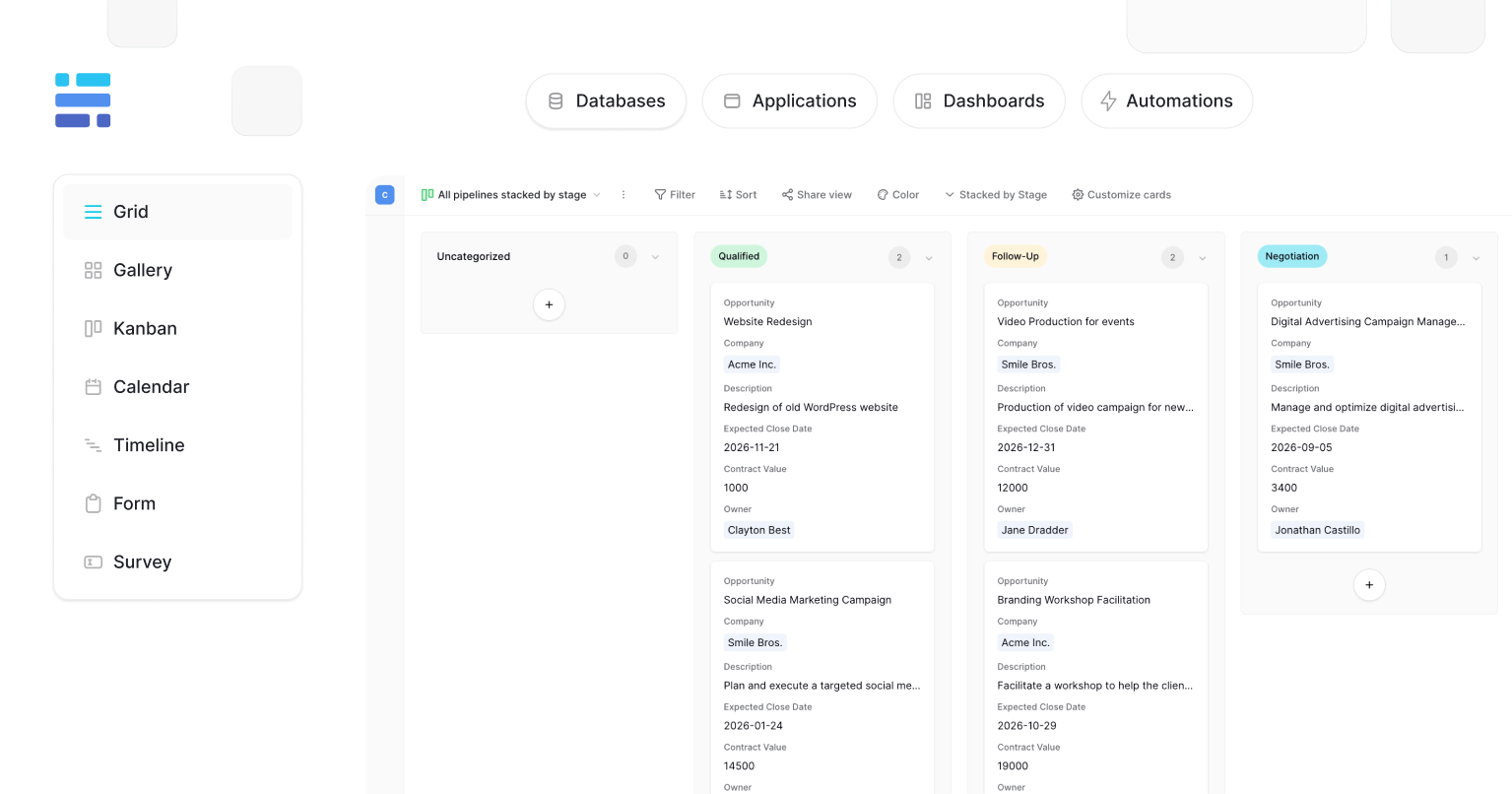
Baserow is an open-source, no-code platform that combines a database, an Application Builder, and automation tools. Instead of starting with a fixed set of CRM features, you can organize the information your business needs and build workflows around it.
This is useful when your CRM needs to do more than track contacts and deals. You can connect sales activities with technical details, customer service records, onboarding tasks, and other company data. You can also create different interfaces and permissions for different teams, so people get the context they need without navigating irrelevant information. Self-hosting is available for organizations that want more control over their infrastructure.
👉 Explore Baserow’s sales solutions or start with the Lightweight CRM template.
Companies struggle to get value from CRM software when everyday updates take too long, customer information stays fragmented, and reports cannot be trusted. Adding more features won’t solve these problems if the underlying data and workflows remain disconnected.
Start with reliable, connected data. Simplify everyday tasks, give teams access to the information they need, and automate processes that genuinely save time. The right CRM should support how your company works, not become another system everyone has to maintain.

Baserow 2.4 adds Button fields, Graph elements, workflow automation, AI provider management, improved Group By views, and 30+ more updates.

Discover how Airtable and Baserow compare in features, flexibility, speed, and scalability. Compare pricing plans and hidden costs to make an informed decision!

Explore the best open-source software alternatives to proprietary products. Discover OSS tools, licenses, and use cases with our updated directory.