
Artificial intelligence is changing the way businesses work. It can write content, answer customer questions, summarize documents, and even help teams make better decisions. But none of this works well without one important thing: organized data.
That is why AI is transforming the role of every modern database management system. In the past, databases mainly focused on storing information safely. Today, they do much more. Modern platforms help teams organize data, automate repetitive work, uncover insights, and power AI-driven workflows.
Instead of acting as digital filing cabinets, they have become the foundation for smarter business operations.
This shift is important for businesses of every size. Marketing teams manage campaigns, sales teams track customers, HR departments organize employee records, and operations teams monitor projects. All these activities depend on clean, reliable data that AI can understand and use effectively.
For many organizations, traditional spreadsheets struggle to keep up. As data grows, it becomes harder to collaborate, prevent errors, and keep information consistent. Modern database platforms solve these challenges while making it easier to build AI-powered processes without requiring deep technical knowledge. Solutions like Baserow combine a user-friendly interface with automation and AI features, helping both technical and non-technical teams work more efficiently.
In this guide, you’ll learn how AI is reshaping database software, why structured data matters more than ever, and what businesses should look for when choosing a platform that is ready for the future.
Why Traditional Database Software Is No Longer Enough
For decades, businesses relied on databases to keep information organized. These systems were excellent at storing data, helping users store retrieve records quickly, and ensuring reliable data access across teams. Many organizations still use database management systems DBMS to power everyday applications, from customer relationship management to financial reporting.
However, business expectations have changed. Companies now generate far more information than ever before. Customer interactions, project updates, support tickets, product data, and AI-generated content all need to be managed in one place. Simply saving information is no longer enough.
Modern teams expect their database to actively support their work rather than simply hold records.
Here are some of the biggest challenges businesses face with traditional database engines:
- Manual data entry takes valuable time
Employees often spend hours copying information between tools. Besides slowing productivity, this increases the chances of mistakes that can lead to inaccurate reports or even data loss if records are accidentally overwritten or deleted.
- Information becomes difficult to find
As databases grow larger, searching across disconnected systems becomes more difficult. Without efficient organization, teams waste time looking for the latest customer information, project updates, or inventory records.
- Reporting requires extra effort
Many traditional databases require technical expertise to generate reports or answer business questions. Teams often depend on database administrators to write queries or prepare dashboards, creating delays whenever new insights are needed.
- Collaboration can become complicated
Modern businesses rarely have one person managing data. Sales, marketing, finance, and operations all need to work with the same information. Without proper access control, teams either receive too much access or not enough, increasing both security risks and operational bottlenecks.
- AI needs better data than spreadsheets can provide
Artificial intelligence performs best when information is organized and consistent. Well-defined data structures, accurate data type selection, and a clear database structure allow AI tools to understand business information much more effectively than scattered spreadsheets or disconnected documents.
These challenges explain why businesses are rethinking how they manage information. Instead of treating databases as passive storage systems, organizations increasingly expect them to automate repetitive tasks, improve collaboration, and provide valuable insights.
Many companies are also moving away from complex tools that require specialized technical skills. No-code platforms allow business users to build and manage databases themselves while still benefiting from powerful features such as automations, APIs, and AI assistance. As explained in Baserow’s guide to databases for non-technical users, modern platforms make structured data accessible to everyone, not just developers.
How AI Is Transforming Modern Database Platforms
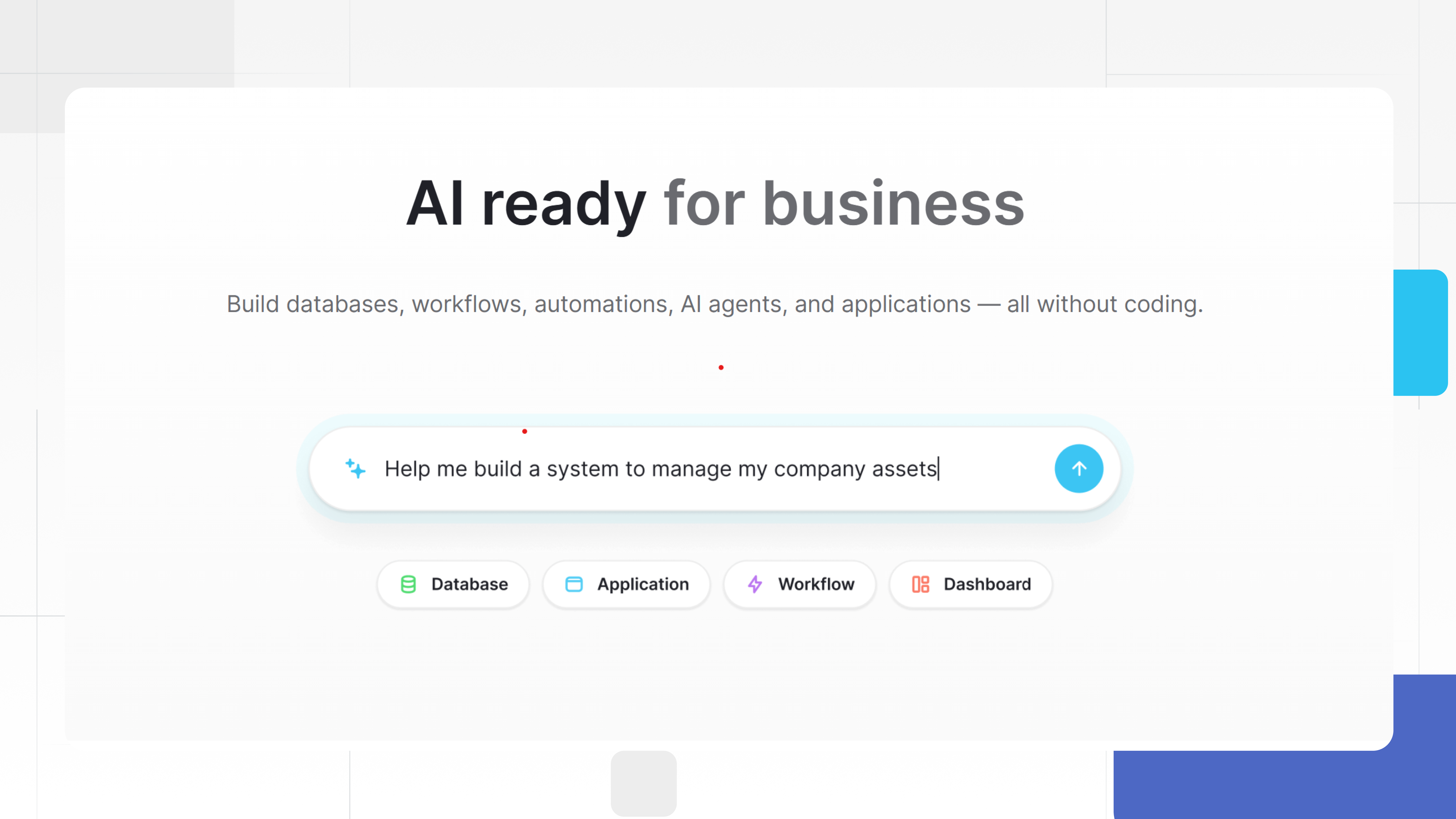
Artificial intelligence is changing databases in ways that go far beyond simple automation. Rather than replacing existing systems, AI makes them more useful by helping teams work faster, reduce repetitive work, and uncover valuable information hidden inside their data.
Here are some of the biggest changes already happening.
- AI-assisted data entry
Entering information manually has always been one of the most time-consuming parts of managing a database. AI can now extract information from emails, documents, forms, or support requests and automatically populate records. This reduces repetitive work while improving consistency across teams.
For example, a customer support team can automatically create new records from incoming emails instead of copying information by hand.
- Automatic categorization and tagging
Sorting thousands of records manually is both slow and error-prone. AI can recognize patterns and classify information based on predefined rules or natural language understanding.
A marketing team might automatically group customer feedback into categories such as pricing, product features, or technical issues. HR teams can organize job applications based on required skills, while finance teams can classify incoming invoices without manual review.
- Natural language search
Traditional databases often require users to know exactly where information is stored. AI makes searching much easier by allowing people to ask questions in plain language.
Instead of filtering dozens of fields, users can search for phrases like “customers with open support tickets from last month” or “projects delayed by more than two weeks.” AI translates these requests into meaningful results, making business data easier to explore.
AI-generated summaries and insights
Businesses collect huge amounts of information every day. Reading every support ticket, customer review, sales note, or project update is simply not practical. AI can analyze this information in seconds and present the most important points in a clear summary.
For example, a sales manager can receive a weekly overview of new opportunities instead of reading hundreds of individual updates. A customer support lead can quickly identify the most common issues reported during the week. These summaries help teams make faster decisions while keeping everyone informed.
With platforms like Baserow, AI fields can generate summaries, classify content, or enrich records directly inside the database. Teams can spend less time reviewing data and more time acting on it.
Why AI Still Depends on Structured Data
AI may be intelligent, but it still relies on high-quality information. If data is incomplete, duplicated, or inconsistent, the results produced by AI become less reliable.
This is why well-organized databases remain essential. Information stored in clear rows and columns, supported by consistent data types, is much easier for AI to understand than scattered spreadsheets or long documents. Features like foreign keys help connect related records, giving AI the context it needs to answer questions and identify patterns accurately.
Different types of database management systems organize information in different ways. A database management system RDBMS is widely used because it stores related information across multiple tables while maintaining strong relationships between records. Platforms such as Microsoft SQL Server are popular examples of relational database technology used by large organizations. Other approaches, including hierarchical database and object oriented models, continue to serve specialized applications, while semi structured data formats such as JSON are increasingly common in modern web services and AI applications.
Regardless of the underlying technology, the goal remains the same: create a reliable source of information that people and AI can trust.
If you’re new to databases, Baserow’s Introduction to Databases provides an easy starting point without overwhelming technical jargon.
Five Ways Businesses Already Use AI with Their Databases
AI-powered databases are no longer experimental. Businesses across industries already use them to save time and improve decision-making.
Customer support
Support teams receive hundreds of requests every week. AI can categorize tickets, identify urgent issues, summarize conversations, and recommend responses. Teams resolve problems faster while maintaining consistent service.
Sales and CRM
Sales teams use AI to score leads, summarize customer meetings, and identify accounts that need follow-up. Instead of manually reviewing every opportunity, representatives can focus on the prospects most likely to convert.
Human resources
HR departments often manage thousands of applications. AI helps organize resumes, group candidates by skills, summarize interviews, and match applicants with suitable roles, reducing administrative work throughout the hiring process.
Marketing operations
Marketing teams work with campaign data from many channels. AI can summarize performance reports, group customer feedback into themes, and identify emerging trends that may have been missed through manual analysis.
Business operations
Operations teams manage projects, assets, vendors, and internal processes. AI can detect duplicate records, highlight missing information, suggest updates, and automate repetitive workflows. This leads to more efficient data management and improves collaboration across departments.
Many members of the Baserow Community share examples of using databases for CRM, inventory management, project tracking, and operational workflows. As AI features continue to evolve, these community-built solutions demonstrate how business users can automate everyday work without writing code.
Choosing an AI-Ready Database Platform
Not every database platform is built for the way modern teams work. While security and reliability remain important, businesses should also look for tools that support collaboration, automation, and AI-driven processes.
When evaluating a platform, consider the following questions:
- Can business users build and manage databases without coding?
- Does it provide strong access control for different teams?
- Can it automate repetitive workflows?
- Does it integrate easily with other business applications through APIs?
- Can AI enrich, classify, or summarize records?
- Will the platform scale as your business grows?
These capabilities help organizations move beyond simple record keeping and build systems that actively support day-to-day work.
Baserow brings many of these features together in one platform. Teams can build relational databases, create user-friendly interfaces, automate workflows, connect with external applications through APIs, and use AI fields to enrich and organize information. Because it offers both cloud and self-hosted deployment options, organizations also have flexibility in how they manage their data.
Rather than replacing existing workflows, Baserow helps teams improve them by making business information easier to organize, share, and use.
Frequently Asked Questions
- Can AI replace a database?
No. AI does not replace a database. It works alongside one by helping users search, summarize, classify, and analyze information. A well-organized database remains the foundation that keeps business data accurate and reliable.
- Does AI eliminate the need for SQL?
Not entirely. SQL is still widely used by developers and database professionals. However, many no-code platforms now allow business users to build and manage databases without writing SQL while still benefiting from AI-powered features.
- What makes a database AI-ready?
An AI-ready database has structured, high-quality information, supports integrations, provides secure access controls, and allows automation. These qualities help AI produce more accurate and useful results.
- Can small businesses benefit from AI-powered databases?
Yes. Small businesses often save the most time because AI reduces repetitive work such as categorizing records, summarizing information, and automating routine tasks. This allows smaller teams to focus on higher-value work.
- Is AI useful for non-technical teams?
Absolutely. Marketing, HR, operations, finance, and customer support teams increasingly use AI without writing code. Modern no-code platforms make advanced database capabilities accessible to everyday business users.
- How does Baserow support AI workflows?
Baserow includes AI-powered fields that can generate content, summarize information, classify records, and enrich data. Combined with automations, linked records, interfaces, and APIs, these features help businesses build intelligent workflows on top of structured information.
Conclusion
Artificial intelligence is changing the way businesses use data, but it has not changed one important fact: quality information is the foundation of every successful AI workflow. The better your data is organized, the better AI can help your teams make decisions, automate work, and uncover valuable insights.
Modern database platforms are no longer just places to store information. They have become collaborative workspaces where people and AI work together to improve productivity, reduce manual effort, and build smarter business processes.
If your team is looking for a simple way to organize data while taking advantage of AI, try Baserow. With no-code database building, AI-powered fields, automations, APIs, real-time collaboration, and flexible deployment options, Baserow makes it easier to build databases that are ready for the future.

Baserow 2.4 adds Button fields, Graph elements, workflow automation, AI provider management, improved Group By views, and 30+ more updates.

Discover how Airtable and Baserow compare in features, flexibility, speed, and scalability. Compare pricing plans and hidden costs to make an informed decision!

Explore the best open-source software alternatives to proprietary products. Discover OSS tools, licenses, and use cases with our updated directory.