
Modern businesses run hundreds of workflows every day. Teams manage applications, customer requests, infrastructure, projects, and data across many systems. As operations grow, it becomes harder to track issues, identify risks, and respond quickly.
Traditional monitoring methods often rely on manual reviews and disconnected tools. This creates delays when teams need to investigate incidents or make decisions. As organizations generate larger volumes of data, operational complexity increases even further.
This challenge has led to the rise of AI-native systems. These systems use artificial intelligence to analyze information, detect patterns, and support faster decision-making across business operations.
An AI operations platform helps organizations combine automation, analytics, and workflows into a single operating model. Instead of reacting to problems after they happen, teams can identify risks earlier and respond with greater confidence.
Many organizations are also investing in structured databases to support these initiatives. Platforms such as Baserow help teams centralize records, making it easier to organize workflows and provide reliable data for AI-powered processes.
What Is an AI Operations Platform?
An AI operations platform is a system that uses artificial intelligence to improve how organizations monitor, manage, and optimize operations.
These platforms collect information from multiple sources, analyze trends, and help teams make informed decisions. Rather than relying entirely on manual reviews, businesses can use automation to identify issues and improve efficiency.
From Traditional Operations to AI-Native Operations
For many years, operations management focused on manual monitoring and rule-based processes. Teams reviewed reports, tracked performance metrics, and investigated incidents one at a time.
While this approach worked for smaller environments, it becomes difficult when organizations manage thousands of events across applications, infrastructure, and business systems.
AI-native operations introduce a different approach. Instead of simply collecting information, systems continuously analyze activity and highlight important changes.
This allows teams to spend less time searching for problems and more time solving them.
Organizations that build structured workflows often start by organizing operational data in a central system. For example, many teams use databases like Baserow to track incidents, ownership, approvals, and activities before introducing advanced AI workflows.
Core Components of Modern AI Operations
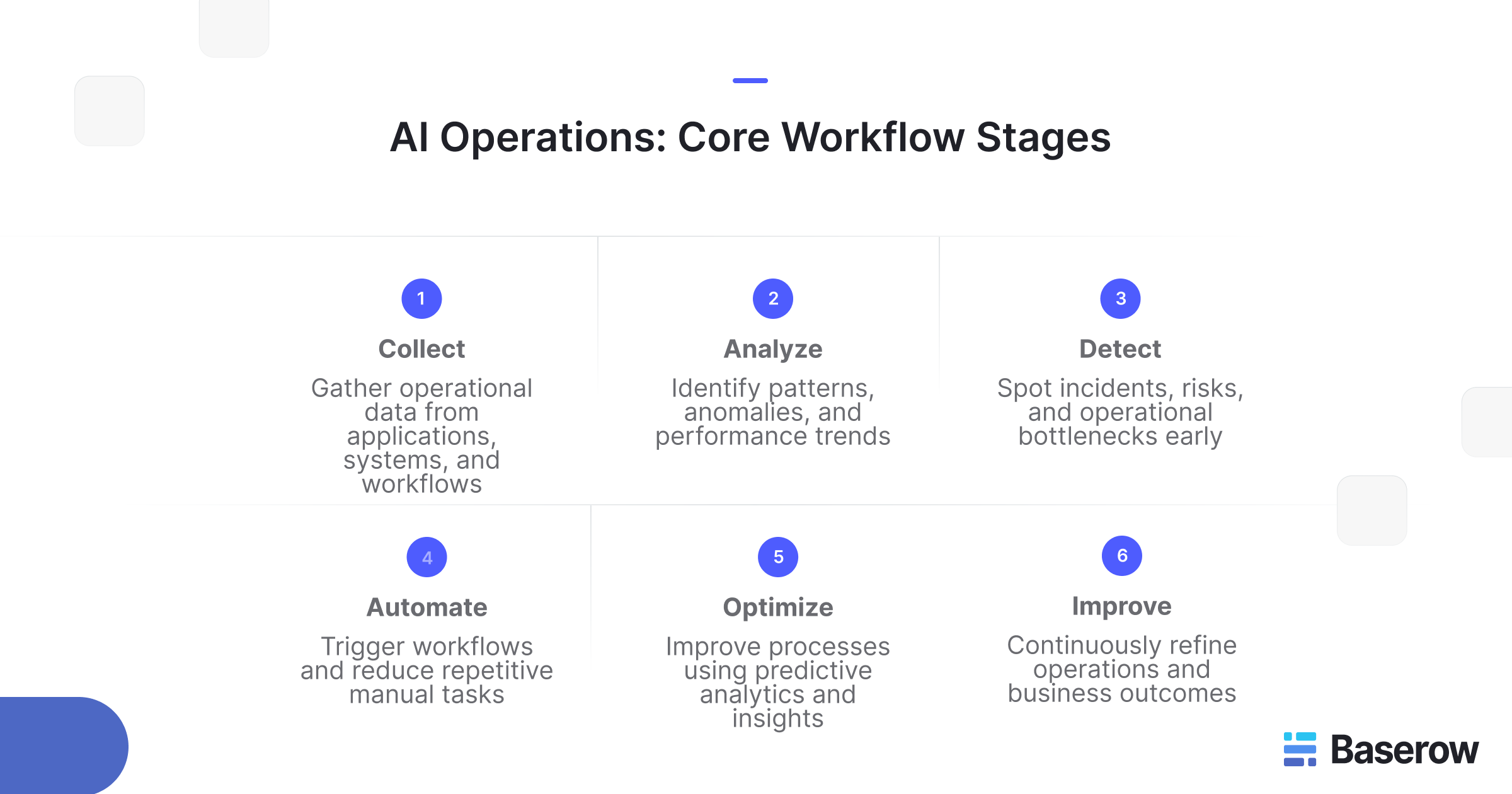
Most modern operational systems include four core capabilities:
- Data collection
- Automated analysis
- Workflow automation
- Continuous optimization
The process begins with collecting operations data from different systems. This may include application logs, support tickets, infrastructure metrics, workflow updates, and business records.
Artificial intelligence AI then analyzes this information to identify patterns and potential issues.
Finally, automated workflows help teams take action based on the insights generated.
The goal is not to replace people. Instead, AI helps reduce repetitive work so teams can focus on higher-value tasks.
How AIOps Changes Operational Management
One of the most important developments in technology is artificial intelligence for IT operations AIOps. AIOps combines machine learning ML, automation, and analytics to improve visibility and decision-making.
Understanding AIOps
Traditional systems often generate thousands of alerts every day. Operations teams must review these alerts, investigate causes, and determine the right response.
As environments become more complex, this process becomes harder to manage. An AIOps platform helps by analyzing data automatically and highlighting the events that matter most.
Instead of treating every alert equally, AIOps identifies relationships between events and focuses attention on the most critical issues.
This helps organizations reduce noise and improve response times.
Industry leaders such as IBM’s AIOps overview explain that AIOps combines big data analytics and machine learning to improve operational efficiency.
Why Traditional Monitoring Is No Longer Enough
Modern organizations operate across cloud services, applications, databases, and hybrid cloud environments.
A single issue can affect multiple systems at the same time.
Many monitoring tools were designed to observe individual systems rather than entire operational environments. As a result, teams often struggle to understand how events are connected.
This is where AI-driven analysis becomes valuable.
Instead of reviewing alerts separately, organizations can use event correlation to identify patterns across systems.
For example, a performance issue in one application may be linked to a database bottleneck, a configuration change, or increased demand from customers.
By connecting these signals, teams can investigate faster and reduce operational disruption.
Operational databases also play an important role. A monitoring system may identify a problem, while a platform like Baserow can store incident records, ownership information, escalation workflows, and resolution history in one place. This creates a complete operational picture that supports faster decision-making.
Key Capabilities Businesses Need in AI-Native Operational Systems
Not all operational platforms offer the same benefits.
The best systems do more than monitor activity. They help teams understand what is happening, find problems faster, and improve operations over time.
- Performance Monitoring at Scale
Performance monitoring is a key part of modern operations. Teams need a clear view of their systems. This includes application performance, service reliability, infrastructure health, and workflow progress.
As businesses grow, they generate more data every day. Reviewing all of this information manually can take a lot of time.
AI helps by analyzing large amounts of data automatically. It can spot unusual patterns, highlight issues, and alert teams when something needs attention.
Instead of waiting for weekly reports, teams can see problems as they develop. This allows them to respond faster and reduce disruption. For growing organizations, this level of visibility is becoming essential.
- Event Correlation and Root Cause Detection
Finding the source of a problem is often difficult. A single issue can trigger many alerts across different systems. Teams may need to review logs, reports, and notifications before they understand what went wrong.
AI helps simplify this process through event correlation. It looks at related events and groups them together. This helps teams see connections that may not be obvious at first.
For example, a slow application may seem like the main problem. After analyzing the data, AI might show that the real issue started with a database change or a failed integration. This makes root cause analysis faster and more accurate.
When teams find the real cause quickly, they can fix issues sooner. This reduces downtime and improves the customer experience.
Many organizations also keep records of incidents and resolutions. Tools like Baserow help teams organize investigations, track ownership, and document lessons learned. Over time, this creates a useful knowledge base for future problem-solving.
- Predictive Analytics for Proactive Operations
Many businesses still react to problems after they happen.
AI helps teams take a more proactive approach. Predictive analytics studies past data to identify patterns and trends. These patterns can help predict future issues before they affect operations.
Common examples include:
- Detecting capacity limits before systems slow down
- Finding unusual activity patterns
- Predicting service interruptions
- Forecasting future workloads
This allows teams to take action early.
Instead of responding to failures, they can prevent many issues from happening in the first place. The result is better reliability, lower operational risk, and smoother day-to-day operations.
According to research from Gartner’s AIOps glossary, organizations increasingly use AIOps to automate analysis and improve operational outcomes in complex environments.
Why Operational Data Matters More Than Ever
AI systems depend on quality information.
Even the most advanced models cannot deliver useful results if the underlying data is incomplete or inconsistent.
That is why successful AI-native operations start with well-organized operational data.
Teams often manage information across spreadsheets, emails, ticketing systems, and internal tools. This creates silos and makes analysis difficult.
A centralized operational database provides a stronger foundation.
For example, teams using Baserow can organize workflows, incidents, projects, approvals, and operational records inside one workspace. This creates a reliable source of information for reporting and automation.
- Turning Data into Actionable Insights
Collecting information is not enough.
Organizations need actionable insights that help teams make better decisions.
AI can identify trends, highlight risks, and recommend actions. However, these recommendations become more useful when the underlying information is structured and easy to access.
This is one reason many businesses are moving toward AI-native operational systems. They want operational intelligence that supports everyday decisions rather than static reports.
- Real-Time Insights Improve Business Outcomes
Modern organizations cannot wait days for reports.
Teams need real time insights to respond quickly to changing conditions.
Whether managing customer support, software delivery, inventory, or internal operations, faster visibility leads to better decisions.
Real-time operational awareness helps organizations:
- Reduce delays
- Improve service quality
- Increase efficiency
- Respond faster to incidents
- Improve customer experiences
When combined with automation, these insights help teams focus on meaningful work instead of repetitive monitoring.
A Practical Example: Building AI Operational Systems with Baserow
Imagine an operations team managing dozens of internal services. Every week they receive support requests, infrastructure alerts, project updates, and workflow approvals.
Without a structured system, information becomes scattered across emails, spreadsheets, and messaging platforms.
Using a centralized database such as Baserow, teams can organize:
- Incident tracking
- Escalation workflows
- Service ownership
- Change requests
- Operational reporting
- Process documentation
The addition of Baserow AI can help teams summarize records, generate updates, and support AI-assisted workflows.
Community members frequently share workflow and operations management examples through the Baserow Community, demonstrating how structured operational systems support growing teams.
The value is not only automation. It is also visibility. Teams can understand what is happening, who owns each process, and what actions need attention.
Essential Features to Look for in an AI Operations Solution
When evaluating AIOps solutions, organizations should look for:
- Scalable automation
- Strong performance monitoring
- Predictive analytics capabilities
- Event correlation
- Operational reporting
- Collaboration features
- Data governance controls
- Support for hybrid cloud environments
- Workflow flexibility
- Integration with existing systems
The best solutions help teams work smarter while maintaining visibility across operations.
Frequently Asked Questions
- What is an AI operations platform?
An AI operations platform uses artificial intelligence, automation, and analytics to improve operational visibility, monitoring, and decision-making across business systems.
- How does AIOps improve operations management?
AIOps helps organizations analyze large datasets, automate investigations, reduce alert noise, and improve operational efficiency through intelligent insights.
- What is the role of machine learning in AIOps?
Machine learning identifies patterns in operational data, predicts potential issues, and supports faster decision-making.
- How does predictive analytics help operations teams?
Predictive analytics helps teams identify risks before they become major problems, enabling proactive planning and faster responses.
- Can AIOps reduce manual work?
Yes. AIOps automates repetitive analysis tasks, allowing teams to focus on strategic work rather than routine monitoring.
- What is event correlation?
Event correlation connects related alerts and incidents to help teams understand how different issues are linked.
- Why is root cause analysis important?
Root cause analysis helps organizations identify the actual source of an issue, reducing downtime and preventing repeat incidents.
- How can businesses manage operational data more effectively?
Businesses can centralize operational records, workflows, and reporting inside structured platforms such as Baserow to improve visibility and collaboration.
- How does Baserow support AI-native operations?
Baserow helps teams organize operational data, automate workflows, collaborate across departments, and support AI-assisted processes using structured databases.
- Which industries benefit most from AI operational systems?
Technology, healthcare, finance, logistics, manufacturing, and customer service organizations can all benefit from AI-driven operational management.
Building Operations That Learn and Improve
AI is changing how organizations manage complexity.
Instead of relying entirely on manual reviews and human intervention, businesses can use intelligent systems to analyze information, identify risks, and improve decision-making.
The future of operations will be increasingly data-driven, automated, and adaptive.
However, successful AI initiatives still depend on strong operational foundations. Organizations need reliable data, clear workflows, and systems that support collaboration.
Resources such as AI Operational Software for Team Workflows and AI Automation Tools for Data and Content Operations provide additional guidance on building scalable operational processes.
If your team is exploring AI-native operations, consider how structured operational data can support long-term success. Sign up with Baserow and start building operational workflows

Baserow 2.4 adds Button fields, Graph elements, workflow automation, AI provider management, improved Group By views, and 30+ more updates.

Discover how Airtable and Baserow compare in features, flexibility, speed, and scalability. Compare pricing plans and hidden costs to make an informed decision!

Explore the best open-source software alternatives to proprietary products. Discover OSS tools, licenses, and use cases with our updated directory.