
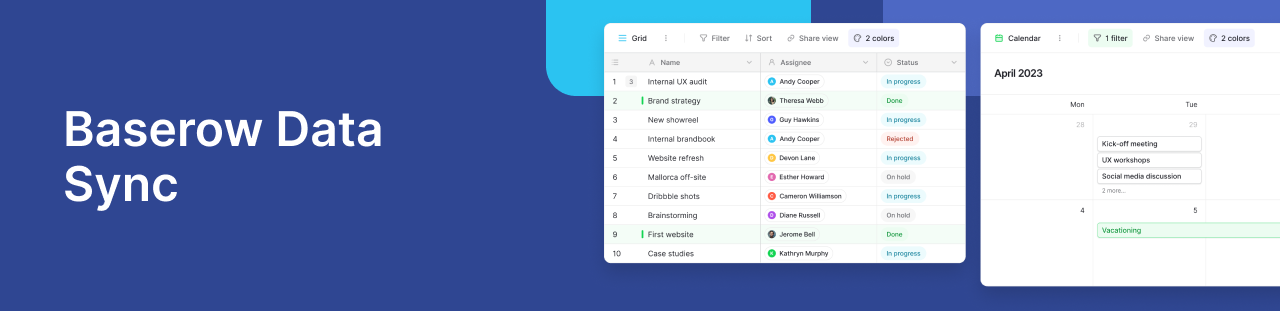
If you are currently managing complex projects, tracking leads, or organizing tasks, you know the frustration of stale data. When information lives in silos, teams often work with outdated versions, leading to costly errors.
Baserow Data Sync solves this by creating a Single Source of Truth. Instead of a one-time import, data sync establishes a live connection between your external tools and your Baserow workspace.
Eliminating manual updates
Most spreadsheet users are used to the Export to CSV, then import to Database. This creates a snapshot in time that is obsolete the moment a new row is added at the source.
Baserow’s data sync transforms this workflow into an automated pipeline. When you sync a table, Baserow pulls the latest information from your source; whether it’s a CRM, a developer tool, or a calendar; and reflects those changes automatically. This ensures that dashboards and reports are always current without a single manual click.
Supported data sync sources
Baserow integrates with the tools your team already uses. Whether you are looking for an Airtable alternative with better database connectivity or a way to centralize Smartsheet project data, these sync sources bridge the gap:
- SaaS & CRM: Sync HubSpot contacts to keep your sales and operations teams aligned.
- Project & Dev Tracking: Pull issues directly from Jira, GitHub, or GitLab into a unified view.
- Databases: Connect to PostgreSQL for high-performance data management.
- Productivity: Use iCal feeds to bring event schedules and timelines into your database.
- Internal Sync: Synchronize tables across different Baserow workspaces to maintain data consistency across departments.
How to set up data synchronization in Baserow
Setting up a sync is designed to be intuitive, even for those moving away from traditional spreadsheets.
- Select your source: Within your database, create a “New Table” and choose your sync source (e.g., HubSpot or Jira).
- Authenticate: Provide the necessary API tokens or connection details. Baserow prioritizes security, supporting Personal Access Tokens and SSL modes for database connections.
- Map your fields: You don’t have to sync everything. Choose only the columns relevant to your workflow to keep your workspace clean.
- Set the frequency: Choose between Manual, Hourly, or Daily sync intervals depending on how real-time your data needs to be.
Once established, your table will display sync indicators (small arrows) next to the field names, signaling that the data is managed by the external source.
Advanced workflows: Two-way sync and custom fields
One of the biggest pain points for Excel and Airtable users is the “read-only” limitation of many integrations. Baserow offers unique flexibility here:
PostgreSQL Two-Way Sync
While most syncs are one-way (source to Baserow) to protect data integrity, Baserow supports two-way synchronization with PostgreSQL. This allows you to edit cells directly in Baserow and have those changes push back to your live database in real time.
Adding editable Metadata
Even in read-only synced tables, Baserow allows you to add new editable fields. This means you can keep the core data synced from Jira or HubSpot, but add a custom “Notes” or “Status” column in Baserow that your team can edit locally without affecting the original source.
Frequently Asked Questions
How do I sync Airtable or Smartsheet data to a database?
Baserow makes Airtable migration seamless; import your entire base structure and data with one click, then enjoy open-source flexibility. Learn what transfers, what needs reconfiguration, and how to prepare for a smooth migration.
Alternatively, you can use a middle-ware or a database source. Many users sync their primary data into a PostgreSQL database and then use Baserow’s PostgreSQL sync to create a powerful, scalable front-end for their teams.
What is the difference between data sync and CSV importing?
Importing creates a static copy of your data; once the import is finished, the connection to the original file is broken. Data sync maintains a continuous link, automatically updating your Baserow table whenever the source data changes.
Can I edit synced data directly in my table?
By default, synced tables are read-only to ensure your Single Source of Truth isn’t accidentally corrupted. However, if you use the PostgreSQL two-way sync, you can enable editing in Baserow to push updates back to the source database.
Does Baserow support real-time synchronization?
Baserow offers periodic sync (Hourly or Daily) and manual sync. The hourly setting ensures your team is always working with the most recent data available from the external API.
For more detailed specifications, visit the Baserow User Documentation.

Baserow 2.4 adds Button fields, Graph elements, workflow automation, AI provider management, improved Group By views, and 30+ more updates.

Discover how Airtable and Baserow compare in features, flexibility, speed, and scalability. Compare pricing plans and hidden costs to make an informed decision!

Explore the best open-source software alternatives to proprietary products. Discover OSS tools, licenses, and use cases with our updated directory.