
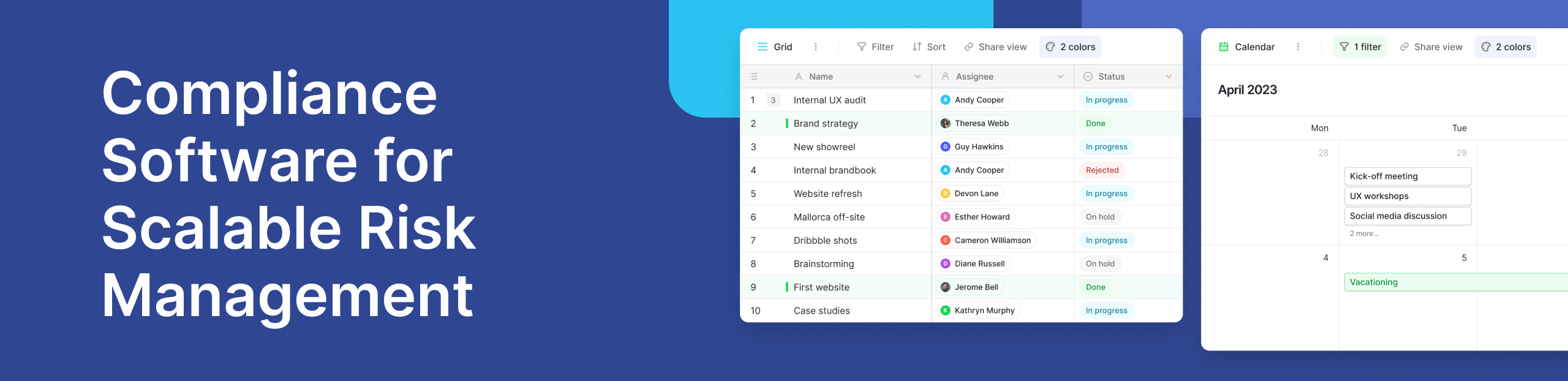
Regulatory pressure has increased across nearly every industry. What was once handled through periodic audits and manual checks now requires structured systems that operate continuously. As organisations grow, compliance becomes less about individual policies and more about coordinated execution across teams, tools, and jurisdictions.
This shift explains why many organisations now rely on purpose-built compliance software to support governance at scale. Instead of reacting to audits or regulatory changes, teams are expected to maintain visibility, traceability, and accountability as part of daily operations. Without the right foundation, managing compliance quickly becomes fragmented and inefficient.
Modern compliance is not only about meeting regulatory obligations. It is about reducing operational risk, enabling faster decision-making, and ensuring that compliance efforts do not slow the business down.
.png)
What Is Compliance Software and Why It Matters
Compliance software refers to systems designed to help organisations manage regulatory obligations, internal controls, and oversight processes in a structured way. These platforms support compliance processes by centralising policies, controls, evidence, and responsibilities so teams can work consistently and transparently.
Unlike manual approaches, software-driven compliance programs enable organisations to track requirements, assign ownership, and maintain records that stand up to audit scrutiny. This becomes critical as regulatory requirements evolve and oversight expands across regions and functions.
Well-designed regulatory compliance software also helps organisations move from reactive compliance to proactive risk management. Instead of scrambling to prepare for audits, teams can rely on continuous monitoring and structured reviews that surface issues early.
The Core Challenges of Managing Compliance at Scale
As organisations expand, compliance challenges multiply. What works for a small team often breaks down once compliance responsibilities are distributed across departments, products, or geographies.
One of the most common issues is fragmented compliance tracking. Policies may live in one system, evidence in another, and approvals in email threads. This fragmentation increases compliance risk management costs and makes it difficult to understand the current state of compliance at any given moment.
Another challenge is ownership. Compliance teams often struggle to maintain clarity over who is responsible for specific controls or regulatory obligations. Without clear accountability, issues linger and risks compound.
Managing compliance also becomes harder when reporting depends on manual updates. Leadership teams need real time insight into compliance status, but static reports cannot keep pace with operational change. This gap increases exposure and slows response times when regulations shift or incidents occur.
Capabilities Modern Compliance Management Software Must Support
Continuous Monitoring and Compliance Monitoring
Traditional compliance relied on periodic reviews. Modern organisations require continuous monitoring to identify issues as they arise. This does not mean constant manual checks. It means systems that surface changes, exceptions, and risks automatically as data evolves.
Effective compliance monitoring supports earlier intervention and reduces last-minute audit pressure.
Compliance Tracking Across Teams and Frameworks
Most organisations operate under multiple frameworks at once. A strong compliance management system must support structured compliance tracking across overlapping requirements without duplicating effort.
This includes mapping controls to multiple regulations, tracking evidence once, and maintaining a clear audit trail that compliance teams can trust.
Integrated Risk and Compliance Management
Treating risk and compliance as separate functions creates blind spots. Modern platforms support integrated risk views, allowing organisations to assess how operational risks impact compliance posture and vice versa.
This alignment is essential for prioritisation and informed decision-making at scale.
User Friendly Systems That Encourage Adoption
Compliance tools fail when they are difficult to use. A user friendly design ensures that compliance responsibilities are carried out consistently, even by non-specialists.
Flexible platforms that allow teams to model workflows without heavy configuration are more likely to be adopted and maintained over time.
Compliance Software vs Traditional GRC Tools
Legacy GRC tools were built for static environments. They often require extensive configuration, specialised training, and long implementation cycles. While powerful, they can slow compliance teams down when agility is required.
Newer software solutions focus on adaptability. Instead of hardcoding processes, they allow organisations to model compliance requirements in ways that evolve alongside regulations and internal structures.
This is where platforms like Baserow are increasingly used by compliance teams. By offering a flexible data layer that supports structured workflows, Baserow enables teams to manage compliance requirements, controls, and reviews without locking them into rigid systems. Its approach aligns with modern guidance on scalable compliance operations.
.png)
Laying the Groundwork for a Sustainable Compliance Program
A sustainable compliance program depends on more than policies. It requires systems that support visibility, accountability, and adaptation. Organisations that invest in adaptable compliance management software position themselves to respond faster to regulatory change while reducing operational friction.
Open and modular approaches are gaining attention, particularly for teams that want control over how compliance data is structured and maintained. Discussions within the Baserow community show how teams use flexible platforms to track audits, manage internal controls, and coordinate reviews across departments without introducing unnecessary complexity.
As compliance expectations continue to rise, the focus is shifting from tools that enforce rules to systems that enable collaboration and insight.
Frequently Asked Questions Answered
- What is a compliance software?
Compliance software is a system that helps organisations manage regulatory obligations, controls, evidence, and reporting in a structured and auditable way.
- What is the best compliance software?
The best option depends on regulatory scope, internal complexity, and how often requirements change. Many teams now prioritise adaptable platforms over rigid, one-size-fits-all tools.
- Which is the best software for statutory compliance?
Statutory compliance is often supported by regulatory compliance software that enables structured tracking, documentation, and review workflows across applicable laws.
- What are the tools used in compliance?
Common tools include compliance management systems, risk registers, policy management platforms, and audit tracking tools that support compliance monitoring and reporting.
- What are the 7 pillars of compliance?
They typically include leadership oversight, risk assessment, controls, monitoring, reporting, training, and continuous improvement.
- Which GRC tool is best?
Rather than a single “best” tool, organisations increasingly choose modular systems that support integrated risk and compliance without excessive rigidity.
Building Compliance That Scales With Change
Regulatory complexity is unlikely to decrease. Organisations that treat compliance as a living system rather than a static obligation are better positioned to adapt. Structured yet flexible software solutions enable compliance teams to respond to change, maintain oversight, and reduce long-term risk.
Platforms like Baserow support this approach by allowing teams to model compliance requirements, track evidence, and manage reviews without locking processes into fixed templates. Its evolution, including recent updates outlined in Baserow 2.0, reflects the growing need for adaptable governance tooling.
To explore how a flexible system can support managing compliance at scale, you can learn more through additional resources:
- Features of a compliance tracking software
- Open source software needed for compliance
- Baserow as a GRC software
If you want to see how this approach works in practice, you can request a demo or start directly by signing up.

Baserow 2.4 adds Button fields, Graph elements, workflow automation, AI provider management, improved Group By views, and 30+ more updates.

Discover how Airtable and Baserow compare in features, flexibility, speed, and scalability. Compare pricing plans and hidden costs to make an informed decision!

Explore the best open-source software alternatives to proprietary products. Discover OSS tools, licenses, and use cases with our updated directory.