
Every business, research team, and operations department relies on information to grow. Whether you’re studying customer behavior, improving internal workflows, or launching a new product, the way you collect data determines the quality of your insights. Choosing the right data collection methods is essential because the accuracy, reliability, and usability of your findings depend on it.
Organizations collect data to validate ideas, test assumptions, measure performance, and improve outcomes. When structured correctly, collected information supports stronger data analysis and ultimately informs decision making across teams.
In this guide, we’ll explore the types of data collection available, explain quantitative and qualitative approaches, compare manual and digital systems, and introduce modern tools that help streamline the entire process.
What Are Data Collection Methods?
Data collection refers to the systematic process used to gather information for analysis and evaluation. Businesses and researchers collect data to answer specific research questions, evaluate performance, and guide strategy.
There are several methods of data collection depending on the purpose and context. Some approaches are designed to measure numbers and trends, while others aim to understand behaviors, motivations, or experiences. The chosen method affects the reliability of outcomes and the efficiency of the data collection process.
Effective methods align with business objectives, available resources, and the depth of insight required. When properly executed, structured data allows teams to identify patterns, reduce uncertainty, and make evidence-based decisions.
Quantitative and Qualitative Data Explained
Understanding the difference between quantitative and qualitative data is fundamental before selecting an approach.
- Quantitative Data Collection
Quantitative and qualitative data serve different purposes. Quantitative data focuses on measurable variables — numbers, percentages, and statistics. This approach is often used when organizations want to identify trends, test hypotheses, or measure performance.
Common examples include:
- Online surveys with rating scales
- Website analytics
- Sales metrics
- Structured questionnaires
Closed questions help standardize answers, making it easier to analyze large datasets. However, including open ended questions can sometimes add context to numerical findings.
Quantitative research is particularly useful when the goal is scalability and statistical comparison.
- Qualitative Data Collection Methods
Qualitative data collection methods focus on understanding experiences, motivations, and behaviors. Instead of numbers, they produce descriptive insights.
Organizations often conduct interviews, host focus groups, or observe participants directly. A survey interview may combine structured questions with conversational follow-ups to explore deeper insights.
Qualitative research helps uncover patterns that numbers alone cannot explain. It provides context to behaviors and reveals the “why” behind the data. This approach is especially helpful when launching new products, refining services, or exploring customer feedback.
Primary vs Secondary Data Collection
Beyond quantitative and qualitative distinctions, it’s important to understand where data originates.
- Primary Data Collection Methods
Primary data collection methods involve directly gathering information from original sources. This may include surveys, interviews, forms, observations, or experiments.
Primary research gives businesses full control over the process. It allows teams to tailor questions, define metrics, and align results with specific objectives. For many organizations, structured digital forms are a cost effective way to gather targeted information quickly.
- Secondary Data Collection
Secondary data collection involves analyzing existing information that has already been gathered by another source. This could include industry reports, academic studies, government databases, or historical company records.
While secondary research can save time and resources, it may not always align perfectly with your goals. It is often best used to supplement primary research rather than replace it entirely.
Manual vs Digital Data Collection Process
The methods used to collect information have evolved significantly over time.
- Traditional Manual Methods
Historically, organizations relied on paper surveys, handwritten notes, and physical interviews. Data was manually entered into spreadsheets, increasing the risk of errors and inconsistencies.
Manual systems can work for small-scale projects but often become inefficient as operations grow.
- Digital Data Collection Tools
Modern data collection tools have transformed how organizations operate. Online forms, automated workflows, and cloud-based systems allow teams to collect and organize information in real time.
Instead of transferring paper responses into spreadsheets, digital systems capture structured inputs instantly. This improves accuracy and speeds up analysis.
Tools like Baserow allow teams to create structured online data collection forms connected directly to a database. By linking responses to organized tables, teams can centralize information, reduce duplication, and maintain consistency across departments.
Digital platforms also support collaboration, enabling multiple stakeholders to review, update, and analyze information without relying on disconnected files.
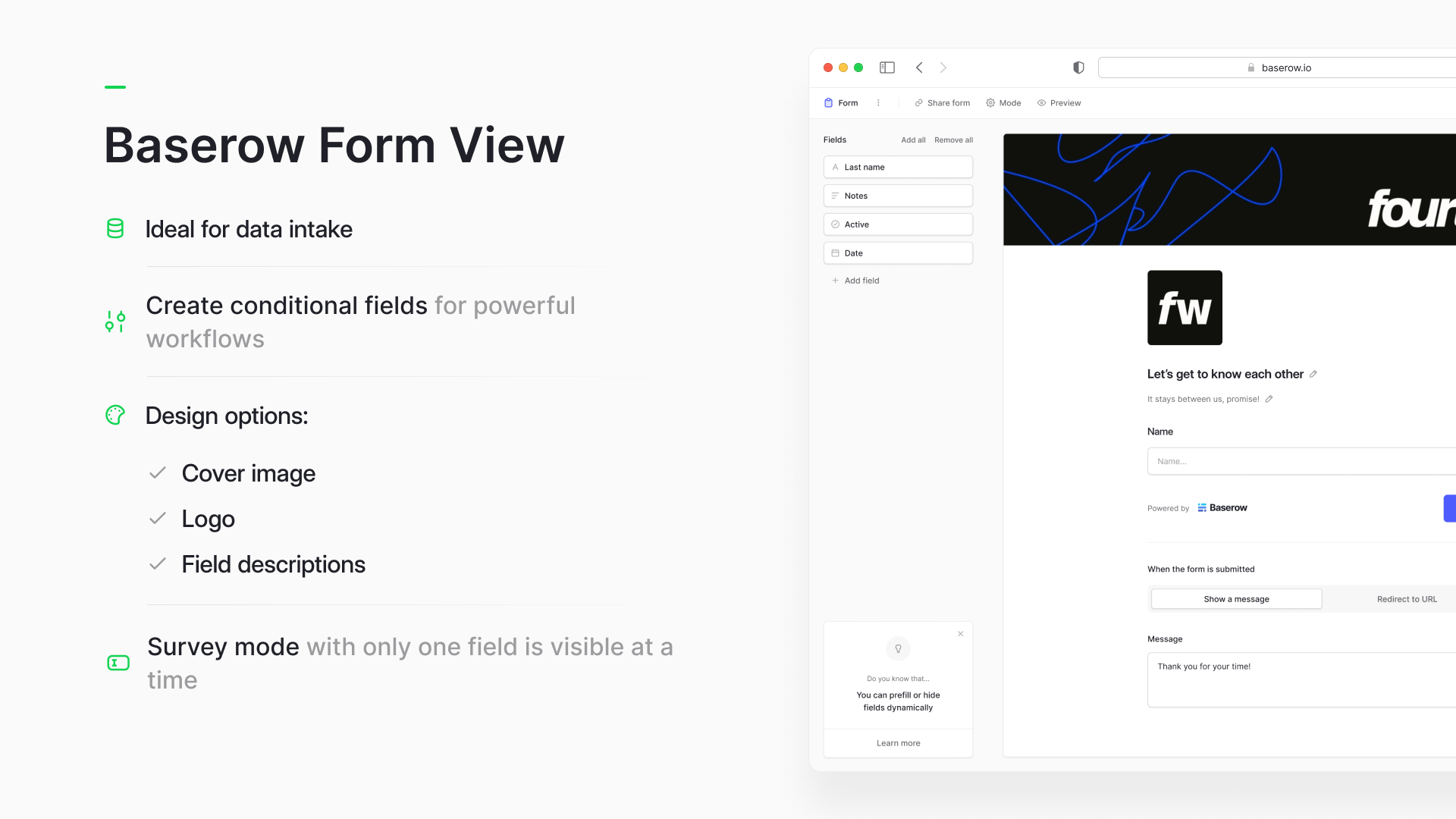
Below is an example of how a modern database-powered form interface looks in practice.
Surveys, Forms, Spreadsheets & Databases Compared
When evaluating data collection including different tools and techniques, it’s important to understand the strengths and limitations of each system.
Surveys are excellent for collecting structured responses at scale. They are commonly used for customer feedback, employee engagement, and market validation. However, survey platforms may limit flexibility when businesses require deeper operational workflows.
Forms provide structured input fields that allow teams to standardize how they gather information. Unlike static surveys, modern online forms can integrate directly with workflows, approvals, and reporting systems.
Spreadsheets are widely used because they are accessible and familiar. While useful for organizing small datasets, they can become difficult to manage as information grows. Manual updates increase the risk of version control issues and inconsistencies.
Databases, on the other hand, are designed for structured storage and scalable growth. They allow organizations to centralize records, connect tables, and maintain data integrity across departments. When forms connect directly to a database, the transition from collection to analysis becomes seamless.
For businesses aiming to scale, database-backed form builders offer greater flexibility than standalone survey tools or spreadsheets. Structured systems reduce duplication, automate validation, and simplify reporting.
You can explore how database-powered forms work in practice through Baserow’s form builder solution.
How to Choose Effective Methods for Your Business
Selecting the right approach depends on your objectives, resources, and operational complexity.
Start by defining your research questions clearly. Are you trying to measure performance, understand customer sentiment, or track operational metrics? The clarity of your goal will determine whether you need quantitative metrics, qualitative insight, or a combination of both.
Consider your budget and scalability needs. Manual approaches may seem affordable at first, but they can become costly in time and accuracy as your dataset grows. Digital tools often provide a more cost effective long-term solution.
Next, think about how the collected information will be used. If data needs to integrate with dashboards, reporting systems, or automated workflows, structured digital platforms are typically more efficient.
The final factor is workflow integration. Modern businesses rarely collect information in isolation. Data flows between teams, informs strategy, and supports reporting. A connected system ensures that once you collect data, it can move seamlessly into review and data analysis processes.
For teams seeking flexibility without heavy technical overhead, platforms like Baserow provide customizable tables, collaborative workflows, and integrated form capabilities.
Conclusion
Understanding the different approaches to collecting information helps organizations design smarter strategies. From qualitative interviews to quantitative surveys, from paper-based systems to digital databases, each method has a purpose.
The key is alignment. When collection techniques match your goals, scale with your operations, and support structured analysis, the value of your data increases dramatically.
Modern digital platforms make it easier to centralize responses, maintain accuracy, and support collaboration. Explore how Baserow simplifies digital data collection and create your own structured system today.

Baserow 2.4 adds Button fields, Graph elements, workflow automation, AI provider management, improved Group By views, and 30+ more updates.

Discover how Airtable and Baserow compare in features, flexibility, speed, and scalability. Compare pricing plans and hidden costs to make an informed decision!

Explore the best open-source software alternatives to proprietary products. Discover OSS tools, licenses, and use cases with our updated directory.