
TL;DR
- Open source means greater control: Businesses can inspect, adapt, and extend software while gaining more choice over how and where it runs.
- Independence supports long-term flexibility: Unlike proprietary software, open-source solutions can reduce vendor dependence and give teams more freedom as their needs change.
- Baserow puts these benefits into practice: Teams can choose cloud or self-hosting, scale on their own infrastructure, and extend Baserow through code, contributions, and plugins.
Businesses rely on digital tools to manage customer records, projects, operations, and internal processes. But choosing a tool is not only about its features. It is also about who controls the technology and what happens when your needs change.
This is why more teams are exploring open source software. Instead of depending fully on one vendor, organizations can gain more control over deployment, customization, and their long-term technology choices.
The difference becomes clearer when comparing an independent platform such as Baserow with a proprietary service such as Airtable.
What Does Open Source Actually Mean?
The term open source describes software whose source code is available under a license that gives users specific rights to view, use, modify, or distribute it.
The Open Source Initiative’s Open Source Definition explains the criteria a license must meet to qualify as open source. This makes open source software OSS different from simply making code publicly visible.
An open source program can also benefit from contributions beyond the company that originally created it. Developers can inspect the code, suggest improvements, report problems, or create their own extensions. Healthy open source communities can therefore play an important role in open source software development.
There are many well-known examples. Linux provides an open source operating system, while the GNU Image Manipulation Program (GIMP) provides tools for editing images. Thousands of other open source projects support databases, developer tools, business applications, and infrastructure.
However, open source does not automatically mean free, secure, or suitable for every business. The license, maintenance model, active project development, and strength of the community all matter.
Open Source vs Closed Source Software
The main difference is who can access and modify the underlying code.
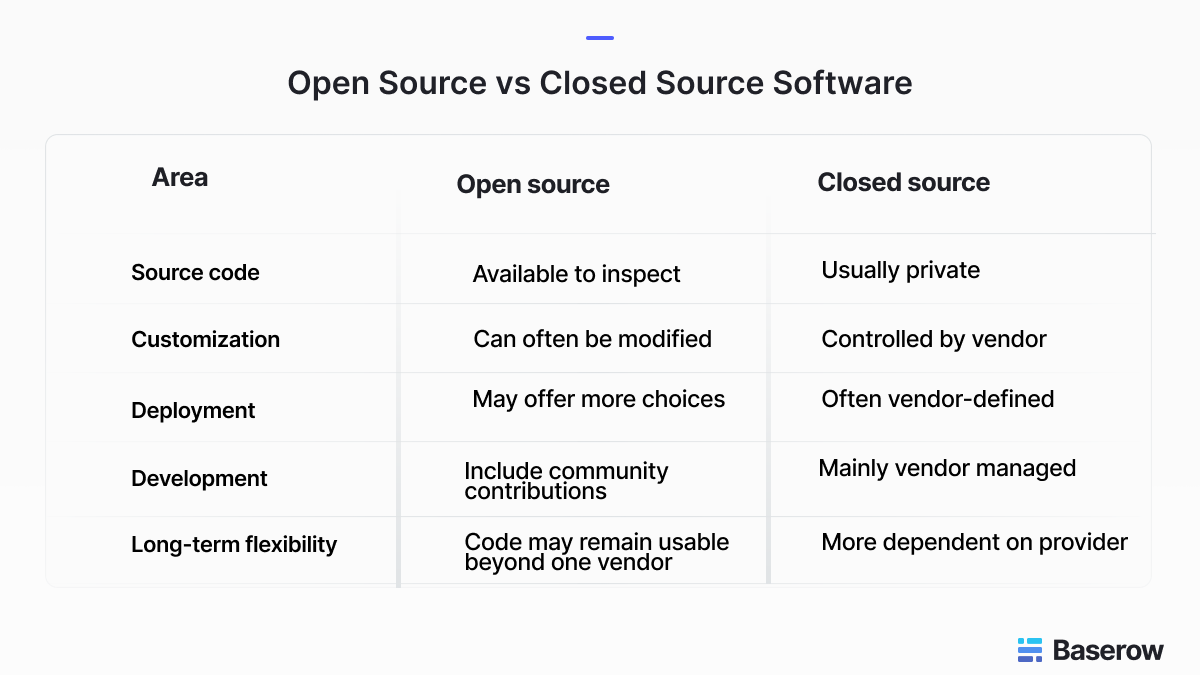
With proprietary software, customers usually purchase access to a finished service rather than the code behind it. This proprietary or closed source model can be convenient because the provider handles much of the infrastructure and product development.
The trade-off is greater dependence on that provider. Pricing, product direction, hosting options, limits, and discontinued features can be outside the customer’s control.
Open source solutions offer another model. Access to the code can give organizations more options when their technical or business requirements change.
For a deeper look at these differences, see Baserow’s guide to the benefits of open-source software.
Why Do Businesses Choose Open Source Solutions?
There is no single reason to choose open source. For businesses, the value often comes from having more choices over time.
- More control and transparency
Access to the code makes it possible to understand how software works and, where the license permits, change it. Technical teams do not always have to wait for a vendor to add a feature they need.
This can also help organizations that want greater control over where their business data and applications run. Baserow, for example, provides both its hosted service and a self-hosted deployment.
- Less dependence on one provider
A closed platform can work well until business requirements change. A company may later need different hosting, deeper integrations, custom functionality, or stronger control over its infrastructure.
Independent open source projects provide another path. Access to the underlying technology can reduce some forms of vendor lock-in and give teams more options for the long term.
This does not remove the need to assess the provider. Businesses should still look at how actively a project is maintained, its documentation, security practices, community, and commercial support.
- A community beyond the vendor
One important feature of open source is that product knowledge does not have to exist only inside one company.
The Baserow community, for example, includes discussions about self-hosting, integrations, API use, troubleshooting, feature requests, and ways teams are adapting Baserow to their own workflows. These conversations give potential users a view of practical questions that arise outside product documentation.
For organizations comparing platforms, an active community can therefore be another useful signal alongside features and pricing.
Understanding Open Source Software Licenses
Access to source code does not mean there are no rules. Open source software licenses explain what users are allowed to do with the code and what conditions they must follow.
Permissive licenses, such as the MIT license, generally provide broad rights to use, modify, and redistribute software while keeping certain notices. The Apache License is another permissive option.
Copyleft licenses take a different approach. The GNU General Public License is a well-known example. Depending on how software is distributed, these licenses can require derivative works to remain available under compatible terms. The GNU Project’s explanation of copyleft provides more detail on the principle.
Understanding these differences matters when evaluating open source code for commercial use. Teams should check the actual license rather than assuming all open source software licenses provide identical rights.
Baserow’s core repository uses the MIT license, giving developers considerable freedom to work with its open-source code. This approach supports the wider goal behind the Baserow product: giving teams a flexible data platform without making them completely dependent on a closed ecosystem.
Why Choose Baserow Over Airtable?
Airtable and Baserow both help teams organize data and build workflows. The key difference is how much control users have over the platform. Airtable is proprietary software, while Baserow has an open-source core and supports self-hosting. This creates several practical advantages:
- Scale on your own infrastructure: Teams can start with Baserow Cloud and later export their workspace to a self-hosted instance. Self-hosting has no Baserow-imposed row or storage limits, so infrastructure can grow with their needs.
- Stay independent: Baserow has been forked more than 700 times, showing how its code can become the foundation for other projects. Blaze is one example built on Baserow. Users can also keep self-hosting the platform rather than being fully dependent on Baserow’s business model.
- Build what you need: Developers can contribute code or create plugins instead of always waiting for functionality to reach the core product. The Baserow Color Field plugin, for example, adds color picking, sorting, filtering, and API access.
Baserow also combines databases with applications, automations, APIs, AI features, and real-time collaboration. This makes the open-source model useful beyond access to code: teams gain more freedom to adapt their platform as their requirements change.
For organizations with stricter requirements around infrastructure and data control, open-source software for compliance explains why this flexibility can be especially valuable.
A Practical Baserow Use Case
Consider an operations team using Airtable to track equipment, maintenance requests, and approvals. As the company grows, it may need to host this information within infrastructure it controls. It may also need custom workflows that connect with internal systems.
Instead of rebuilding the process from scratch, the team could use Baserow to create linked tables, forms, applications, and automated steps around the same workflow.
Because Baserow is independent and open source, technical teams also have access to the underlying platform. This gives them another option when standard features do not meet a specific business need.
Teams interested in other ways to use this model can explore examples of open-source alternatives and open-source project management software.
Frequently Asked Questions
- What is open-source software in simple terms?
It is software with source code that people can access under an approved license. Depending on that license, users may be able to study, modify, or redistribute the code. This gives users more visibility than most closed source software provides.
- Is open-source software free to use?
Not always. “Open source” describes the rights provided by the software license, not its price. A company can charge for hosting, support, enterprise features, or other services while maintaining an open-source project.
- Is open-source software safe for businesses?
It can be, but open source alone does not make a product secure. Businesses should review security practices, updates, access controls, project activity, hosting options, and support. The same careful review should be applied to proprietary products.
- Why do companies choose open-source software?
Common reasons include greater control, flexible deployment, customization, transparency, and less dependence on a single vendor. The right choice still depends on the company’s technical skills, budget, security needs, and long-term plans.
- What are the main types of open-source licenses?
Two common groups are permissive and copyleft licenses. MIT and Apache 2.0 licenses are examples of permissive approaches. Copyleft licenses, such as the GNU General Public License, place different conditions on how modified software can be distributed.
- Is Baserow an open-source alternative to Airtable?
Yes. Both platforms help teams organize structured data and create business workflows. The main difference is that Baserow provides an open-source core and a self-hosting option, while Airtable follows a proprietary model. You can read complete comparison here.
Choosing Software You Can Control
Choosing between open and proprietary technology is about more than a feature list. Businesses should consider where their data will live, how easily the platform can be extended, what its license permits, and whether the tool can adapt to future requirements.
An independent platform can be valuable when control and flexibility are long-term priorities. Baserow combines that approach with no-code databases, applications, automations, APIs, and collaboration tools.
If your team wants more control over its data platform without giving up an easy-to-use interface, start using Baserow and explore what you can build.

Baserow 2.4 adds Button fields, Graph elements, workflow automation, AI provider management, improved Group By views, and 30+ more updates.

Discover how Airtable and Baserow compare in features, flexibility, speed, and scalability. Compare pricing plans and hidden costs to make an informed decision!

Explore the best open-source software alternatives to proprietary products. Discover OSS tools, licenses, and use cases with our updated directory.