
A single source of truth is one trusted place where a team stores, manages, and accesses accurate business data. Instead of spreading information across spreadsheets, emails, dashboards, and disconnected tools, teams use one reliable source of information to make decisions and run daily work.
For growing companies, this matters more than ever. When data lives in multiple systems, team members often waste time checking which version is correct. Sales might use one record, operations another, and finance a third. Over time, those gaps create data silos, duplicate work, reporting errors, and slower business decisions.
In this guide, we’ll explain what a single source of truth means, why it matters, common examples, and how to build one with structured data and tools like Baserow.
.png)
What is a single source of truth?
A single source of truth, often called source of truth SSOT, is a centralized and trusted system where key information is stored and maintained. The goal is to make sure every team works from the same accurate data.
This does not always mean every piece of information must live in one tool. In many companies, different sources of data still exist. A CRM may store customer data, a billing system may store payment data, and a data warehouse may support reporting.
The important part is that each type of information has one trusted place of record. For example, customer relationship data may belong in the CRM, product usage data may belong in analytics software, and operational data may belong in an internal database.
A strong single source helps teams know where to find the latest version of each record, who owns it, and how it should be updated.
Why companies need a single source
Companies need a single source because scattered information creates confusion. When the same data appears in multiple sources, it becomes difficult to know which version is correct.
For example, one spreadsheet may list a customer as active, while a CRM says they are inactive. A project tracker may show a task as complete, while an operations dashboard shows it as delayed. These small inconsistencies can lead to poor decisions.
A single source helps teams:
- Reduce duplicate records
- Improve data accuracy
- Break down data silos
- Keep team members aligned
- Make faster business decisions
- Improve reporting and visibility
- Manage business data with more control
- Reduce manual updates across multiple systems
When teams trust their data, they can work faster and make more data driven decisions.
Common examples of a single source of truth
A single source of truth can look different depending on the company and the type of data being managed.
For sales teams, a CRM is often the trusted source for leads, accounts, opportunities, and customer relationship history.
For finance teams, accounting software may be the source for invoices, payments, expenses, and revenue records.
For operations teams, an internal database can become the trusted place for project status, inventory, asset tracking, approvals, or supplier information.
For leadership teams, a data warehouse may combine information from multiple systems to support dashboards and reporting.
For support teams, a helpdesk or customer database may store tickets, issues, and customer data.
The key is not the tool itself. The key is knowing where each important piece of information should live, who maintains it, and how other teams access it.
What happens without a single source?
Without a clear source of truth, teams often create their own versions of the same information. This usually happens slowly.
A sales manager exports CRM data into a spreadsheet. Operations creates another tracker. Finance adjusts numbers in a separate file. Marketing builds its own campaign reporting table. Soon, no one knows which version is correct.
This creates several problems:
- Teams make decisions based on outdated data
- Reports do not match across departments
- People spend time reconciling records manually
- Important updates get lost between tools
- Leaders lose confidence in the numbers
- Employees duplicate work without realizing it
The result is not only messy data. It is slower execution and weaker decision-making.
Single source of truth vs data warehouse
A data warehouse can support a single source of truth, but the two are not exactly the same. It can also support master data management (MDM). It helps teams define key records across the business. It also helps teams maintain and govern these records.
A data warehouse collects data from multiple systems and organizes it for analyzing, reporting, and business intelligence. Data teams, analysts, and leadership often use it to understand performance across the company.
A single source of truth is broader. It refers to the trusted place where someone maintains specific information. In some cases, that place may be a data warehouse. In other cases, it may be a CRM, an ERP, a no-code database, or an internal operations tool. Read more about databases and data warehouse here.
For example, a data warehouse may be the best place for company-wide reporting. But a CRM may still be the source of truth for customer relationship records. An operations database may be the source of truth for project status or inventory.
The best approach depends on the type of data and how teams use it. Read more about the best practices to handle your data.
How to build a single source of truth
Creating a single source of truth starts with clarity. Before choosing tools, teams need to define what information matters and where it should live.
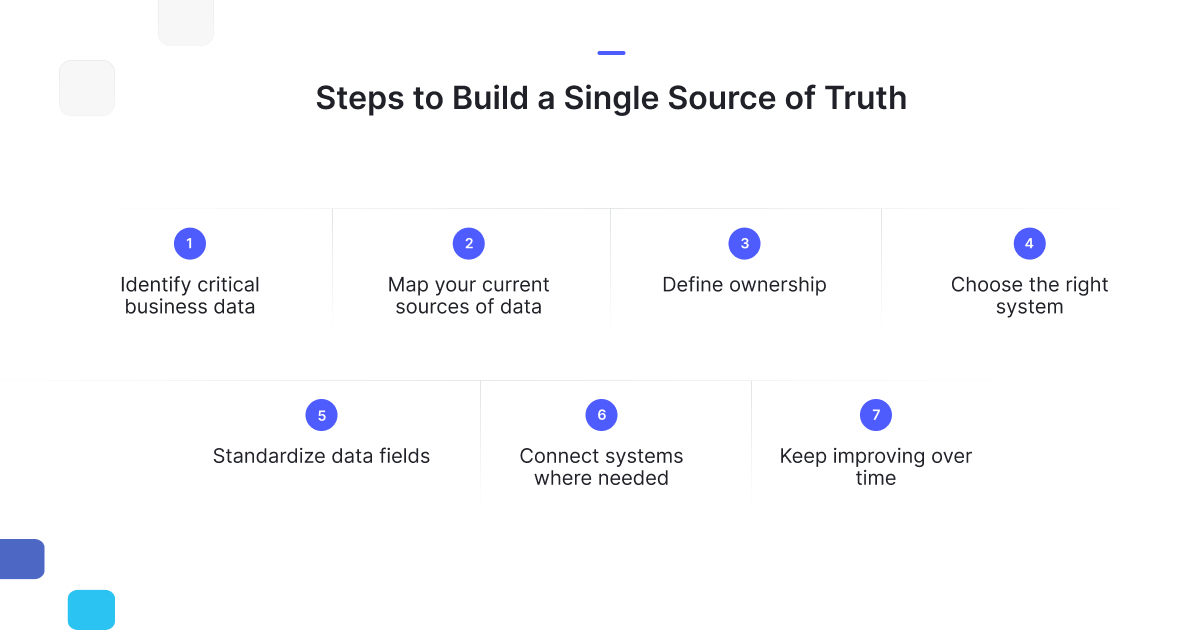
1. Identify critical business data
Start by listing the data your teams rely on every day. This may include customer data, project data, financial data, product data, employee data, or operational data.
Focus on the information that affects business decisions, workflows, reporting, and customer experience.
2. Map your current sources of data
Next, identify where that data currently lives. Most companies find information spread across multiple systems, spreadsheets, inboxes, dashboards, and management systems.
This step helps reveal duplicate records, unclear ownership, and data silos.
3. Define ownership
Every important dataset needs an owner. Someone should be responsible for keeping records accurate, deciding how updates happen, and making sure teams follow the same process.
Without ownership, even the best system becomes messy.
4. Choose the right system
The right system depends on the type of data. A CRM may work for customer relationship data. A data warehouse may work for reporting. A no-code database may work well for operational data, internal workflows, and team processes.
This is where Baserow can fit naturally. Baserow helps teams create structured databases, views, forms, workflows, and internal tools without starting from scratch. Instead of managing business data across scattered spreadsheets, teams can use Baserow to create one organized, collaborative source of information.
Baserow also supports permissions, integrations, APIs, webhooks, and self-hosting, which makes it useful for teams that need more control over their data and infrastructure.
5. Standardize data fields
A single source only works when data is consistent. Define the fields, naming rules, statuses, categories, and required information.
For example, if one team uses “Active” and another uses “Live,” reports may become unreliable. Standard fields help keep every piece of information easier to understand and compare.
6. Connect systems where needed
A single source does not mean every system disappears. Many teams still need multiple systems for different workflows.
The goal is to connect tools so updates flow correctly. Integrations, APIs, and automations can help keep records synced in real time and reduce manual copying.
7. Keep improving over time
A source of truth is not a one-time project. As teams grow, processes change. Review your system regularly, remove outdated fields, improve permissions, and make sure team members still trust the data.
Final thoughts
A single source of truth helps teams work from accurate, trusted, and consistent information. It reduces data silos, improves reporting, and helps companies make better business decisions.
The right setup depends on your data, workflows, and team structure. Some companies need a CRM, some need a data warehouse, and others need a flexible internal database.
For teams that want to organize operational data, replace scattered spreadsheets, and create structured workflows, Baserow is a strong option. It gives teams a practical way to build a trusted source of information without relying on heavy custom development.
👉 Sign up for free today and explore how Baserow can help you organize, analyze, and scale your data operations.

Baserow 2.4 adds Button fields, Graph elements, workflow automation, AI provider management, improved Group By views, and 30+ more updates.

Discover how Airtable and Baserow compare in features, flexibility, speed, and scalability. Compare pricing plans and hidden costs to make an informed decision!

Explore the best open-source software alternatives to proprietary products. Discover OSS tools, licenses, and use cases with our updated directory.