
Businesses create more data than ever before. Customer records, project updates, financial reports, operational metrics, and support requests all produce valuable information. The real challenge is not collecting that information. It is organizing it, protecting it, and turning it into better business decisions.
Artificial intelligence is changing how organizations manage data. Instead of relying on manual processes or disconnected spreadsheets, businesses now use AI to automate repetitive work, improve data accuracy, and uncover insights more quickly. AI does not replace employees. It supports them by reducing routine tasks so they can focus on solving problems and making informed decisions.
As AI becomes part of everyday operations, organizations also need platforms that support collaboration without compromising security. Solutions like Baserow combine structured databases, AI-powered features, and collaborative workflows in one place. This allows teams to manage information more efficiently while maintaining control over their data.
In this guide, you’ll learn what AI means for modern data management, how it improves business processes, the challenges organizations should prepare for, and practical ways to build a reliable, AI-ready data strategy.
What Is AI and Data Management?
AI and Data Management refers to using artificial intelligence to improve how organizations collect, organize, secure, analyze, and maintain information throughout its lifecycle. Traditional systems often depend on manual updates and repetitive administrative work, while AI helps automate many of these activities and recommends smarter ways to work with information.
At its core, modern data management processes involve collecting information, storing it securely, maintaining accuracy, and making it available to the right people. AI strengthens each of these activities by identifying patterns, detecting inconsistencies, and supporting better decision-making.
The typical stages of the data management lifecycle include:
- Collecting information from multiple sources
- Organizing and storing it consistently
- Maintaining accuracy over time
- Protecting sensitive information
- Analyzing information for insights
- Archiving or removing outdated records
Rather than replacing existing systems, AI often works alongside them. For example, AI can automatically categorize incoming records, suggest relationships between datasets, or recommend workflow improvements based on historical activity. According to the NIST AI Risk Management Framework, organizations should combine AI innovation with governance and oversight to ensure trustworthy outcomes.
Many businesses are now adopting AI-enabled platforms that allow both technical and non-technical users to work with structured information more efficiently. This shift is making advanced capabilities accessible without requiring specialized data science expertise.
Why Traditional Data Management Is No Longer Enough
For many organizations, business information is spread across spreadsheets, email inboxes, cloud storage, and different applications. As the business grows, managing information across so many systems becomes more difficult.
Common challenges include:
- Duplicate records across departments
- Inconsistent reporting
- Manual data entry
- Limited collaboration
- Delays in finding accurate information
- Difficulty maintaining a single source of truth
These issues affect more than productivity. They can also increase compliance risks, create reporting errors, and slow down business decisions.
AI helps solve many of these challenges. It improves data accessibility by making information easier to find and share across teams. It also reduces repetitive administrative work by organizing records, recommending updates, and identifying inconsistencies before they become bigger problems. With workflow automation, employees spend less time maintaining information and more time using it.
Another major benefit is data integration. Instead of copying information between multiple systems, businesses can connect their applications so information moves automatically. This reduces manual work, improves reporting, and gives employees access to the latest information in real time.
For example, an operations team may manage inventory, maintenance requests, and supplier records in separate spreadsheets. By moving everything into one collaborative platform, the team can reduce duplicate work and improve visibility across departments.
Businesses looking for a flexible database often choose open platforms that can grow with their needs. Our guide on open source databases explains why many organizations are adopting customizable platforms that support collaboration and long-term scalability.
Interest in AI-powered workflows is also growing within the Baserow Community. Community members regularly discuss automations, integrations, workflow improvements, and practical ways to manage operational data more efficiently. These real-world conversations show how organizations are using modern AI capabilities to improve everyday work.
How AI Improves Every Stage of Data Management
Artificial intelligence doesn’t simply analyze information—it enhances every stage of managing it. From the moment new information enters a system until it is archived, AI can reduce manual effort while improving consistency and reliability.
- Smarter Data Collection
Every successful data strategy begins with accurate information. AI improves data discovery by helping organizations identify valuable information from forms, connected applications, documents, and external systems.
Instead of requiring employees to manually categorize every record, intelligent systems can perform data classification automatically. For example, customer requests can be grouped by priority, invoices can be identified by document type, and support tickets can be routed to the appropriate team without human intervention.
This reduces administrative work while improving consistency across large datasets.
- Better Data Preparation
Raw information often includes duplicate records, inconsistent formatting, and missing values. Before organizations can use this information effectively, they need to clean and organize it.
AI makes data cleansing faster and more accurate. It can identify duplicate entries, correct formatting issues, flag missing values, and recommend consistent data structures. This reduces manual work and helps teams prepare reliable information for reporting and decision-making.
The result is better data quality and less time spent cleaning spreadsheets by hand. Employees can focus on analyzing information instead of fixing errors.
Many modern platforms now include these AI capabilities as part of everyday workflows. For example, Baserow’s recent AI features, including Kuma AI and AI-assisted field generation, help users organize information, build formulas, and structure databases more efficiently. This makes it easier for both technical and non-technical users to work with data confidently.
- Smarter Data Organization and Governance
Collecting clean information is only the first step. Organizations also need a clear structure so employees can quickly find what they need while keeping confidential records protected.
AI helps organize information in several ways. It groups related records, recommends connections between datasets, and identifies missing links. Instead of searching through multiple spreadsheets or applications, teams can work from one centralized system. This makes information easier to manage and keep up to date.
Organizations also need to control who can view or edit information. Strong access control ensures that only authorized users can update or access business-critical records. This is especially important when managing sensitive data, including customer records, financial information, employee details, and operational reports.
AI-powered search also makes everyday work easier. Employees no longer need to remember where information is stored. They can search using natural language and quickly find relevant results. This saves time and helps teams make faster, more confident decisions.
Platforms like Baserow bring these capabilities together in one workspace. Features such as Kuma AI, Global Search, and the Automations Builder help teams organize information, build workflows, and find the right records without switching between multiple tools.
- Turning Data Into Better Decisions
Well-organized information helps teams make better decisions. This is one of the biggest benefits of AI.
Instead of building reports manually, AI improves data analysis by finding trends, spotting unusual activity, and highlighting useful insights. This helps teams make faster and more informed decisions.
For example, sales teams can identify top-performing products, while operations teams can spot recurring equipment issues before they become bigger problems. Finance and HR teams can also use AI to improve planning.
Modern AI models support forecasting by comparing past and current business data. Human judgment is still important, but AI helps teams respond more quickly to change.
Balancing AI Innovation with Security and Compliance
As businesses use more AI, protecting information becomes even more important. Automation can improve efficiency, but it should never reduce trust or security.
Every organization should have clear rules for how information is collected, stored, shared, and deleted. Good governance supports both data security and security and compliance. It also helps AI systems work with accurate and reliable information.
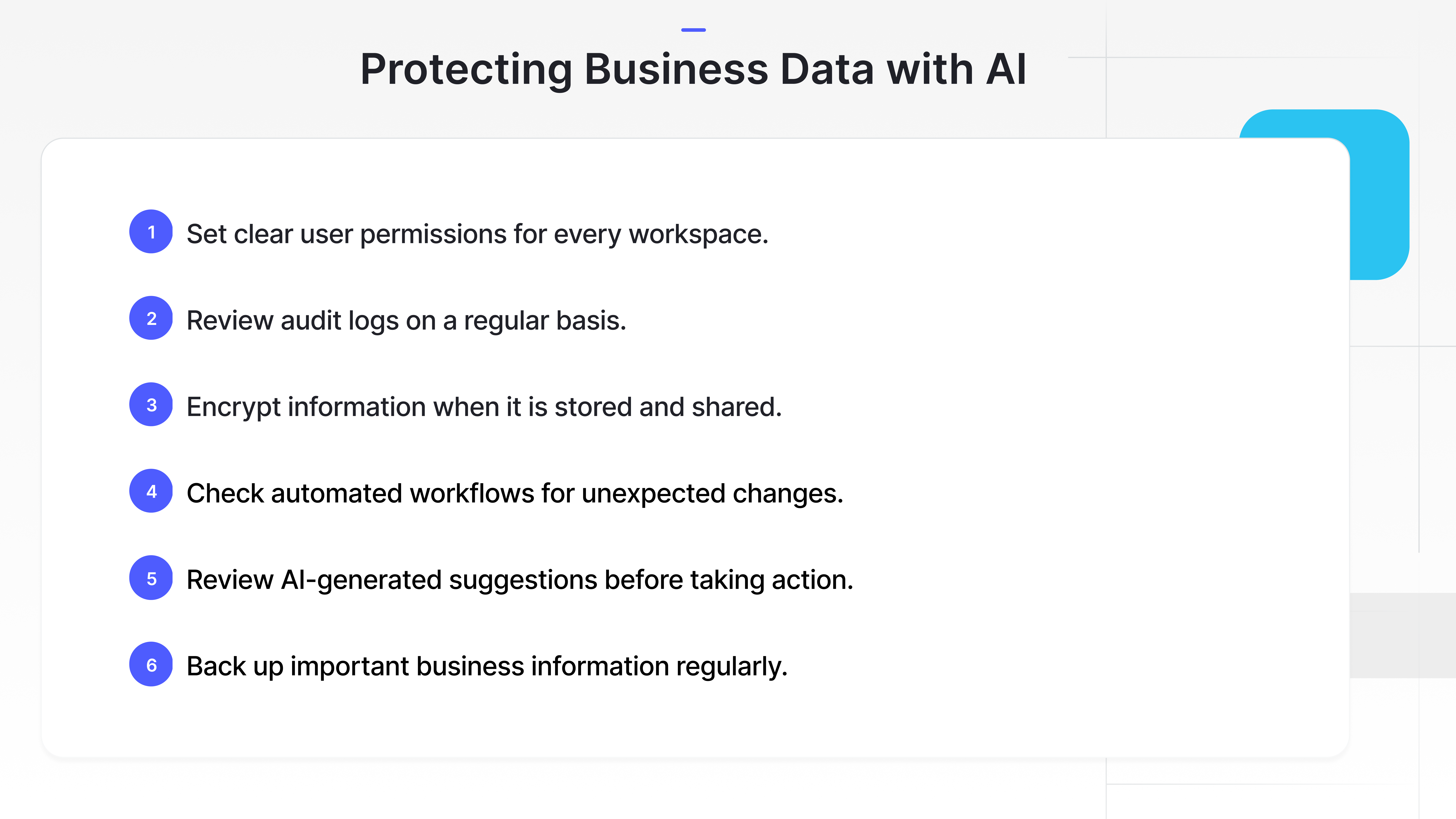
Technology alone is not enough. Employees also need to understand how AI is used and when human review is required. This is especially important for financial, legal, and customer information.
Real-World Use Case: Modernizing Operations with AI
Imagine a manufacturing company that manages production schedules, equipment maintenance, supplier records, and quality inspections in separate spreadsheets. As the business grows, teams face duplicate work, reporting delays, and inconsistent information.
By moving to Baserow, the company brings all operational data into one shared workspace. Every department works from the same source of truth, making collaboration faster and more reliable.
The Automations Builder sends maintenance reminders, routes quality issues to the right team, and automates approval workflows. Kuma AI helps organize datasets, generate formulas, and simplify everyday database tasks.
Managers can quickly find information with Global Search, while role-based permissions keep operational records secure.
The result is less manual work, better collaboration, and more time to focus on improving the business. To learn more about similar solutions, explore our guide to AI database tools, which explains how modern platforms support smarter data workflows.
Best Practices for Building an AI-Ready Data Strategy
Organizations don’t need to rebuild everything overnight to benefit from AI. Small improvements can create a strong foundation for future innovation.
Some practical best practices include:
- Build a single source of truth instead of maintaining duplicate records.
- Standardize naming conventions and database structures.
- Clean information regularly to maintain accuracy.
- Adopt AI-driven automation for repetitive administrative tasks while maintaining human oversight.
- Apply role-based permissions to protect confidential information.
- Review AI-generated recommendations before acting on them.
- Connect business systems to reduce manual updates.
- Encourage teams to document workflows for consistency.
As AI becomes part of everyday business operations, collaboration becomes just as important as technology. Teams using structured workflows and shared information often deliver projects more efficiently. Our guide to project management tools explores how collaborative platforms support modern business operations alongside AI-powered workflows.
Frequently Asked Questions
- What is the difference between AI data management and traditional data management?
Traditional data management relies heavily on manual processes for organizing and maintaining information. AI-powered data management automates repetitive tasks, improves accuracy, identifies patterns, and helps organizations make faster, more informed decisions while still keeping people in control.
- How does AI improve data quality?
AI improves data quality by identifying duplicate records, detecting missing information, recommending standardized formats, and continuously monitoring datasets for inconsistencies. This reduces manual cleanup and improves reporting accuracy.
- Can AI automate data management processes safely?
Yes, when implemented responsibly. Organizations should combine automation with governance, user permissions, audit trails, and regular human review to ensure AI supports business decisions without introducing unnecessary risks.
- Which industries benefit most from AI-powered data management?
Nearly every industry can benefit, including manufacturing, healthcare, education, finance, logistics, retail, and professional services. Any organization that manages large volumes of information can improve efficiency through AI-assisted workflows.
- How can small businesses start using AI for data management?
Small businesses should begin by organizing information in a centralized platform, cleaning existing records, and automating simple repetitive tasks. As their data becomes more structured, they can gradually introduce AI features for search, reporting, and workflow automation.
- Does AI replace human decision-making?
No. AI supports people by processing information faster and identifying useful insights, but important business decisions still require human judgment, context, and oversight.
Conclusion
AI is changing how organizations collect, organize, protect, and use information. It reduces repetitive work, improves data accuracy, and gives employees more time to focus on important decisions.
To get the best results, businesses need more than AI tools. They also need well-organized data, clear governance, secure collaboration, and reliable workflows. Together, these create a strong foundation for growth and better decision-making.
Platforms like Baserow combine structured databases, AI-powered features, workflow automation, and collaborative workspaces in one flexible platform. This helps teams manage projects, operations, and business data more efficiently.
Ready to improve your data workflows? Create a free Baserow account and see how structured data and AI-powered automation can help your team work smarter.

Baserow 2.4 adds Button fields, Graph elements, workflow automation, AI provider management, improved Group By views, and 30+ more updates.

Discover how Airtable and Baserow compare in features, flexibility, speed, and scalability. Compare pricing plans and hidden costs to make an informed decision!

Explore the best open-source software alternatives to proprietary products. Discover OSS tools, licenses, and use cases with our updated directory.