
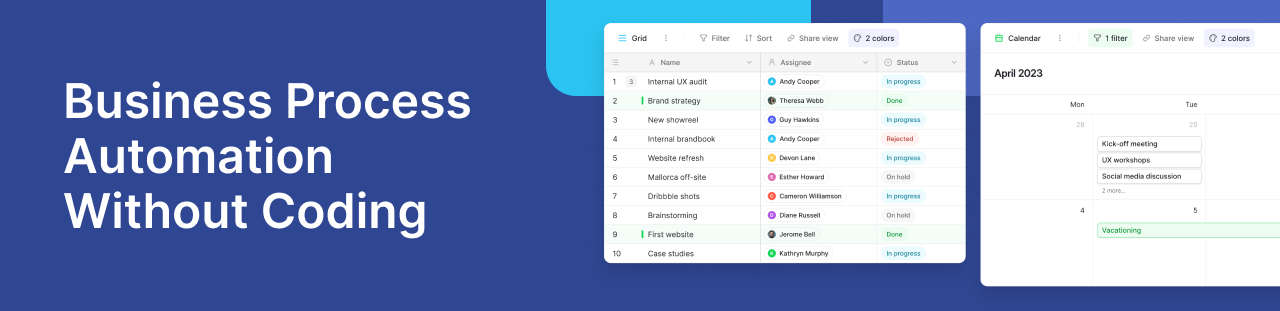
Business process automation is the use of software to automate repeatable business tasks, reduce manual work, and help teams move information through a process with less manual intervention. It can support approvals, data entry, task routing, customer updates, purchase orders, and other recurring workflows.
For many teams, the challenge is not only choosing automation technologies. It is first defining the process, organizing the data, and creating a system that non-technical team members can actually use.
Done well, automation helps teams reduce delays, improve visibility, and make daily work more consistent without relying on custom software for every process.
What is Business Process Automation?
Business process automation means using software to automate repeatable processes across a team or company. It helps move tasks, data, approvals, and updates through a defined workflow with less manual work.
Business process automation definition: Business process automation is the use of software to complete or coordinate recurring business tasks with less manual work, fewer errors, and better process visibility.
BPA can apply to operations, HR, finance, sales, IT, customer support, compliance, and administration. Examples include routing an approval request, assigning a task, updating a record, sending a notification, or collecting information through a form.
The most successful automation projects start with a clearly defined process. If the workflow is unclear, automation can make confusion happen faster. Before automating processes, teams need to understand the steps, owners, inputs, approvals, and outcomes.
%20(1).png)
Why Business Process Automation Matters
Manual processes are often slow, repetitive, and difficult to track. Work gets spread across spreadsheets, emails, chat messages, and disconnected tools. When this happens, teams lose visibility and spend too much time asking for updates.
Automation helps teams improve business operations by reducing repetitive tasks and making work easier to follow.
A good automation setup can help teams:
- Reduce costs by cutting manual follow-up and rework
- Save time on time consuming tasks
- Reduce human error in repeated work
- Improve status tracking in real time
- Standardize handoffs across teams
- Make approvals easier to manage
- Keep process data in one structured place
Automation is not only about speed. It also gives teams more control, visibility, and consistency. When a process is structured, owners know what to do next, managers can see what is blocked, and teams can make better decisions.
Business Process Automation Examples
Business process automation can support many common workflows. Here are practical examples for business teams.
- Purchase order approvals
Purchase orders often involve several steps: request intake, budget validation, manager approval, finance review, vendor confirmation, and final record keeping.
Automation can collect the request through a form, route it to the right approver, update the status, notify finance, and store the final record. This reduces back-and-forth and makes the approval trail easier to review.
- Employee onboarding
Onboarding includes tasks such as account setup, document collection, equipment requests, training checklists, policy reviews, and manager approvals.
Automation can assign tasks to HR, IT, and managers as soon as a new hire is added. It can also track completion status so nothing gets missed before the employee starts.
- Customer support handoffs
Support teams often need to categorize requests, assign owners, escalate urgent issues, and track follow-up actions.
Automation can route tickets based on issue type, priority, customer segment, or severity. It can also notify the right team when a response is overdue.
- Invoice or expense approvals
Finance teams can automate invoice intake, validation, approval routing, and payment status updates.
For example, an employee submits an expense form. The system checks required fields, sends the request to the manager, updates the approval status, and notifies finance when it is ready for review.
- Data entry and record updates
Data entry is one of the clearest automation opportunities. Instead of copying information between spreadsheets and tools, teams can collect data through forms and update structured records automatically.
This reduces duplicate entry and makes reporting more reliable.
- Content or project workflows
Marketing, operations, and project teams can automate draft reviews, approvals, due dates, task assignments, and publishing status.
A workflow can move a project from “briefed” to “in review” to “approved” without relying on manual status updates in a spreadsheet.
Which Business Processes should you Automate First?
Not every process should be automated immediately. Start with workflows that are repeated often and easy to define.
Good candidates for automation are processes that are:
- Repeated frequently
- Rule-based
- Time consuming
- Dependent on approvals or handoffs
- Prone to errors
- Stuck in spreadsheets or email threads
- Important for reporting or compliance
- Easy to break into clear steps
Before choosing a bpa tool, map the workflow from start to finish. Identify who owns each step, what decisions need to happen, what data moves through the process, and where delays usually occur.
This prevents teams from automating a messy process before they understand it.
Business Process Automation vs Workflow Automation vs RPA
Business process automation, workflow automation, robotic process automation rpa, and intelligent automation are related, but they are not the same.
Business process automation focuses on improving an entire process from start to finish. It coordinates multiple steps, people, tools, and records across a broader workflow. A purchase order approval process is a good example because it may include request intake, budget checks, manager approval, finance review, vendor updates, and final record storage.
Workflow automation focuses on moving tasks, information, or approvals between specific steps. For example, it can route a draft to a reviewer, assign a task to the next owner, or notify a manager when an approval is needed.
Robotic process automation rpa is often used to mimic repetitive actions across software interfaces. For example, it may copy data from one system to another when no direct integration exists.
Intelligent automation may combine automation with artificial intelligence ai and machine learning. This can help teams classify requests, summarize text, detect patterns, or recommend the next action.
In simple terms: BPA improves the full process, workflow automation moves work between steps, RPA repeats rule-based actions, and intelligent automation adds AI to support decisions or recommendations.
How to Automate Business Processes without Coding
Teams do not need to start with a large custom software project. Many processes can be automated with no-code or low-code bpa solutions.
A practical approach looks like this:
- Identify one process with clear business value.
- Map each step from start to finish.
- Define roles, responsibilities, and approval points.
- Identify the data needed at each step.
- Replace scattered spreadsheets with structured records.
- Choose a no-code or low-code bpa tool.
- Create forms, views, statuses, and notifications.
- Test the process with real team members.
- Improve the workflow over time.
No-code tools are useful because business teams can adapt workflows without waiting for every change to become a development project. This is especially valuable when processes change often or when teams need quick improvements.
What to Look for in Business Process Automation Software
The best bpa software is not only the tool that triggers actions. It is the system that keeps process data clean, structured, and usable.
When evaluating bpa solutions, look for software that supports:
- Structured data
- Forms for intake
- Workflow views
- Permissions and roles
- Approval tracking
- Status updates
- Automation rules
- Integrations
- Reporting
- Scalability
- Auditability
- Flexibility as processes change
A good automation setup should help teams see what is happening, who owns the next step, and where work is blocked.
For many teams, this starts with a structured database. A No-code database can help replace scattered spreadsheets with organized records that are easier to connect to workflows and automation rules.
Common Mistakes to Avoid
Automation should reduce manual work, not create a hidden system that is harder to understand.
Common mistakes include:
- Automating a broken process too early
- Skipping process mapping
- Using messy spreadsheets as the source of truth
- Creating automations no one owns
- Ignoring permissions and governance
- Overcomplicating the first version
- Failing to test with real users
- Not reviewing the workflow after launch
The best approach is to start small. Automate one clear process, measure whether it improves the work, and expand from there.
How Baserow Helps Teams Automate Structured Workflows
Automation works best when the underlying data is structured. Baserow gives teams a flexible place to organize process data, manage workflows, and build no-code systems around the way they actually work.
Baserow is a no-code database and application-building platform that helps teams create the structured foundation needed for automation. Instead of managing work across scattered spreadsheets, teams can create databases, forms, views, permissions, and workflow systems in one place.
With Baserow, teams can:
- Replace scattered spreadsheets with structured databases
- Create forms to collect process data
- Build views for different teams, owners, or statuses
- Track approvals, deadlines, and ownership
- Connect records to projects, customers, assets, or requests
- Manage permissions for sensitive processes
- Integrate with automation tools and internal workflows
- Support operational visibility without custom software from day one
For example, an operations team could use Baserow to track purchase requests, assign approvers, monitor status, and connect records to vendors, budgets, or projects. The workflow becomes easier to manage because the data is structured from the beginning.
Teams exploring custom internal systems may also find Internal tool builder, Online database, and Baserow automations useful.
Final Thoughts
Business process automation helps teams reduce manual work, improve consistency, and gain better visibility into recurring processes.
The best processes to automate are repeatable, rule-based, and easy to define. Automation should start with process mapping and structured data, not only with a tool.
No-code tools make automation more accessible to non-technical teams. They help business users create forms, track records, manage approvals, and improve workflows without relying on custom development for every change.
If your team is still managing processes in spreadsheets, docs, and email threads, Baserow can help you build a structured workflow system without starting from scratch.
Frequently Asked Questions
- What is business process automation?
Business process automation is the use of software to automate repeatable business tasks and move work through a defined process. It helps teams reduce manual work, improve visibility, and complete recurring workflows more consistently.
- What is an example of business process automation?
A common example is purchase order approval. A team can automate request intake, approval routing, status updates, finance review, and final record storage.
- What business processes should be automated?
Good candidates are repeatable, rule-based, time-consuming, error-prone, and approval-heavy processes. Examples include onboarding, invoice approvals, data entry, task tracking, and support handoffs.
- What is the difference between BPA and workflow automation?
BPA looks at a broader business process from start to finish. Workflow automation usually focuses on moving tasks, information, or approvals between specific steps.
- Can business process automation be done without coding?
Yes. No-code and low-code tools can help teams create forms, workflows, automations, and structured records without custom software development.
- Why does structured data matter for automation?
Automation depends on reliable data. If data is scattered, inconsistent, or duplicated, automated workflows become harder to manage and more likely to fail.
Ready to begin should explore Baserow’s capabilities Start your journey here: Create your free Baserow account.

Baserow 2.4 adds Button fields, Graph elements, workflow automation, AI provider management, improved Group By views, and 30+ more updates.

Discover how Airtable and Baserow compare in features, flexibility, speed, and scalability. Compare pricing plans and hidden costs to make an informed decision!

Explore the best open-source software alternatives to proprietary products. Discover OSS tools, licenses, and use cases with our updated directory.