
As companies scale, workflow automations shift from being optional enhancements to essential infrastructure. Teams need reliable integrations that move data between tools, trigger business processes, streamline sales marketing efforts, and reduce repetitive tasks across departments. Zapier has been the default platform for years, but as automation needs mature, many organisations begin exploring a Zapier alternative that offers more flexibility, transparency, and scalability.
This trend is particularly visible among fast-growing businesses and enterprise level teams that require tighter control over their automation tools, the ability to handle large datasets, and more predictable cost structures. Teams also expect a clean user interface, easier ways to create automated processes, and support for both no-code and code based workflows.
Within this landscape, platforms like Baserow have become increasingly relevant. While Baserow is not a direct substitute for Zapier, it plays a critical role in building workflows that depend on a structured, scalable data layer. Many teams discover the value of using Baserow alongside automation platforms after reading resources such as What Is Zapier and How to Sync and Automate Data Entry with Baserow and Zapier, which show how clean data structures improve automation reliability.
Why Growing Businesses Seek a Zapier Alternative
Teams evaluating alternatives often cite four consistent challenges: scalability, pricing, workflow limitations, and data control.
- Scaling automation across tools and teams
As organisations expand, basic hosted plans often become insufficient. Workflows multiply, new tools are introduced, and automation requirements evolve beyond simple pre built triggers. At this point, teams seek platforms that offer deeper workflow automations and more operational control.
- Cost increases with automation volume
Pricing is one of the most common reasons businesses consider a Zapier alternative. As action counts rise, automation costs compound. Zapier’s own pricing model confirms that higher volumes can move companies into more expensive tiers, prompting teams to evaluate whether an alternative offers better long-term value.
- Complex workflows require more flexibility
Modern teams—especially in sales marketing, customer success, and operations—need automations that operate across multiple conditions, data layers, or branches. A drag and drop builder solves part of this, but true workflow depth comes from pairing automation tools with a strong data backend such as Baserow. Its documentation on using Baserow with Zapier highlights how well-structured data reduces automation failures and enables more advanced logic.
As organisations grow, business process automation becomes essential for maintaining operational efficiency. Pairing automation tools with a scalable database like Baserow allows companies to streamline processes without creating technical bottlenecks.
- Data ownership, security, and hosting requirements
As organisations mature, data governance becomes a priority. Many companies look for automation platforms that can integrate with open source or self-hosted systems rather than relying solely on closed hosted plans. This is also one of the reasons teams explore tools beyond traditional enterprise databases. Inside the Baserow Community, discussions frequently highlight how Baserow’s self-hosting and open source flexibility give teams confidence in long-term data ownership—especially for those moving away from rigid systems like Oracle.
What Businesses Want in a Zapier Alternative
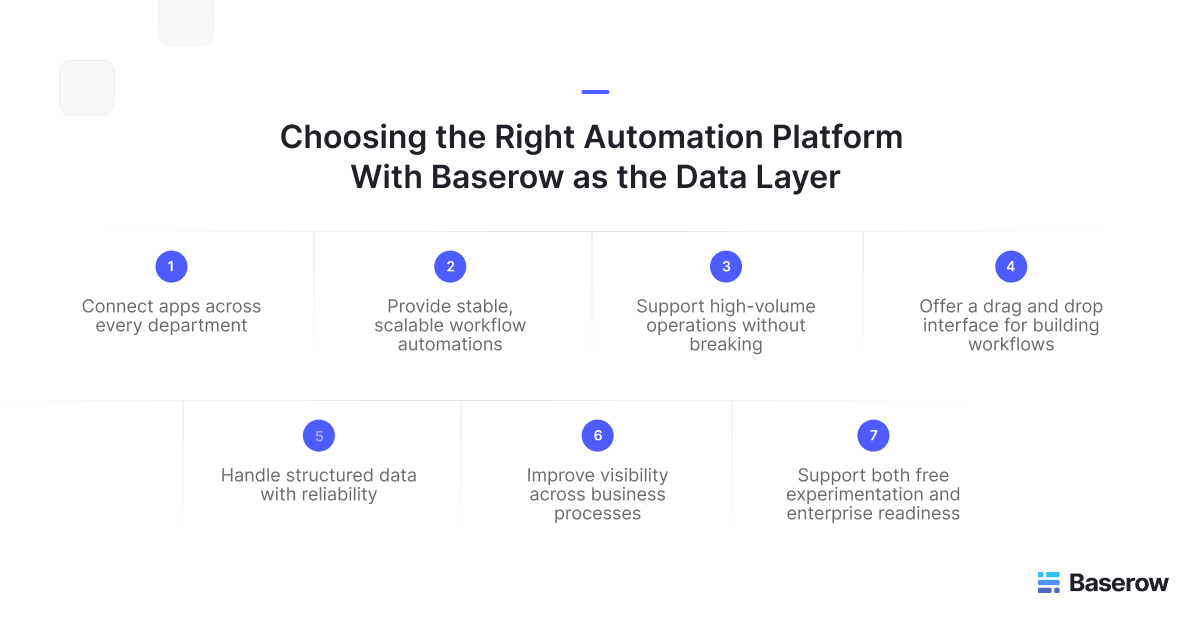
Before choosing another automation platform, teams typically evaluate a set of core criteria.
- Flexibility when building workflows
An effective platform should enable powerful workflow automations without forcing unnecessary workarounds. It must allow teams to map their business processes visually, customise each step, and adapt actions based on real-world conditions.
- A strong data foundation behind the automation platform
One of the biggest weaknesses in many automation setups is the data layer. When information is inconsistent, duplicated, or poorly structured, automations fail more frequently. This is why many teams use Baserow as the underlying database for their automation tools.
As an API-first, relational, open source platform, Baserow keeps data stable, predictable, and easy for automations to process. Its product overview highlights why growing teams rely on it for process-heavy operations.
- Connectivity across marketing, operations, finance, and product tools
A Zapier alternative must integrate widely and support tools across an organisation—email marketing platforms, CRMs, analytics systems, internal databases, support tools, and more. Connectors are the backbone of workflow automations, and a broader integration library gives teams more freedom.
- Support for high-performance, large-scale operations
Growing companies often handle tens of thousands of records, multi-step workflows, and continuous data flows. Any viable alternative must handle high automation volume, complex logic, and large datasets without performance loss. Baserow’s architecture makes it a strong choice as the data layer in these environments, helping organisations scale automation without compromising reliability.
How Baserow Enhances Any Zapier Alternative Through Better Data
When evaluating a Zapier alternative, it’s easy to focus entirely on workflow features—connectors, triggers, pricing, or interface. But the real differentiator for long-term success is the data layer supporting your automations. Even the most powerful automation platform becomes unreliable if the data feeding it is inconsistent or poorly structured.
This is where Baserow naturally fits into an organisation’s automation strategy. While not a workflow engine itself, it functions as a central, organised source of truth for every operational team. Many businesses discover this through guides like How to Sync and Automate Data Entry with Baserow and Zapier, which illustrates how automation becomes dramatically more stable when the underlying tables, fields, and relationships are designed properly.
Because Baserow is open source, API-first, and built for scale, it integrates seamlessly with automation platforms—giving teams more confidence in the data powering their workflow automations. Whether you’re automating inventory updates, customer onboarding, sales pipelines, or email marketing triggers, Baserow ensures that the information flowing through your workflows remains consistent, clean, and structured.
Practical Use Case: A Growing Company Automating Operations
To understand why businesses pair Baserow with the automation platform they choose as a Zapier alternative, consider a real scenario frequently discussed in the Baserow Community:
A mid-sized services company wants to automate its entire customer onboarding journey. The process spans multiple departments—sales marketing, operations, support, and finance—each using different tools.
Here’s how Baserow fits in:
- All customer records live in a central Baserow database, organised into tables for contacts, proposals, onboarding tasks, project milestones, and billing.
- Their chosen workflow automation platform monitors changes in these tables to trigger processes.
- When a new customer row is created, automated onboarding tasks are generated and assigned to team members.
- As customers progress, status updates trigger emails, invoices, or internal alerts.
- Data from external systems—CRMs, lead forms, calendars, invoicing tools—sync directly into Baserow, eliminating manual work.
This system works because Baserow becomes the single source of truth. The automation platform simply handles the logic. Together, they create a powerful hybrid setup that feels fully automated without sacrificing transparency or control.
Many companies expand this approach after reading guides such as Best Zapier Integrations for Business or the comparison insights shared in What Is Zapier.
Why Open Source Matters in a Zapier Alternative
As teams mature, open source capabilities become increasingly important—especially once data sovereignty, compliance, or long-term cost predictability come into play.
Here are some reasons businesses prioritise open tools:
- Greater control over hosting and data
Instead of being locked into hosted plans, companies can choose between cloud deployment and self-hosting. Baserow supports both, making it appealing for teams exploring alternatives to restrictive enterprise tools.
- Avoiding vendor lock-in
Open source tools grow with you. You can customise, extend, and integrate them in ways proprietary systems rarely allow.
- Alignment with IT and security frameworks
Technical teams appreciate the transparency and governance benefits of open platforms. Articles like Red Hat’s overview of what open source means for enterprise teams reinforce why open ecosystems are becoming the default approach to modern software architecture.
For these reasons, teams moving away from Oracle—often due to high cost, heavy infrastructure, or slow implementation cycles—find themselves gravitating toward flexible, relational, open source alternatives. Baserow fits this requirement naturally without overwhelming business users.
Because Baserow is structured for clarity and offers an intuitive user interface, teams can connect apps and create clean relational models even without technical training. Its product overview, which describes the platform’s open architecture and extensibility, helps teams understand how it supports long-term automation growth.
How Baserow Compares to Airtable in Automation Ecosystems
A frequently asked question—is how Baserow compares to Airtable when paired with an automation system. Here’s a quick comparison teams usually care about:
- Scalability: Baserow handles larger datasets more efficiently, which is critical when automations depend on thousands of records.
- Self-hosting: Airtable does not support self-hosting; Baserow does. Many teams choose Baserow for this reason alone.
- Open source availability: Baserow’s open source foundation appeals to companies wanting full transparency and control.
- API-first architecture: Baserow’s API-first design means workflow automation tools can reliably read, write, and sync data at scale.
These factors make Baserow an ideal supporting platform for any Zapier alternative you choose—especially when long-term reliability and data flexibility matter. When evaluating workflow platforms compared to Zapier, many teams prioritise open source flexibility, predictable pricing, and better control over their data models. This is why Baserow frequently appears in automation architecture discussions—it strengthens the reliability of whichever automation engine a team adopts.
Why Baserow Is Easy to Learn for Teams Starting With Automation
Even though Baserow is capable of handling advanced business processes, most users highlight its simplicity. It features:
- A clean, spreadsheet-like interface
- Predictable field types
- Templates to accelerate setup
- Clear documentation
- A helpful community
- Strong compatibility with automation platforms
This makes it accessible for operational teams, not just technical ones.
Whether you are testing workflows on a free plan or preparing enterprise-grade automations, Baserow provides the structure needed for predictable, stable workflow behaviour.
Baserow and Large Datasets: Built for Automation at Scale
One of the strongest reasons teams adopt Baserow is its ability to support operations at scale. This becomes essential when automations depend on:
- millions of rows
- long-running workflows
- frequent sync cycles
- complex branching logic
- multi-source data aggregation
Its performance-focused backend ensures that even high-volume workflow automations—such as syncing product inventories, customer records, or financial processes—remain smooth.
This is reinforced in practical guides like Sync Baserow with Excel using Zapier, where structured syncs remain stable even with large datasets.
Frequently Asked Questions About Choosing a Zapier Alternative
Modern teams rely heavily on workflow automations, so it’s natural that many of the most asked questions—both in traditional search engines and AI tools—focus on finding platforms that offer more control, flexibility, and scalability.
- Is there a better alternative to Zapier?
There isn’t a single “best” alternative—rather, the right choice depends on your needs. Some teams need more predictable pricing, others need deeper workflow automations, and some want open source capabilities or on-premise deployment. What is consistent, however, is that pairing a reliable automation platform with a clean, structured backend such as Baserow creates a far more stable automation environment. Baserow ensures that the data powering your workflows is consistent, relational, and scalable, making whichever Zapier alternative you select more effective.
- How does Baserow compare to Airtable?
Airtable provides a polished interface and is popular for lightweight use cases, but Baserow offers advantages that matter for automation-heavy teams:
- Open source and self-hosting options
- API-first architecture ideal for workflow automations
- Better performance on large datasets
- Greater control over security and deployment
For teams exploring a Zapier alternative, Baserow often becomes the more flexible long-term choice because it integrates cleanly with automation platforms and scales more predictably as operations grow.
Learn more through Baserow’s product overview, which explains how the platform supports modern, automation-centric workflows.
- Is Baserow easy to learn?
Yes. Baserow is designed so that non-technical users can build organised databases using a familiar spreadsheet-like interface. Teams can create tables, fields, and relationships quickly, work from pre-configured templates, and follow documentation that includes practical automation examples—such as using Baserow with Zapier or step-by-step automation guides. This makes it accessible for small teams starting on a free plan and scalable enough for enterprise deployments.
- Why are people moving away from Oracle?
Teams often move away from Oracle because traditional enterprise systems can be expensive, slow to implement, and difficult to adapt to evolving business processes. Modern companies need tools that are lighter, faster to deploy, and compatible with workflow automations. Baserow is frequently adopted as an alternative data layer because it is open source, flexible, and suitable for both cloud and self-hosted environments. Many discussions in the Baserow Community highlight organisations switching from large legacy databases to tools that better support automation ecosystems.
- Can Baserow be self-hosted?
Yes. Self-hosting is one of Baserow’s strongest differentiators. Companies with compliance requirements, strict data governance policies, or private infrastructure can deploy Baserow on their own servers while still integrating it with their automation platform. This is a major advantage for teams evaluating a Zapier alternative, as self-hosted data layers allow full ownership and long-term operational control.
- Can Baserow handle large datasets?
Absolutely. Baserow is built to support high-volume operations, making it suitable for automation-heavy workflows that depend on hundreds of thousands—or even millions—of records. Performance remains stable even when powering complex workflow automations, high-frequency sync cycles, or multi-departmental processes. Guides such as Sync Baserow with Excel using Zapier demonstrate how Baserow maintains performance even in large-scale automation setups.
Final Thoughts: Choosing a Reliable Zapier Alternative
Finding the right Zapier alternative isn’t just about replacing an automation tool—it’s about designing a future-proof automation ecosystem.
Workflows are only as strong as the data behind them. While automation tools handle logic, triggers, and actions, the stability and clarity of your data determine how reliable those automations will be. This is where Baserow becomes an essential part of the modern automation stack.
By combining:
- an open, scalable backend
- a clean interface for business teams
- an API-first architecture
- flexible hosting options
- powerful integration capabilities
Baserow enhances the reliability of any workflow automation platform you choose. Whether you’re automating sales marketing processes, syncing customer data, coordinating operations, or centralising data from multiple tools, Baserow provides the structure needed to keep everything running smoothly.
As your business grows, so does the complexity of your workflows. Choosing the right automation platform—and pairing it with a reliable data layer like Baserow—ensures your organisation remains efficient, resilient, and ready for scale.
Start Building Reliable, Scalable Workflow Automations
If you’re ready to structure your data and create a more dependable automation ecosystem, you can begin exploring what Baserow offers here:
Whether you’re experimenting with your first automated workflow or scaling operations across teams, Baserow provides the foundation needed for long-term success.

Baserow 2.4 adds Button fields, Graph elements, workflow automation, AI provider management, improved Group By views, and 30+ more updates.

Discover how Airtable and Baserow compare in features, flexibility, speed, and scalability. Compare pricing plans and hidden costs to make an informed decision!

Explore the best open-source software alternatives to proprietary products. Discover OSS tools, licenses, and use cases with our updated directory.