
Every business depends on processes. Teams approve requests, manage projects, update records, and coordinate work across departments. As organizations grow, these activities become harder to manage manually. Small delays can create larger operational problems, especially when information is spread across multiple tools.
This is why workflow automation has become a major focus for modern organizations. Companies want systems that reduce repetitive work, improve visibility, and help teams move faster. Instead of relying on manual updates and constant follow-ups, they are investing in platforms that can automate routine activities while keeping people informed.
An automated workflow builder helps organizations create structured processes that run with minimal manual effort. These systems connect data, people, and applications so tasks move from one stage to the next automatically. The result is greater consistency, fewer errors, and improved operational efficiency.
The growing adoption of AI-driven operations is also changing how automation works. Modern workflow automation platforms can analyze information, suggest actions, and support decision-making in ways that were difficult just a few years ago. Rather than simply following fixed rules, organizations can now build more adaptive operational systems.
This shift is particularly important for teams managing large volumes of operational data. Whether the goal is customer onboarding, content approvals, product operations, or internal requests, automation helps teams spend less time on administration and more time on meaningful work.
Platforms such as Baserow support this transition by combining database management, collaboration, and automation capabilities within a flexible environment. As businesses continue building AI-native operational systems, workflow automation is becoming a core part of how work gets done.
What Is an Automated Workflow Builder?
A workflow builder is a tool that allows teams to design, manage, and automate repeatable processes. Instead of performing the same tasks manually every day, organizations can create workflows that automatically move information between systems, notify stakeholders, and update records when specific events occur.
At its core, workflow automation focuses on making business processes more efficient. The objective is simple: reduce manual effort while ensuring work progresses consistently.
Understanding Workflow Automation in Simple Terms
Think about a customer submitting a request form. Without automation, a team member might need to:
- Review the submission
- Create a task
- Notify the appropriate department
- Update a spreadsheet
- Send confirmation emails
Each step requires time and creates opportunities for mistakes.
With workflow automation, these actions happen automatically. Once the form is submitted, the system can route information, create records, assign tasks, and notify the correct people without human intervention.
This approach helps organizations standardize processes and improve operational reliability.
As businesses continue adopting workflow automation tools in 2026, the focus is shifting from simple task automation to complete operational orchestration. Teams want systems that connect departments, applications, and data sources through a single workflow.
Core Components of Modern Workflow Builders
Most modern workflow builders share several important capabilities.
- Visual Workflow Design
Many platforms provide a visual canvas that allows users to see how information moves through a process. Rather than writing code, users can design workflows visually and understand each step at a glance.
- Drag and Drop Configuration
A drag and drop interface makes workflow creation more accessible. Users can add triggers, actions, conditions, and notifications by arranging components visually. This approach reduces complexity and allows faster implementation.
- Triggers and Actions
Every workflow begins with a trigger. Examples include:
- Form submissions
- New records
- Status changes
- Customer requests
- Database updates
Once triggered, predefined actions automatically execute.
- Access Controls
As workflows become more important, organizations need stronger governance. Access controls help define who can view, edit, approve, or manage workflow processes. This protects operational data while supporting collaboration.
- Error Handling
Operational systems cannot depend on perfect conditions. Strong error handling capabilities help teams identify failures, retry actions, and maintain workflow reliability even when external systems experience issues.
- AI Features
Modern automation platforms increasingly include AI features that help teams create smarter workflows. These capabilities may include:
- Workflow recommendations
- Automated categorization
- Content analysis
- Intelligent routing
- Decision support
As AI adoption grows, these functions are becoming an important differentiator between traditional automation tools and newer operational platforms.
Why AI-Native Operations Need Workflow Automation
Organizations generate more data than ever before. Customer interactions, internal requests, operational metrics, support tickets, and project updates create constant streams of information. Managing these activities manually becomes difficult as complexity increases.
Workflow automation provides the structure needed to manage this scale.
The Rise of AI-Driven Operational Systems
Traditional operational systems were designed to record information.
Modern operational systems are expected to do much more.
Businesses now want systems that can:
- Identify trends
- Reduce manual effort
- Improve decision-making
- Accelerate response times
- Support continuous improvement
This is where AI powered technologies are creating new opportunities.
Instead of reviewing reports after problems occur, organizations can analyze information in real time and respond faster.
AI driven operational environments combine automation with intelligence. Workflows no longer simply move tasks between people. They can also evaluate information, prioritize requests, and surface important insights.
For example, a customer support workflow may automatically:
- Classify incoming requests
- Determine urgency levels
- Assign the correct team
- Escalate critical issues
- Generate performance reports
This reduces workload while improving service quality.
Where Manual Processes Break Down
Many operational problems share a common cause: manual coordination. Teams often rely on emails, spreadsheets, chat messages, and disconnected applications to manage work. This creates several challenges.
- Delayed Responses: Important requests can remain unnoticed until someone manually reviews them.
- Inconsistent Execution: Different team members may follow different processes, creating variability and confusion.
- Data Silos: Information stored across multiple systems makes it difficult to maintain a single source of truth.
- Scaling Challenges: Processes that work for a small team often become difficult to manage as organizations grow.
Workflow automation addresses these issues by creating structured processes that operate consistently regardless of scale.
For example, discussions within the Baserow community frequently highlight operational use cases involving marketing approvals, content workflows, project tracking, and service request management. In each case, teams benefit from having connected workflows that reduce manual coordination and improve visibility.
Similarly, organizations exploring process management software for workflows often discover that automation becomes significantly more valuable when operational data, collaboration, and workflow management exist within the same environment.
This foundation becomes even more important as AI capabilities continue expanding across modern operational systems.
Key Features to Look for in Workflow Automation Platforms
Not all automation platforms offer the same value. Some focus on simple task automation. Others help teams build complete operational systems that connect data, people, and decisions.
As organizations expand their automation efforts, it becomes important to choose a platform that supports both current needs and future growth.
Visual Workflow Design Makes Adoption Easier
Many teams avoid automation because they think it requires coding. Modern workflow platforms solve this problem through visual design tools.
A visual canvas allows users to see every step of a process in one place. Team members can understand how work moves through the system without reading technical documentation. This approach offers several benefits:
- Faster workflow creation
- Better collaboration
- Easier troubleshooting
- Improved visibility
When workflows become complex, visual design also helps managers identify bottlenecks and opportunities for improvement.
For organizations managing many business processes, visual tools reduce the learning curve and speed up adoption.
Drag-and-Drop Workflow Creation
A drag and drop interface helps users build workflows quickly. Instead of writing code, users can connect actions through simple visual elements. Common workflow steps include:
- Creating records
- Updating status fields
- Sending notifications
- Assigning tasks
- Triggering approvals
- Generating reports
This approach helps both operational teams and technical teams create automation without long development cycles. As a result, organizations can improve processes faster while reducing dependency on engineering resources.
AI-Powered Workflow Assistance
One of the biggest changes in workflow software is the addition of artificial intelligence. Many organizations now want systems that do more than execute predefined rules. They want automation that can help make decisions.
An AI assistant can support users by recommending workflow steps, suggesting improvements, and helping build processes more quickly. Instead of manually configuring every action, users can describe a goal and receive workflow suggestions.
This reduces setup time and makes automation more accessible.
Natural Language Workflow Creation
Natural language interfaces are becoming increasingly common. Users can explain what they want to automate using plain language rather than technical instructions.
For example: “Notify the product team when a high-priority request is submitted and create a follow-up task.”
The platform can interpret the request and generate the workflow structure automatically. This capability lowers barriers for non-technical teams while helping experienced users work more efficiently.
The Growing Role of AI Agents
Many organizations are also exploring the use of an ai agent within operational workflows. Unlike traditional automation, AI agents can evaluate context and support decision-making. Examples include:
- Categorizing incoming requests
- Prioritizing tasks
- Reviewing content
- Identifying risks
- Routing work to the correct department
These capabilities help organizations build more adaptive operational systems.
Collaboration and Governance Matter
Automation affects multiple departments. Because of this, governance becomes just as important as functionality. Organizations should look for platforms that support collaboration while maintaining security and control. Important capabilities include:
- Role-based permissions
- Audit visibility
- Workflow ownership
- Approval management
Strong governance helps organizations scale automation without creating confusion.
Supporting Growing Teams
As automation expands, more users become involved. A platform that supports unlimited users can remove adoption barriers and encourage broader participation across departments.
Operational workflows often involve managers, analysts, support teams, marketers, and executives. Allowing these groups to collaborate within one system improves visibility and reduces communication gaps.
Access Controls Improve Operational Security
Access controls help ensure that sensitive information remains protected. Different users may require different permissions. For example:
- Administrators manage workflows.
- Managers approve requests.
- Team members update records.
- Stakeholders view reports.
This structure helps organizations maintain security while supporting collaboration.
Reliable Error Handling Reduces Risk
No workflow operates in perfect conditions. External systems may fail. Records may contain incomplete information. Integrations may experience interruptions. Good error handling helps organizations manage these situations effectively.
Important capabilities include:
- Workflow monitoring
- Retry mechanisms
- Error notifications
- Activity logs
These features help teams resolve issues quickly and maintain operational continuity. Organizations that overlook error management often face larger operational problems later.
How Baserow Supports AI-Powered Workflow Operations
Many businesses struggle because their operational data lives in separate systems. Customer information may exist in one application. Project tracking may happen elsewhere. Workflow management often requires additional software. This fragmentation creates unnecessary complexity.
Baserow helps address this challenge by combining database management, collaboration, and automation within a single environment.
- Centralizing Operational Data
Strong automation starts with organized data. When information is scattered across multiple tools, workflows become harder to manage and maintain. Baserow provides a database-first approach that helps teams centralize operational information.
Instead of moving data between spreadsheets and disconnected applications, organizations can manage workflows around a shared source of truth.
This approach improves:
- Data accuracy
- Team visibility
- Process consistency
- Reporting quality
Teams building AI-native operational systems often find that centralized data creates a stronger foundation for automation.
Organizations can learn more through the Baserow platform overview, which explains how databases, collaboration, and automation work together.
- Supporting Technical and Non-Technical Users
One common challenge with automation projects is adoption. Some platforms require extensive technical knowledge. Others are too limited for advanced operational needs. Baserow helps bridge this gap.
Technical users can create sophisticated workflows and integrate multiple systems. At the same time, non-technical users can manage records, update information, and participate in workflows through a familiar interface.
This balance helps organizations expand automation without creating dependency on a small group of specialists.
- Building Powerful Automation Around Data
Modern operations require more than isolated task automation. Organizations need powerful automation that connects directly to business data. For example, workflows can be triggered when:
- New records are created
- Status values change
- Approvals are completed
- Customer requests are submitted
- Operational metrics reach specific thresholds
Because automation is connected to operational data, teams can build systems that respond quickly to changing conditions.
The workflow automation documentation provides examples of how teams can automate routine operational activities while maintaining visibility and control.
Use Case: AI-Powered Customer Onboarding Operations
Consider a company onboarding new customers. Without automation, the process may involve multiple emails, spreadsheets, and manual updates. A workflow built in Baserow could automate much of this work.
- Step 1: A customer submits an onboarding form.
- Step 2: A new record is created automatically.
- Step 3: The workflow validates required information.
- Step 4: Tasks are assigned to the correct department.
- Step 5: Notifications are sent to relevant team members.
- Step 6: AI-powered review helps identify missing information.
- Step 7: Progress updates are tracked automatically.
- Step 8: Reports are generated for management.
The result is a faster onboarding experience with fewer delays and less manual effort. This type of workflow demonstrates why database-driven automation is becoming increasingly important for operational teams.
As organizations continue investing in AI-driven systems, they need platforms that combine structured data, collaboration, and automation within a single operational environment. Baserow’s growing feature set makes it well suited for teams that want to build scalable workflows while maintaining flexibility as operational requirements evolve.
Real Operational Use Cases for Automated Workflow Builders
Workflow automation is no longer limited to IT departments. Today, teams across the organization use automation to reduce repetitive work and improve consistency. The most successful implementations focus on processes that happen often and follow clear rules.
Product teams manage large amounts of information. Feature requests, bug reports, customer feedback, and release planning often involve several stakeholders. Without automation, updates can become difficult to track.
A workflow can automatically:
-
Capture new feature requests
-
Assign ownership
-
Update priorities
Product Operations
-
Notify stakeholders
-
Track progress
-
Generate reports
This helps product teams spend more time improving products and less time managing spreadsheets. Organizations building operational databases often combine workflow automation with structured data management to improve product visibility.
Marketing Operations
Marketing teams manage campaigns, content, approvals, and performance reporting. Many activities involve multiple reviews before publication. Workflow automation helps standardize these processes. For example, a content workflow may:
- Receive a content request
- Assign a writer
- Route content for review
- Collect approvals
- Schedule publication
- Update performance dashboards
This reduces delays and helps teams maintain consistent processes. Marketing teams also benefit from automation because it creates clear accountability at every stage.
Customer Operations
Customer-facing teams often process large numbers of requests every day. Manual routing can slow response times and affect service quality. Workflow automation can:
- Classify requests
- Assign support tickets
- Escalate urgent issues
- Notify managers
- Track resolution times
When customer data and workflows exist in the same system, organizations gain better visibility into performance and service quality.
Internal Operations
Many internal processes still rely on emails and manual approvals. Examples include:
- Equipment requests
- Budget approvals
- Procurement processes
- Employee onboarding
- Leave requests
Automation helps create consistent experiences for employees while reducing administrative work. Instead of chasing approvals through email chains, workflows guide requests through a predefined process. This improves efficiency and makes reporting easier.
Traditional Automation vs AI-Powered Systems
Many organizations already use automation. However, not all automation works the same way. Understanding the difference between traditional automation and AI-powered systems can help teams make better decisions.
Rules-Based Automation
Traditional automation follows predefined instructions. If a specific event occurs, the system performs a specific action. For example:
- If a form is submitted, create a task.
- If a ticket is marked urgent, notify a manager.
- If an invoice is approved, update the database.
This approach works well for predictable activities. The challenge is that rules must be created and maintained manually. As workflows become more complex, maintenance requirements increase.
AI-Powered Automation
AI-enhanced systems add intelligence to workflows. Instead of following only fixed rules, they can evaluate information and provide recommendations. For example, an AI system may:
- Identify trends in customer requests
- Detect unusual activity
- Recommend priorities
- Categorize records automatically
- Suggest next actions
This helps organizations move beyond simple automation and toward operational intelligence.
Is AI Automation Better Than Traditional Automation?
The answer depends on the use case. Traditional automation remains effective for repetitive and predictable tasks. AI-powered automation becomes valuable when workflows involve large amounts of data, changing conditions, or decision-making support.
Many organizations use both approaches together. Rules-based workflows provide consistency, while AI adds flexibility and insight. This combination is becoming a common feature of modern operational systems.
How to Choose the Right Workflow Builder
Selecting the right platform requires more than comparing features. Organizations should evaluate how well a solution supports long-term operational goals. Before selecting a workflow solution, consider the following questions.
- Can It Scale Across Departments?: Many organizations start with a single workflow. Over time, automation expands into other teams. A platform should support growth without requiring major changes later.
- Does It Support Operational Data?: Workflows are only as effective as the data behind them. Look for systems that connect workflows directly to operational records. This improves visibility and reduces duplication.
- Is It Easy to Use?: Complicated tools often face adoption challenges. A platform should support both technical and business users. Ease of use becomes especially important when workflows involve multiple departments.
- Does It Provide Governance Features?: Organizations need visibility into how workflows operate. Features such as permissions, approvals, and audit trails help maintain control.
Understanding Free and Paid Options
Most workflow platforms offer both free and paid plans. The right choice depends on operational requirements. Free plans often support:
- Basic workflows
- Small teams
- Limited automation volume
As organizations grow, they may need additional capabilities such as:
- Advanced automation
- Larger databases
- Expanded integrations
- Enhanced governance
- Enterprise security
When evaluating paid plans, focus on long-term operational value rather than short-term cost. A platform that supports future growth can reduce migration challenges later.
Common Workflow Automation Mistakes to Avoid
Automation can deliver strong results, but only when implemented thoughtfully. Many challenges occur because organizations automate too quickly without improving the underlying process.
- Automating a Broken Process
Automation cannot fix a poorly designed workflow. If a process contains unnecessary steps, automation may simply make those inefficiencies happen faster. Before automating, review the process carefully and remove unnecessary complexity.
- Creating Overly Complex Workflows
Simple workflows are easier to maintain. Some teams attempt to automate every possible scenario from the start. This often creates confusion and increases maintenance effort. A better approach is to begin with core processes and expand gradually.
- Ignoring Workflow Ownership
Every workflow should have a clear owner. Without ownership, updates and improvements may be delayed. Assign responsibility for monitoring performance and maintaining automation.
- Neglecting Documentation
Workflows evolve over time. Documentation helps teams understand how processes work and why decisions were made. Clear documentation also improves onboarding and knowledge transfer.
- Overlooking Error Management
Failures will happen. Systems change, integrations break, and data quality issues appear. Organizations that plan for these situations recover more quickly. Monitoring and maintenance should be part of every automation strategy.
The Future of AI Workflow Automation
Workflow automation continues to evolve. The next generation of platforms will focus on helping organizations build intelligent operational systems rather than simple task automation. Several trends are shaping this future.
- More Natural Language Interfaces
Users increasingly expect to interact with software using everyday language. Future workflow systems will make it easier to describe processes and generate workflows automatically. This will reduce technical barriers and increase adoption.
- Greater Use of AI Agents
AI agents are likely to play a larger role in operational workflows. Instead of performing a single action, they will help manage complete processes. For example, an AI agent may:
- Monitor operational data
- Recommend actions
- Coordinate tasks
- Identify risks
- Generate reports
This creates opportunities for more adaptive operations.
- Smarter Operational Decision Support
Organizations want more than automation. They want systems that help teams make better decisions. Future platforms will provide stronger analytical capabilities and operational insights. This shift supports faster responses and more informed planning.
- Connected Operational Ecosystems
Businesses increasingly want a single environment for data, collaboration, and automation. This is one reason database-centered platforms are gaining attention. When workflows operate around shared operational data, organizations reduce complexity and improve visibility.
Baserow’s continued investment in automation, database flexibility, and AI-related capabilities aligns closely with this trend. As operational systems become more intelligent, organizations will need platforms that can adapt without becoming difficult to manage.
In many ways, the future of operations is not just about automation. It is about creating connected systems that help people work more effectively.
Building Smarter Operations with Workflow Automation
Organizations are under constant pressure to move faster while maintaining accuracy and control. Manual processes often struggle to keep up with growing volumes of data, requests, and operational complexity.
Workflow automation provides a practical way to solve these challenges. By connecting people, processes, and information, businesses can reduce repetitive work, improve consistency, and create more efficient operations.
The next stage of automation goes beyond simple task execution. AI-powered systems can help teams make decisions, identify patterns, and adapt workflows as operational needs change. This is why workflow automation is becoming a critical component of AI-native operational software.
For teams looking to build connected pre built systems, a platform that combines databases, collaboration, and automation can create significant advantages. Baserow offers this foundation by helping organizations manage operational data while automating key processes within a flexible environment.
If you are exploring ways to improve operational efficiency, streamline workflows, and prepare for the future of AI-driven operations, you can start by exploring the Baserow platform overview. You may also find value in learning more about process management software and workflows and AI automation tools for operational teams.
Ready to build smarter operational workflows? Create your workspace and explore what is possible with Baserow: Sign up for Baserow.

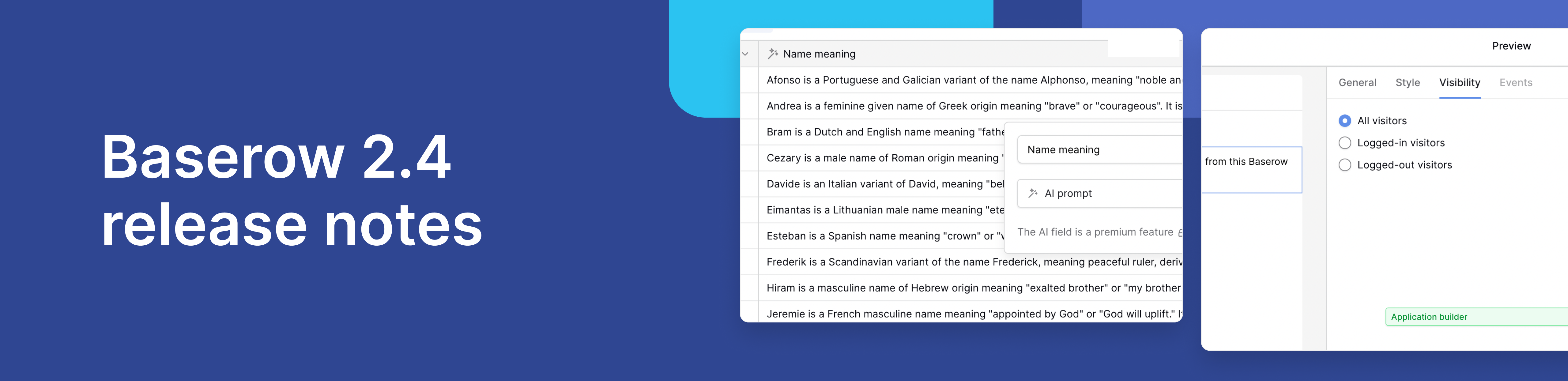
Baserow 2.4 adds Button fields, Graph elements, workflow automation, AI provider management, improved Group By views, and 30+ more updates.

Discover how Airtable and Baserow compare in features, flexibility, speed, and scalability. Compare pricing plans and hidden costs to make an informed decision!

Explore the best open-source software alternatives to proprietary products. Discover OSS tools, licenses, and use cases with our updated directory.