
TL;DR
- API development covers design, implementation, testing, documentation, and maintenance.
- Good API design starts with clear resources, endpoints, requests, and responses.
- REST APIs use standard HTTP methods such as GET, POST, PATCH, and DELETE.
- Authentication and permissions protect data and control access.
- API documentation helps developers understand how to integrate a service.
- Testing helps identify errors before they affect connected applications.
- Baserow is an API-first database with REST access, automatically generated documentation, and granular database token permissions.
API development is the process of designing, building, testing, documenting, and maintaining an application programming interface (API) that allows different software systems to communicate.
Modern software rarely works in isolation. Web applications, mobile apps, databases, automation tools, and other services often need to exchange information. A well-designed web service provides a consistent way for these systems to request data or perform actions without exposing their internal implementation.
This guide explains the most important parts of building an API, from initial design to authentication, testing, and documentation.
New to APIs? Start with our guide to What Is an API? How It Works and Real-World Examples to understand the basics before diving into API development.
What is API development?
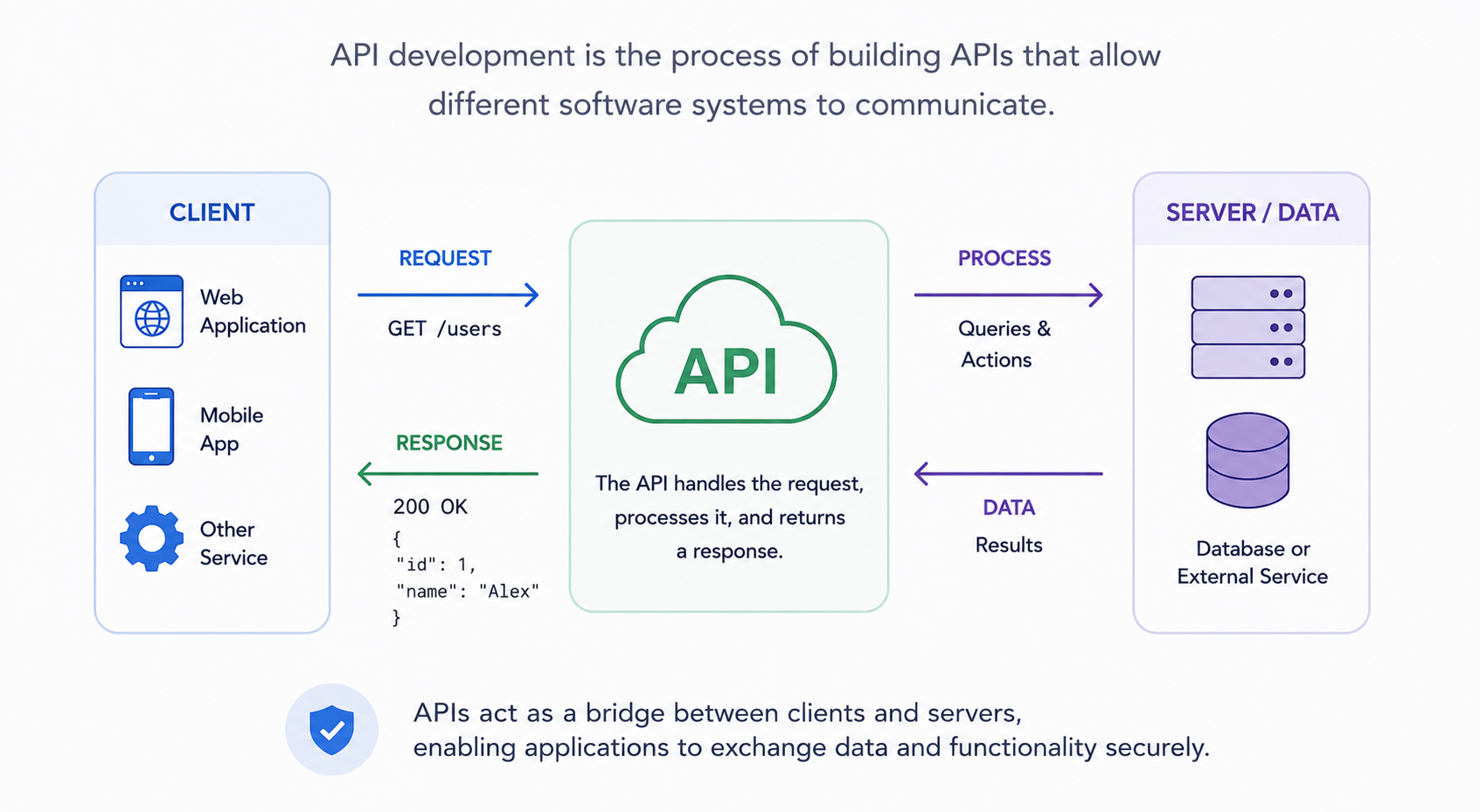
API development creates the connection between a client and server.
The client might be a website, mobile application, automation workflow, or another service. It sends an API call to an endpoint, and the server processes the request before returning a response.
The development process usually includes:
- Planning what data and functionality to expose
- Designing resources and endpoints
- Building the server-side logic
- Adding authentication and permissions
- Testing different scenarios
- Creating documentation
- Maintaining the interface as the application evolves
The design stage is an important part of the process because changes to an existing interface can affect every application that depends on it.
API design fundamentals
Good API design makes an interface predictable and easy to use.
Start by identifying the resources an application needs to expose. These could be customers, orders, products, projects, or database records.
Each resource can have several API endpoints:
GET    /products
GET    /products/123
POST   /products
PATCH  /products/123
DELETE /products/123
The endpoint identifies the resource, while the HTTP method describes the requested operation.
Consistency is important. Naming conventions, response formats, authentication, permissions, and error handling should follow predictable patterns.
REST APIs and HTTP methods
A REST API is one of the most common approaches to building web interfaces. REST stands for Representational State Transfer and uses standard HTTP behavior to work with resources.
A web API allows applications to communicate over the web using standard protocols such as HTTP.
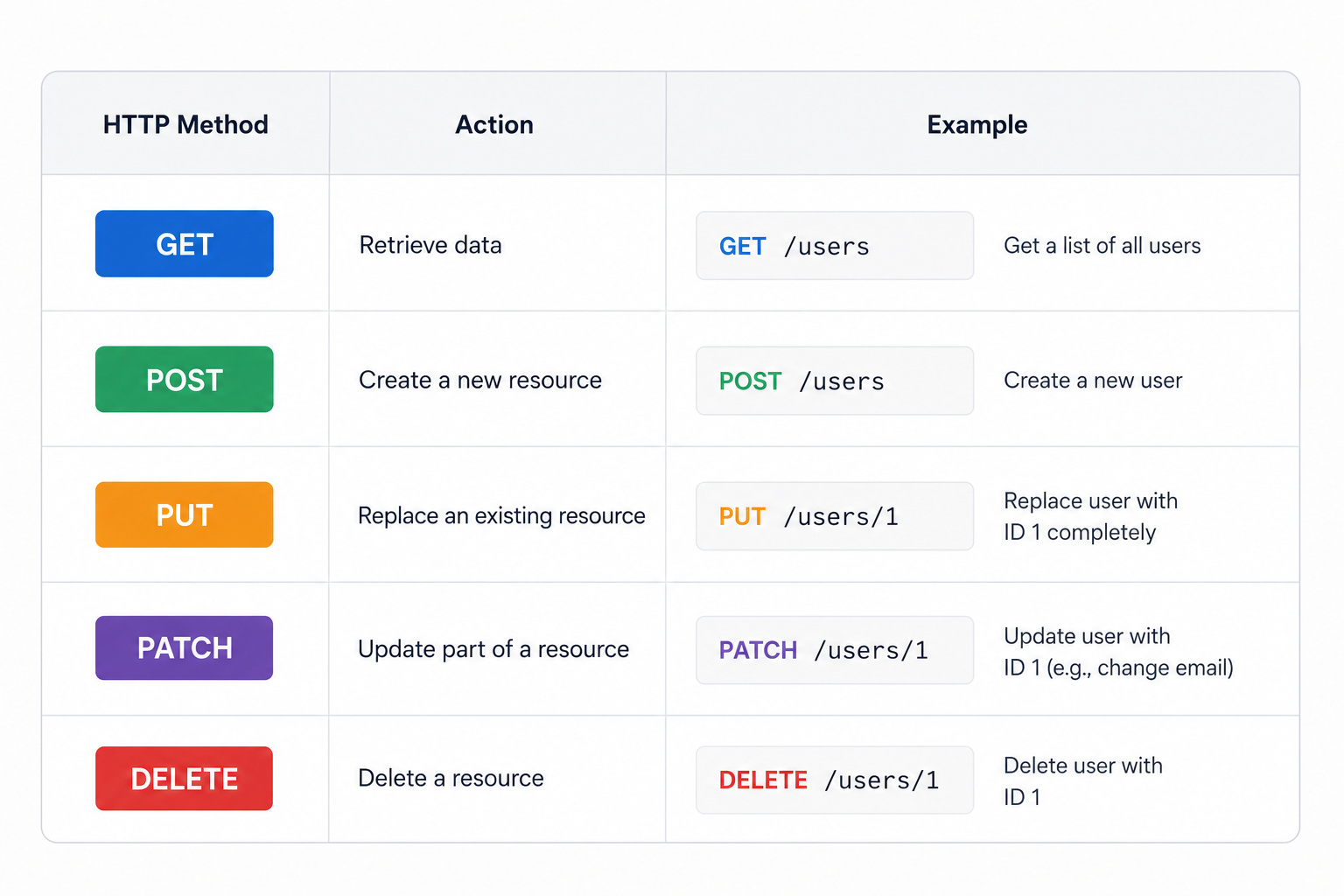
Common HTTP methods include:
- GET — retrieve information
- POST — create something new
- PUT — replace an existing resource
- PATCH — update part of a resource
- DELETE — remove a resource
REST is not the only approach. SOAP (Simple Object Access Protocol) uses a more structured messaging model, while GraphQL allows clients to specify the data they need. gRPC is another approach designed for efficient communication between services.
These are different types of APIs, and the right choice depends on the application, performance requirements, data model, and development environment.
How API requests and responses work
An API request tells a server what a client wants to retrieve or change.
A request can contain:
- An endpoint
- An HTTP method
- Headers
- Authentication credentials
- Query parameters
- A request body
The server processes the request and returns a response, often using JSON to exchange structured data:
{
  "id":123,
  "name":"Project",
  "status":"active"
}
The response also includes a status code. For example, 200 usually indicates success, while 404 means the requested resource could not be found.
The part of the API responsible for handling errors should return useful information so that the client can determine what went wrong.
See APIs in action: Explore API Example: 4 Practical Uses Explained to see how APIs are used for payments, forms, authentication, and database connections.
Authentication and security
Authentication identifies the client making a request, while authorization determines what that client is allowed to access.
Common approaches include API keys, tokens, and OAuth.
Credentials should never be exposed in public client-side code. Requests should use HTTPS, incoming data should be validated, and integrations should receive only the permissions they need.
Baserow as an API-first example
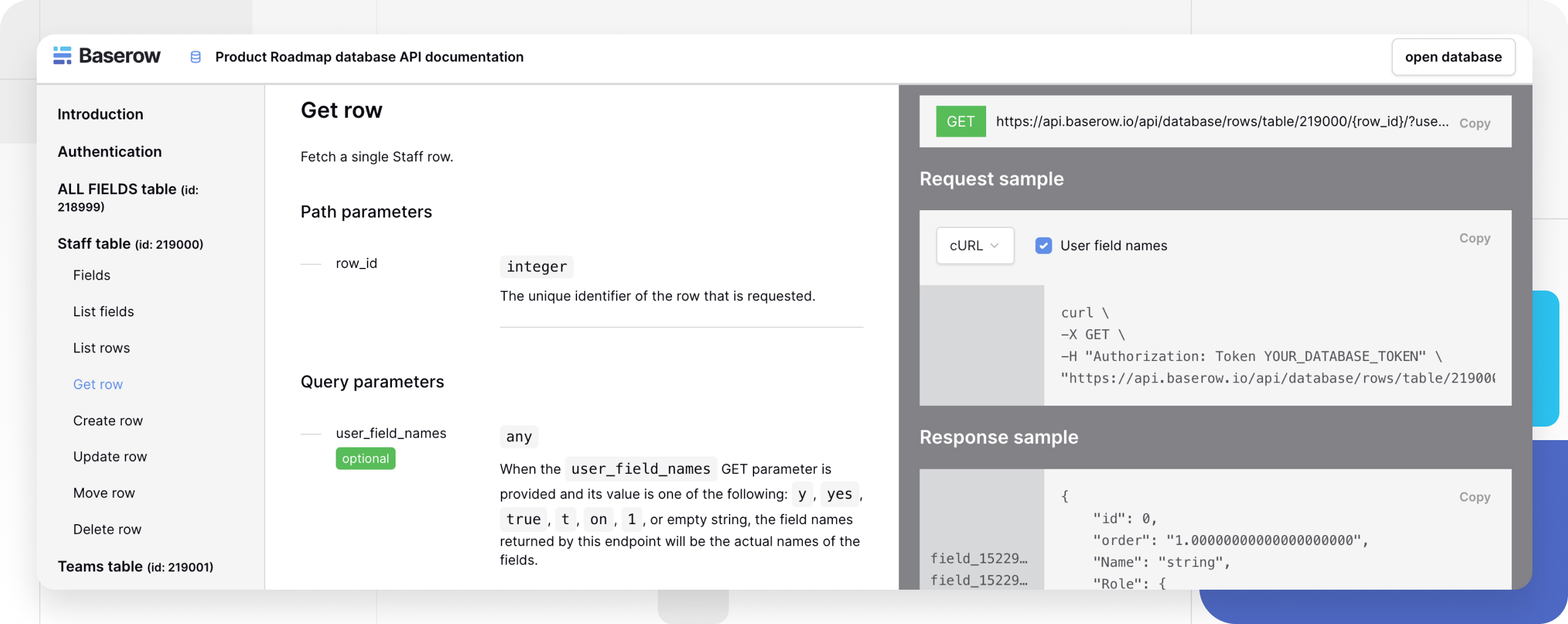
Baserow is a useful example of an API-first database. Its backend and web frontend communicate through a REST interface, while external applications can access database data programmatically.
Each database can have automatically generated API documentation based on its tables and fields. Database tokens provide granular permissions, allowing teams to control which operations can be performed on specific tables.
This means a team can manage structured data through a visual interface while applications, scripts, and automation tools interact with the same information programmatically.
API documentation
Good API documentation tells developers how to work with a service without needing to inspect its source code.
Documentation commonly includes:
- Available endpoints
- HTTP methods
- Authentication requirements
- Parameters
- Request and response formats
- Status codes
- Error messages
- Examples
API specifications provide a standardized way to describe these details. OpenAPI, for example, can document endpoints, parameters, authentication, and response structures.
Baserow automatically generates documentation for each database based on its current schema. Developers can see available endpoints and example requests and responses for their specific database.
API testing
API testing checks whether an interface behaves correctly under different conditions.
Developers can test endpoints using tools such as curl, Postman, or Insomnia. Tests should cover both successful and unsuccessful requests, including:
- Valid and invalid input
- Missing authentication
- Insufficient permissions
- Missing resources
- Unsupported methods
- Unexpected data
Automated tests are especially useful when an application changes frequently because they can run whenever new code is introduced.
Building APIs for databases
Many applications need a reliable way to connect their interface to structured data. Building this layer from scratch can require database infrastructure, server-side logic, authentication, permissions, endpoints, and documentation.
An API-first database can provide much of this functionality as part of the database itself.
Baserow combines a visual database with REST access to tables and rows. Its automatically generated documentation and token-based permissions make it possible to connect external applications without building a separate backend layer for every database project.
For example, a team could store customer records in Baserow and allow an external application to retrieve records, create new entries, or update existing ones through REST endpoints.
Explore an API-first database: See how Baserow takes an API-first approach to API design and makes database data accessible to applications, integrations, and automations.
API development best practices
A few principles make interfaces easier to build and maintain:
- Keep endpoints consistent. Use predictable naming and resource structures.
- Return useful errors. Developers should be able to understand why a request failed.
- Use appropriate status codes. Standard codes communicate results consistently.
- Protect credentials. Store tokens securely and never expose them in client-side code.
- Limit permissions. Give each integration only the access it needs.
- Document important behavior. Documentation should reflect how the service actually works.
- Test before releasing changes. Automated tests can prevent regressions.
- Plan for change. Consider versioning and backward compatibility when an interface evolves.
Frequently asked questions
What is the difference between API design and API development?
API design focuses on how the interface should work, including resources, endpoints, methods, authentication, and responses. API development includes design as well as implementation, testing, documentation, deployment, and maintenance.
Which API style should I use?
REST is a strong choice for many web applications because it uses familiar HTTP conventions. GraphQL can work well when clients need flexible data queries, while gRPC is often useful for high-performance communication between services. SOAP can still be relevant for systems that depend on its structured messaging and established standards.
Is Baserow an API-first database?
Yes. Baserow provides REST access to database data and automatically generated documentation for individual databases. Its database tokens can also be configured with granular permissions.
What makes an API secure?
Use HTTPS, protect authentication credentials, validate incoming data, limit permissions, and revoke or rotate credentials when necessary. Security should be considered during design rather than added after the interface is built.
API development brings together design, implementation, security, testing, and documentation to create reliable connections between software systems.
For teams working with structured data, an API-first database can remove much of the infrastructure normally required to expose database information to applications. Baserow combines this programmatic access with a visual database, making it possible for people and software to work with the same data.
Want to build an application around structured data without building the entire backend from scratch?

Baserow 2.4 adds Button fields, Graph elements, workflow automation, AI provider management, improved Group By views, and 30+ more updates.

Discover how Airtable and Baserow compare in features, flexibility, speed, and scalability. Compare pricing plans and hidden costs to make an informed decision!

Explore the best open-source software alternatives to proprietary products. Discover OSS tools, licenses, and use cases with our updated directory.