
TL;DR
- An API-first approach treats an API as a core part of a product rather than something added later.
- API-first design can make it easier for development teams to build applications, integrations, and services around the same interface.
- An API-first database makes its data accessible to applications, automation tools, and other services through an API.
- Baserow takes an API-first approach with REST APIs, automatically generated API documentation, database tokens, and webhooks.
- Baserow can serve as a flexible data layer for websites, custom applications, automations, and AI-powered workflows.
An API first approach treats an API as a core part of a product rather than something added after the main interface is built. For a database, this means making data accessible to websites, applications, automation tools, and other services from the beginning.
Baserow follows this approach with REST APIs, automatically generated API documentation, database tokens, and webhooks. This lets teams use Baserow as both a visual database and a programmable data layer for applications and integrations.
What does API-first mean?
An API first approach considers how applications will access a product’s data and functionality before building the interfaces around it.
Instead of building a product first and adding an API later, an api first strategy considers the API, data model, and integrations as part of the product architecture from the start.
This can help development teams build different parts of a product in parallel. Once the expected API behavior is defined, teams can develop applications, integrations, and backend services against the same interface.
It can also make it easier to adopt an API across different applications instead of creating separate connections for each use case.
New to APIs? Before exploring the API-first approach, start with our guide to what an API is to understand how applications communicate and exchange data.
What is API design?
API design is the process of defining how applications communicate with a service.
A good approach to API design considers both the technical structure of the interface and the user experience for the developers who use it.
Effective API design typically defines:
- Resources and API endpoints
- HTTP methods such as GET, POST, PATCH, and DELETE
- Request and response formats
- Authentication and permissions
- Status codes and error handling
- An API contract that describes expected behavior
Using standard HTTP methods and predictable patterns makes an API easy to understand. Clear API docs and API documentation are also important because developers need to find available endpoints, understand required parameters, and know what responses to expect.
RESTful API design follows these principles by using standard HTTP methods and treating data as resources that applications can interact with through predictable endpoints.
For larger applications, API design can also be part of a microservices architecture, where separate services communicate through well-defined interfaces.
Ready to build an API? Our guide to API development covers the process of designing, building, testing, and maintaining APIs.
API-first development
An API first approach can change the development process by defining how systems will communicate early in a project.
For example, development teams can agree on an API contract before every component is finished. Teams can then work in parallel, building different applications or services against the agreed interface.
Tools such as mock servers can simulate an API before the underlying service is ready. This allows developers to test requests, responses, and integrations earlier in the development process.
As an API grows, API governance helps teams maintain consistency across endpoints, authentication, documentation, naming conventions, and security.
What is an API-first database?
An API-first database makes programmatic access to its data a fundamental part of the product.
For example, a company might store customer or product data in a database and allow:
- A website to retrieve product information
- An application to create new records
- An automation to update order information
- An internal tool to access customer data
- An AI application to work with structured information
The database becomes a central source of data that different applications can use.
This is different from a database that simply happens to offer an API. With an API-first database, programmatic access is considered when the product, data model, documentation, authentication, and integrations are designed.
How Baserow applies an API-first approach
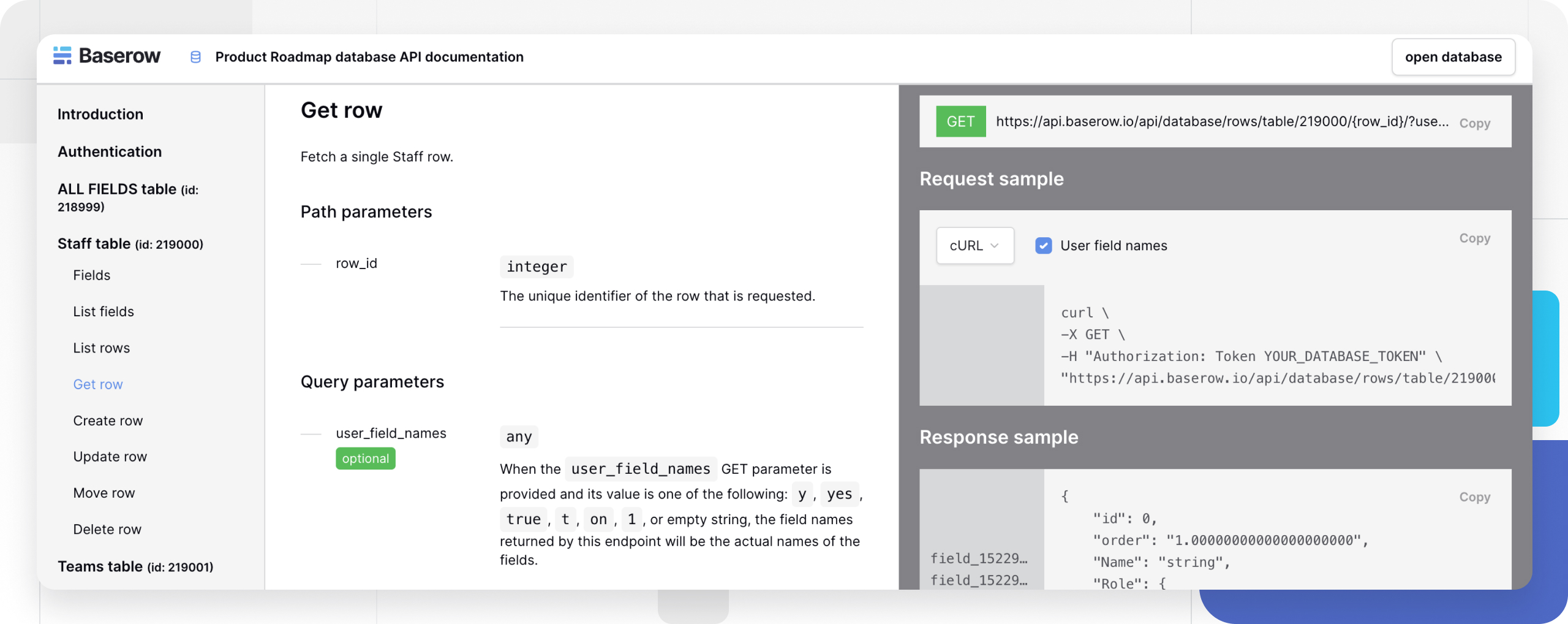
Baserow combines a visual database interface with programmatic access to the same structured data.
Its REST APIs provide endpoints for common database operations, including creating, reading, updating, and deleting rows. Baserow also automatically generates API documentation based on your database schema.
The generated API docs show the endpoints, fields, parameters, and request information available for your database. When the database structure changes, the documentation can reflect the updated schema.
This means teams can use Baserow as a data layer for websites, applications, automations, and integrations without building a separate API from scratch.
Want to see API concepts in practice? Explore our API examples to see how APIs are used for payments, forms, authentication, and database connections.
Baserow API authentication and permissions
An API-first product also needs to consider security and access control.
Baserow uses database tokens to authenticate applications connecting to a database. Permissions can be configured for different tables and operations, including creating, reading, updating, and deleting records.
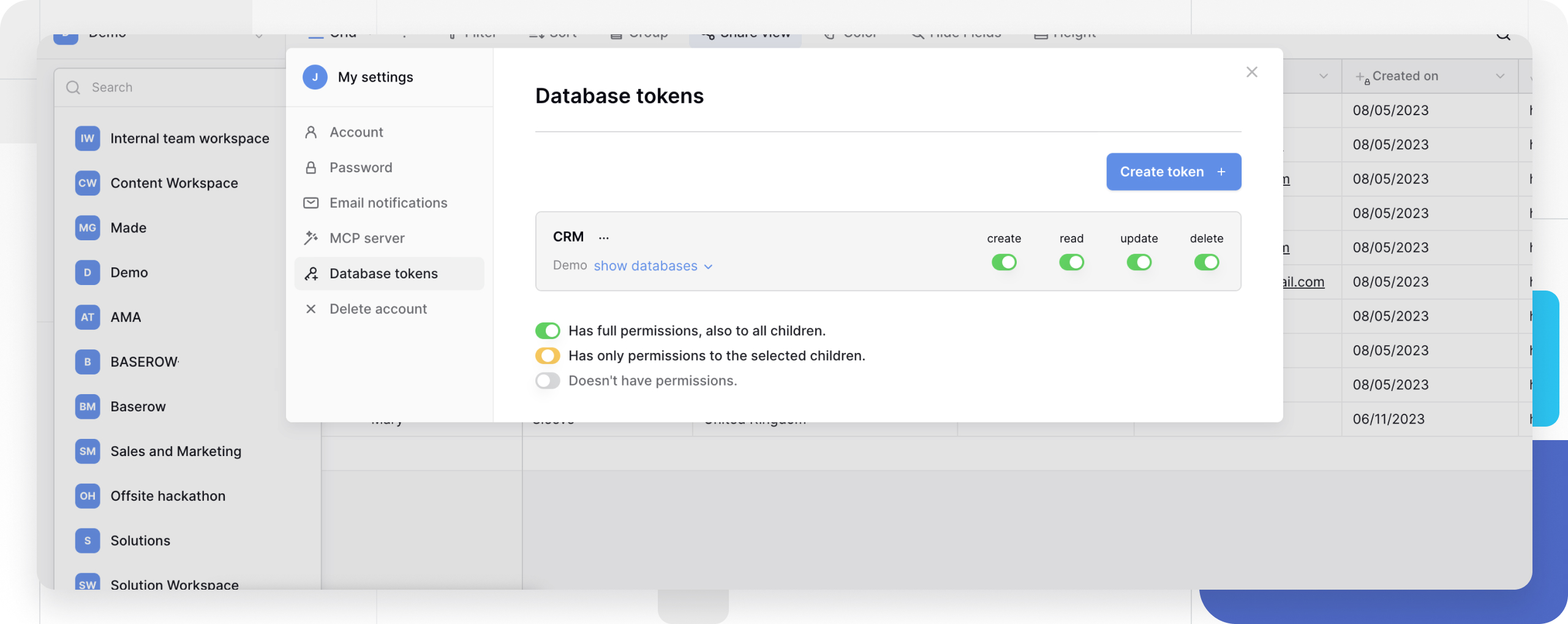
This allows an application to receive only the access it needs. For example, an application that only displays product information does not need permission to modify or delete records.
Connecting applications with Baserow
An API-first database becomes especially useful when you need to connect multiple systems.
A typical workflow might look like this:
Website
   ↓
Baserow
   ↓
Automation
   ↓
CRM / Email / Other service
A website can send submitted information to Baserow, an automation can process the new record, and another application can retrieve the resulting data.
Baserow also supports webhooks, which can notify external applications when data changes. This complements the API: applications can use REST APIs to read and modify data, while webhooks can trigger actions when changes occur.
Common use cases for an API-first database
Build a custom application
Baserow can provide the structured data layer behind a web application or internal tool. The application can interact with database records through the API while the data remains manageable through Baserow’s visual interface.
Connect external tools
API access gives different applications a way to exchange information with the same database.
Automate data management
Applications and automation platforms can create, update, or retrieve records without requiring someone to enter every change manually.
Build AI-powered applications
AI applications often need access to structured information. An API provides a programmatic way to retrieve data and, where permissions allow, make changes to it.
Support multiple interfaces
The same database can power a website, dashboard, internal tool, automation, or custom application without requiring every system to maintain its own copy of the data.
API-first vs. API-enabled
An API-enabled product provides an API that developers can use to connect to it.
An API-first product goes further by considering programmatic access as part of the core product architecture.
This distinction can influence API design, documentation, authentication, data structure, and the developer experience.
Baserow combines a visual database with REST APIs, generated documentation, database permissions, and webhooks, making programmatic access part of the database experience.
Why choose an API-first database?
An API-first database gives teams flexibility in how they use and manage their data.
You can start by managing information through a visual interface and later connect that data to a website, custom application, automation, or external service without moving it into another database.
It can also reduce development work. Instead of building database infrastructure and API endpoints from scratch, teams can use an existing data platform and focus on the application they are building.
For organizations with multiple tools and workflows, this approach helps keep data centralized while making it accessible wherever it is needed.
FAQ
What is an API-first approach?
An API-first approach treats the API as a fundamental part of a product’s architecture and development process, rather than adding API access after the product has been built.
What is an API-first database?
An API-first database makes programmatic access to its data a core part of the product. Applications, websites, automations, and other services can interact with the same underlying data.
What is API design?
API design defines how applications interact with an API, including its endpoints, HTTP methods, authentication, requests, responses, permissions, and error handling.
Is Baserow an API-first database?
Yes. Baserow is designed with API access as a core part of its database experience, providing REST APIs, automatically generated API documentation, database tokens, and webhooks.
Does Baserow have REST APIs?
Yes. Baserow provides REST APIs for operations such as creating, reading, updating, and deleting database records.
Can Baserow be used as a backend?
Yes. Baserow can act as a structured data layer for websites, custom applications, internal tools, automations, and other services through its API.
An API-first approach makes programmatic access part of a product from the beginning. For databases, this means treating data as something that applications, integrations, automations, and other services can work with.
Baserow combines this approach with a visual database, REST APIs, automatically generated API documentation, database tokens, and webhooks, giving teams a flexible way to manage structured data while keeping it accessible to the applications and services they use.

See who's editing in real time, organize data with new Group By views, execute JavaScript, build reusable workflows, import Excel files, and more in Baserow 2.3.

Discover how Airtable and Baserow compare in features, flexibility, speed, and scalability. Compare pricing plans and hidden costs to make an informed decision!

Explore the best open-source software alternatives to proprietary products. Discover OSS tools, licenses, and use cases with our updated directory.