
TL;DR
- An application programming interface lets different software systems communicate.
- A client sends a request, and a server returns a response.
- Endpoints define where particular resources or actions can be accessed.
- REST is one of the most common approaches for building web APIs.
- Interfaces can be public, private, internal, partner, or composite.
- They can connect applications to databases and automate workflows.
- An API-first database makes its data available to applications as well as people.
- Baserow combines a visual database with REST API access, automatically generated documentation, and database tokens.
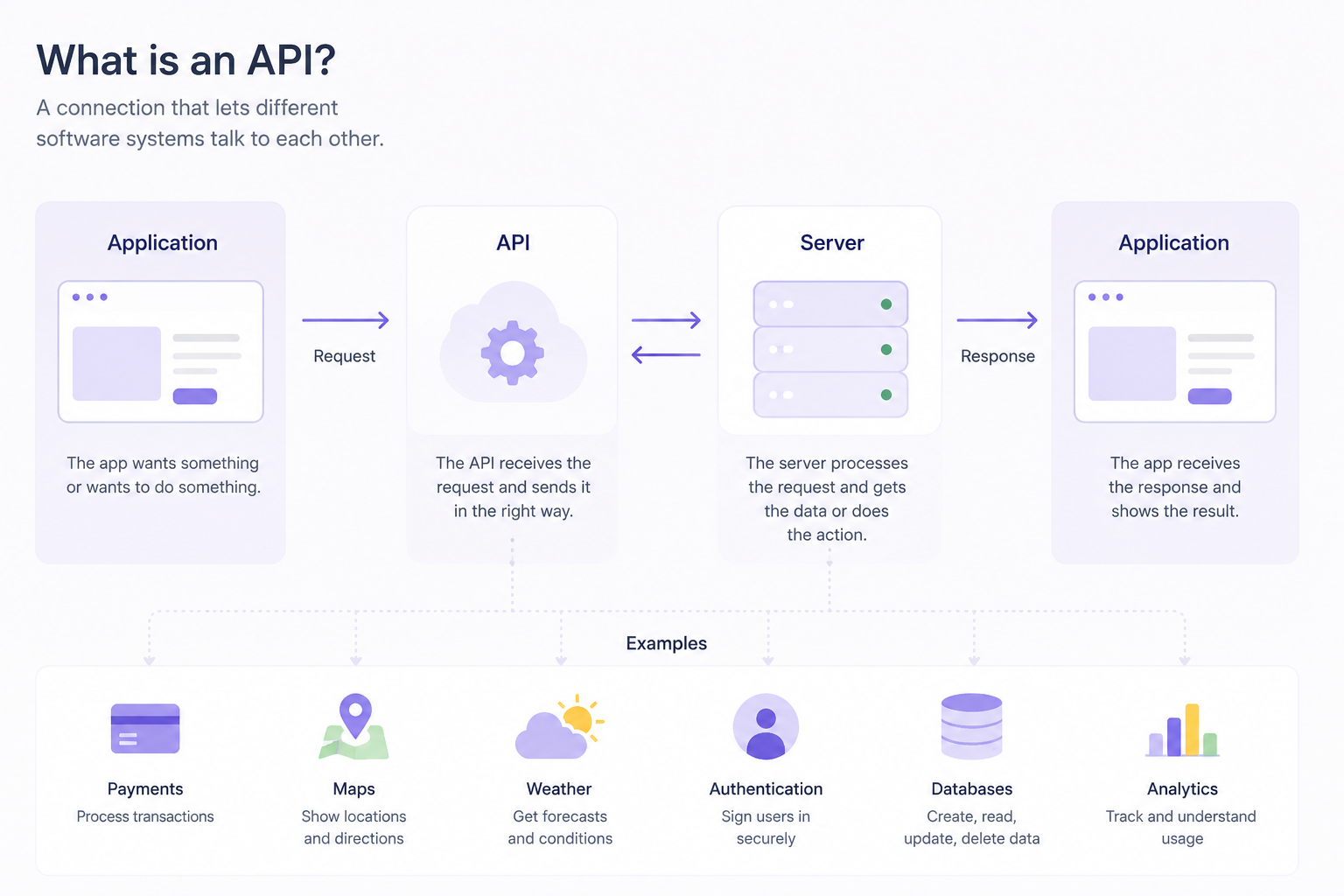
An application programming interface (API) is a set of rules that allows different software systems to communicate and share information.
Instead of exposing how a system works internally, an interface provides a defined way for another application to request information or perform an action.
For example, a weather app doesn’t need to maintain its own weather stations. It can send a request to a weather service and receive current conditions or a forecast in return.
The same principle is used to connect websites, mobile apps, databases, payment systems, cloud platforms, and other software components.
How does an API work?
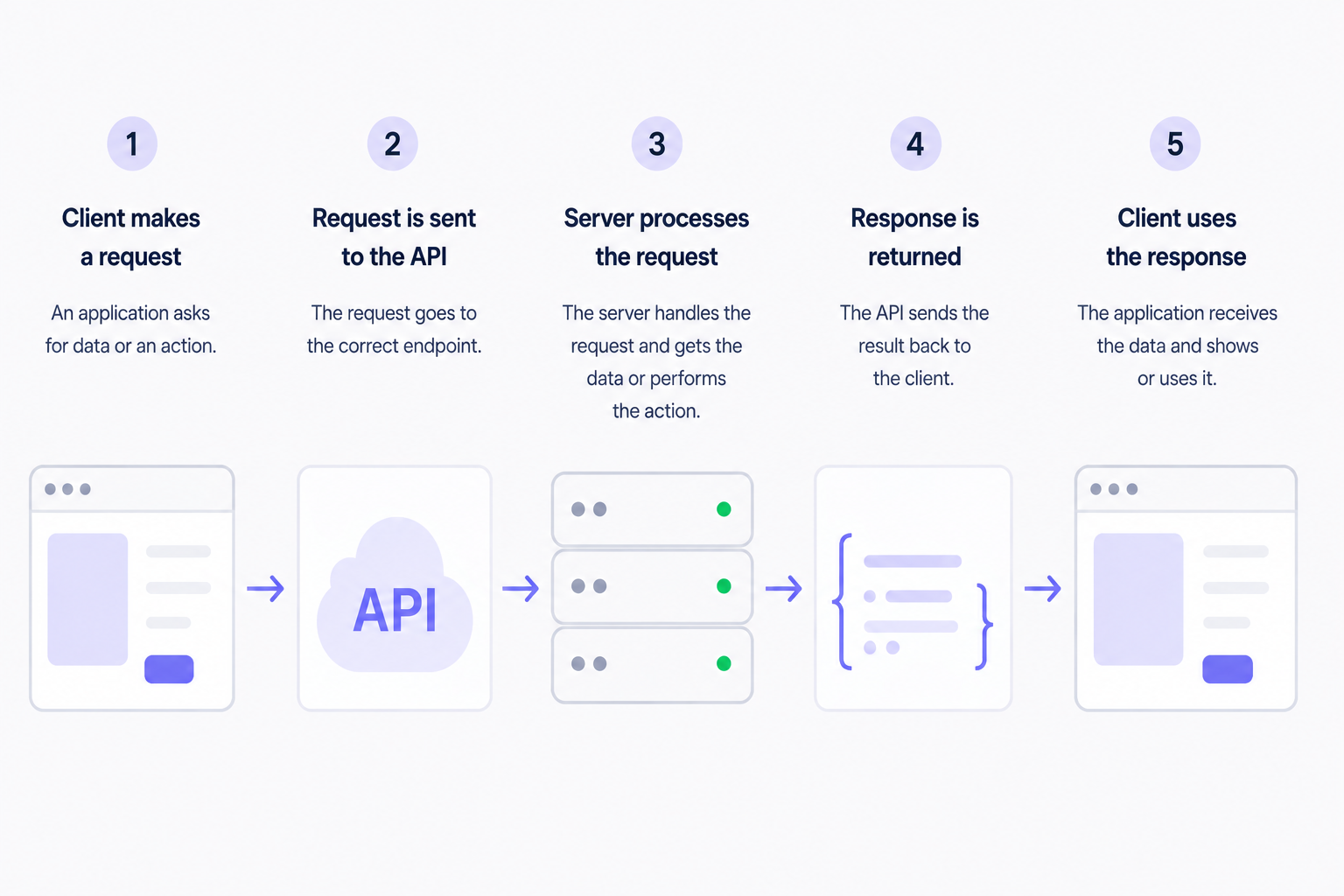
The basic process is straightforward:
- A client makes a request. This could be a website, mobile app, or another software system.
- The request reaches an endpoint. The endpoint determines which resource or operation is being requested.
- The server processes the request. It retrieves information, changes data, or performs another operation.
- A response is returned. The result is sent back to the client.
- The client uses the result. The application can display the information or use it in another workflow.
This creates a clear separation between the client and server. The client doesn’t need to know how the server stores its information or how its internal code works. It only needs to follow the rules for communicating with it.
Want to see API development in more detail? Explore our guide to API Development: How to Build Better APIs for a practical look at designing, building, testing, and documenting APIs.
Requests and responses
An API request tells a system what the client wants to do.
Depending on the service, a request might:
- Retrieve information
- Create a record
- Update existing data
- Delete a record
- Trigger an action
The request can include an endpoint, HTTP method, parameters, authentication credentials, and data.
The server then returns a response. Web services commonly use JSON because it provides a structured format that applications can easily process.
Endpoints
An API endpoint is a specific URL or address associated with a resource or operation.
For example, a service could have separate endpoints for customers, orders, or products. Each endpoint can support different operations.
This structure makes it possible for applications to interact with only the resources they need.
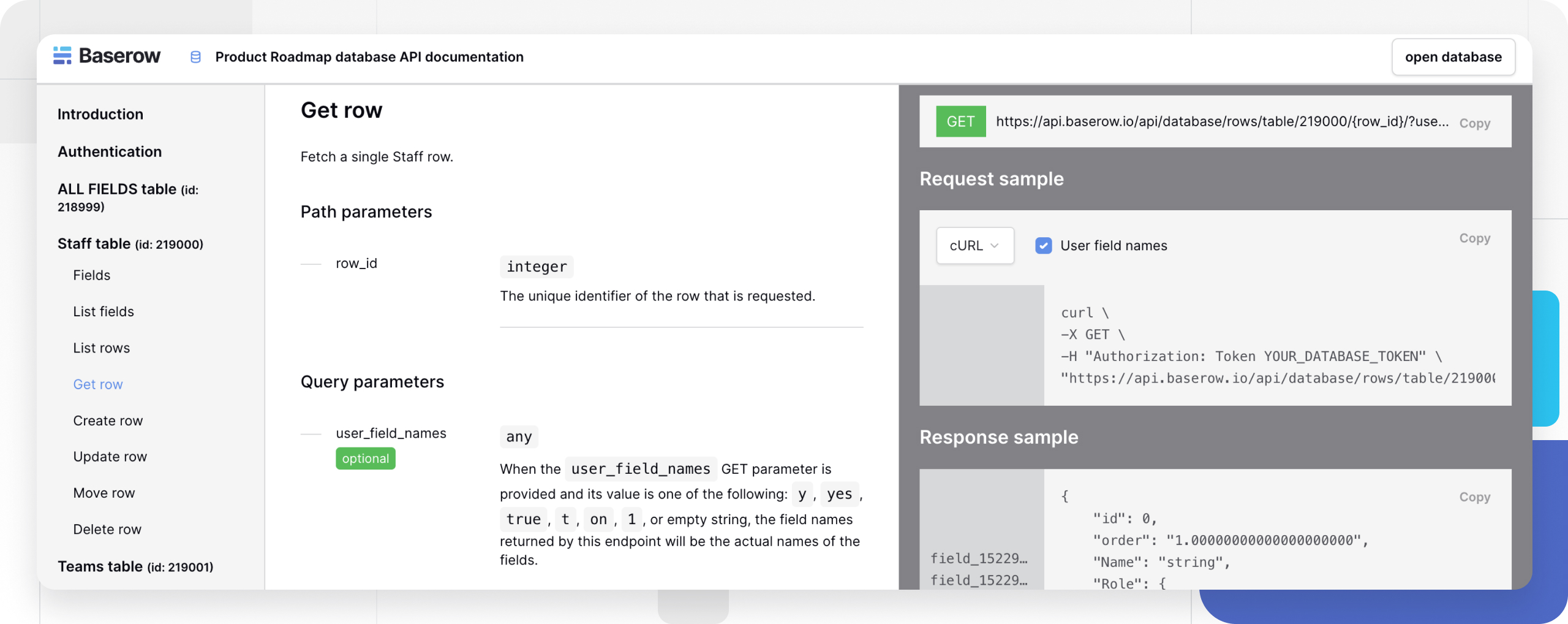
Baserow automatically generates API documentation for every database, including endpoints based on its tables and fields.
What are APIs used for?
The technology is useful whenever two or more systems need to work together.
Connecting web applications
Web applications often rely on interfaces to connect their frontend with backend services.
When you log in, submit a form, search for a product, or update your profile, your browser may communicate with a backend through these connections.
The same principle applies to mobile apps.
Connecting external services
Businesses can connect their software to an external web service instead of developing the same functionality themselves.
An online store, for example, might connect separate services for:
- Payments
- Maps
- Authentication
- Analytics
- Shipping
Each service handles its own job while the connections allow them to work together.
Automating workflows
These connections are also useful for automation.
Imagine someone submits a form. The submission could automatically create a record in a database, send information to a CRM, notify a sales representative, and trigger an email.
No one has to manually copy the information between systems.
Baserow can serve as the central database in workflows like this. Its REST API allows external applications and automation tools to work with database records programmatically.
Working with databases
A database stores information, while an interface provides a way for other applications to interact with it.
This distinction becomes particularly important with an API-first database.
Instead of treating programmatic access as an additional feature, an API-first approach makes it possible to use the same database through both a visual interface and software integrations.
Baserow takes this approach by combining a visual database with REST access to its data. Each database receives automatically generated API documentation, while database tokens provide control over what integrations can access.
See real-world API examples: Explore API Example: 4 Practical Uses Explained to see how APIs connect applications, process payments, handle forms, and work with databases.
What are the different types?
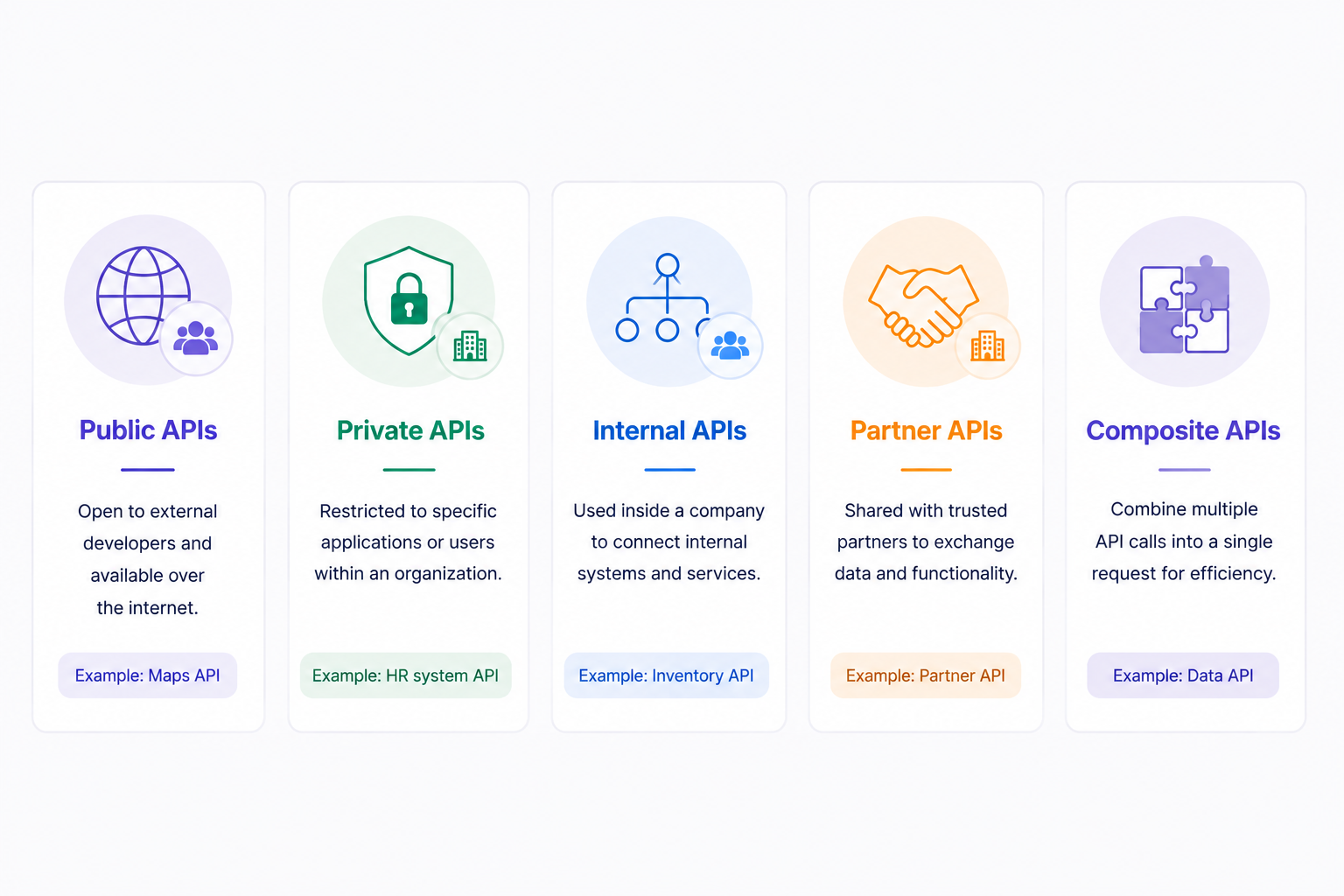
There are several types of APIs, depending on who can access them and how they are used.
Public APIs
Public APIs are made available to developers outside the organization that created them.
For example, a company might allow developers to access its product catalog or use a particular service within their own applications.
Public access doesn’t necessarily mean unlimited access. Authentication, usage limits, and permissions can still apply.
Private APIs
Private APIs are restricted to authorized applications or users.
They are often used inside a company to connect systems without making those connections available externally.
Internal APIs
An internal API is designed specifically for communication between systems within an organization.
A company might have separate systems for sales, customer support, finance, and operations. Internal connections allow those systems to share information while remaining separate applications.
Partner APIs
Partner APIs are shared with selected organizations.
For example, two businesses might use them to exchange order, customer, or inventory information. Access is typically restricted to approved partners.
Composite APIs
Composite APIs combine several operations into a single request.
This can be useful when an application needs information from multiple resources at the same time. Instead of making several independent requests, the client can use one interface that combines the required operations.
What is a REST API?
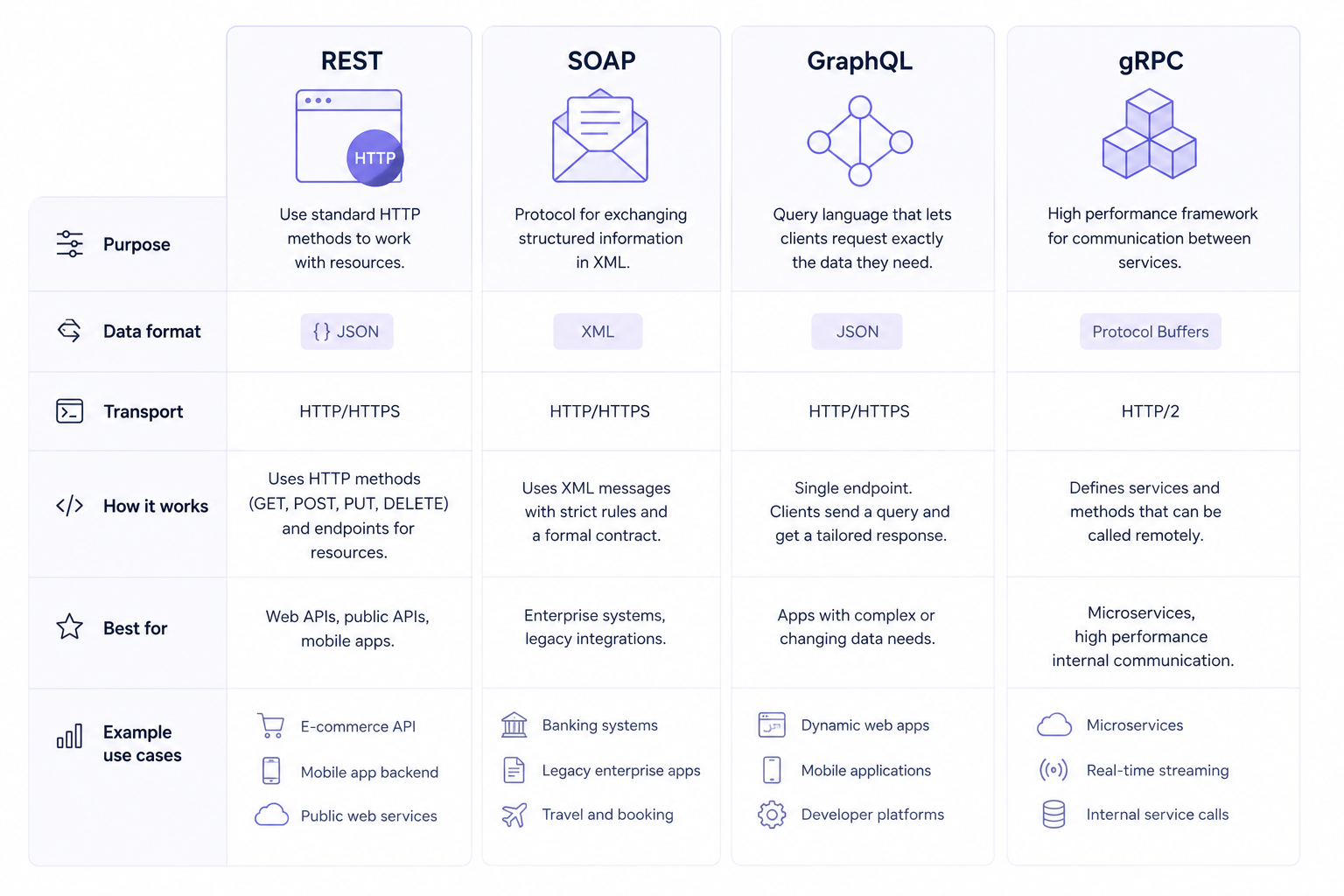
A REST API is a web API that follows the principles of Representational State Transfer (REST).
REST uses standard HTTP methods to work with resources:
- GET retrieves information
- POST creates something new
- PUT or PATCH updates existing information
- DELETE removes information
For example, an application could use GET to retrieve a customer and POST to add a new customer.
REST is popular because it uses familiar web technologies and provides a straightforward way for different systems to communicate.
Baserow’s API follows REST conventions and supports standard HTTP methods for working with database tables and rows. It also uses JSON for data exchange and provides automatically generated documentation.
REST, SOAP, GraphQL, and gRPC: what’s the difference?
REST isn’t the only way to build an interface between software systems.
SOAP
SOAP, or Simple Object Access Protocol, is a protocol for exchanging structured information between applications.
It has traditionally been common in enterprise environments where formal messaging standards and strict contracts are important.
GraphQL
GraphQL is a query language that allows a client to specify exactly which data it wants.
Rather than receiving a fixed response, the client can construct a query based on the information it needs.
gRPC
gRPC is a high performance framework designed for communication between services.
It uses remote procedure calls, allowing one service to invoke methods on another. This makes it particularly useful for communication between backend services.
Each approach has different strengths. REST is common for web applications, while SOAP, GraphQL, and gRPC can be better suited to particular architectures and requirements.
How is access secured?
Any system that allows external applications to access data needs appropriate security controls.
API keys are one common authentication method. A key identifies the application making a request and can be used to determine what it is allowed to access.
Other approaches include OAuth and token-based authentication.
Authentication answers who is making the request, while authorization determines what they can do.
Baserow uses database tokens for authentication. Access can be restricted to specific tables and operations, including create, read, update, and delete.
Credentials should be stored securely and never exposed in public source code.
What is OpenAPI?
OpenAPI is a specification used to describe and document APIs.
It can define:
- Available endpoints
- Supported HTTP methods
- Request parameters
- Response formats
- Authentication requirements
- Data structures
This gives developers a standardized description of how a service works and makes integrations easier to build.
Baserow provides an OpenAPI specification containing information about its endpoints, parameters, and request and response examples.
Real-world examples
You interact with API-powered services every day, often without realizing it.
Maps
A Maps API can allow an application to display locations, search for places, calculate routes, or work with geographic information.
Payments
An online store can connect to a payment provider to process transactions and receive confirmation when a payment succeeds.
Weather
A mobile application can retrieve current conditions and forecasts from a weather provider instead of collecting that information itself.
Authentication
Applications can connect to authentication services to let users sign in without building an entire identity system from scratch.
Databases
Applications can also connect to databases to create, retrieve, update, and delete records.
This is where Baserow can be particularly useful. Teams can manage structured information visually while applications and automation tools access the same data programmatically through REST.
Why are APIs important?
Modern software rarely works in isolation.
A single application may depend on several specialized services for payments, authentication, analytics, maps, communication, or data storage. Interfaces provide the connections that allow these separate systems to work together.
They also make software more flexible. A company can replace one service with another without rebuilding its entire application, as long as the new service provides a compatible way to communicate.
For businesses, this can mean less manual data entry, fewer disconnected systems, and more automated workflows.
For teams managing structured information, an API-first database can be especially useful. It gives people a familiar interface for working with data while allowing other software to access the same information.
Baserow combines both approaches: teams can manage their databases visually, while developers and automation tools can connect to the data through REST.
Looking for an API-first database? Learn how Baserow takes an API-first approach to API design, combining a visual database with REST APIs, documentation, and programmatic access.
Frequently asked questions
How does an API work in simple terms?
It provides a set of rules for communication between software systems. One application sends a request, another processes it, and a response is returned.
What is an API call?
An API call is a request made by one application to another system through an API. It can retrieve information, create data, update records, or trigger an action.
What is an API endpoint?
An endpoint is a specific address used to access a resource or perform an operation.
What is an API key?
An API key is a credential used to identify an application and control its access to a service.
Is an API a database?
No. A database stores and organizes information. An API provides a way for applications to communicate with a system, which can include a database.
What is an API-first database?
An API-first database makes programmatic access a core part of its design. Applications can work with stored information through an API while people manage the same data through a visual interface.
Baserow is one example, providing REST access, automatically generated documentation, and database tokens for controlling access.
What is the difference between an API and a web service?
A web service is software made available over a network, while an API defines how other software can communicate with it. Many web services expose APIs.
Is GitHub an API?
GitHub is a software development platform. It also provides APIs that developers can use to interact with repositories and other resources programmatically.
APIs make it possible for different pieces of software to communicate without requiring them to share their internal implementation.
They power everything from maps and payments to database integrations and automated business workflows.
For teams looking to connect structured data with the rest of their software stack, an API-first database can provide a useful middle ground: people get a visual way to manage information, while applications get programmatic access.
Baserow brings these two experiences together, with a visual database and REST access that lets applications and automation tools work with the same data.
Build your database, connect your tools, and put your data to work with Baserow.

Baserow 2.4 adds Button fields, Graph elements, workflow automation, AI provider management, improved Group By views, and 30+ more updates.

Discover how Airtable and Baserow compare in features, flexibility, speed, and scalability. Compare pricing plans and hidden costs to make an informed decision!

Explore the best open-source software alternatives to proprietary products. Discover OSS tools, licenses, and use cases with our updated directory.