
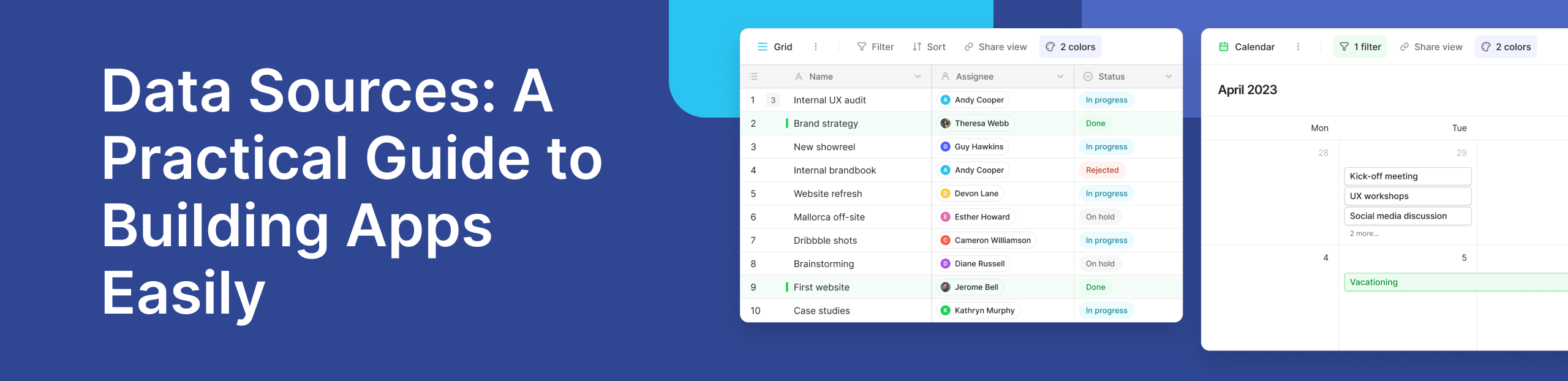
A supplier’s address sits in a spreadsheet, while their latest order appears in another system. When someone needs both, they have to search, compare, and copy information. This slows down routine work and creates opportunities for mistakes.
Understanding where information comes from helps teams choose reliable records and put them to use. The next step is connecting those records to an application that people can navigate.
What Is a Data Source?
A data source is the place or system from which information is obtained. It could be a spreadsheet, a database, a survey, or a service that provides records through an API.
The meaning also depends on context. In an application builder, the term can describe a configured request that retrieves particular records for a page.
For example, Baserow lets teams organize information in tables and build applications around it. A table stores supplier details, while a configured connection retrieves the records needed for a directory. The application then displays those details through elements such as tables or text.
Where Does Business Information Come From?
Business data comes from activities within an organization and information collected outside it. Knowing the origin helps teams understand its purpose, ownership, and limitations.
Internal information includes sales records, stock levels, employee details, and customer support requests. External information might include supplier catalogues, market research, or published government statistics.
These categories describe where information originates. They are different from types of data, which can describe its format or content. Structured records follow defined fields, such as product names and prices. Unstructured material, such as written reports, needs a different approach to storage and analysis.
Before combining information, check that the fields mean the same thing. Two systems may use “customer” to describe different groups, making their totals difficult to compare.
How Do You Check Information Before Using It?
A connection is only useful when the information behind it is suitable for the task. Start by checking whether records are accurate, complete, consistent, and recent enough.
The Government Data Quality Framework explains these quality dimensions and encourages organizations to address problems at their origin.
In practice, check for missing supplier names, duplicate entries, and dates stored in different formats. Give someone responsibility for reviewing errors and maintaining shared definitions.
Record where information came from and when it changed. W3C guidance on data provenance supports documenting its origin so people can judge whether to trust and reuse it.
For a supplier directory, decide how often contact details need review. A record that was correct last year may no longer support purchasing decisions.
How to Connect Records to a Baserow App
Prepare Your Table
Start with a clear structure. For a supplier directory, create fields for company name, location, service, and contact details. Keep each supplier in a separate row and use consistent field types.
The guide to organizing records in tables explains the foundations. Kuma can also help create and edit tables, as described in the Baserow 2.0 feature announcement. Review the suggested structure before adding important records.
Connect, Filter, and Display Records
Open an application page and add a connection through the Data tab. Choose an integration, then select the database and table.
Use “List multiple rows” for a directory or “Get single row” for an individual supplier’s detail page. Add filters to narrow the results, then connect the returned fields to page elements.
If you select a database view, its filters also affect which records reach the application. Test the result with different searches before publishing.
Follow the guide to configuring an app’s data connection or watch the step-by-step video tutorial.
Use Case: A Searchable Supplier Directory
Consider an operations team that needs to find suppliers by location and service. A directory built around a maintained table could give staff a simple search page and separate supplier details.
Baserow fits this workflow because teams can manage structured records and build the interface in one platform. Its self-hosted option also offers control over deployment.
Related conversations show why interface design matters. One community member asked about filtering records by typed location. Another wanted a simpler search interface for a plant database used by people with limited technical experience.
For the operations team, start with one task: finding an approved supplier in a chosen area. Test whether staff can complete it without help. Keep internal notes out of the public interface, and review access settings before making the directory available to other users.
These examples highlight a practical goal: help people find relevant information without learning database filters. The Baserow community offers a place to discuss similar workflows and ask implementation questions.
Frequently Asked Questions
- What is the difference between a database and a data source?
A database stores organized records. A data source is anything that supplies information for a task, including a database, spreadsheet, or survey. In an app, it can mean a configured request for specific records.
- Is an API the same as a database?
No. An API lets software request information or perform actions through defined rules. A database stores information. An application can use an API to retrieve records without directly accessing the underlying database.
- Does connecting an application copy every record?
Not necessarily. A connection can retrieve selected records when needed. In Baserow, the chosen action and filters determine the results, while pagination controls how many rows are fetched at a time.
- Why might an app display no matching records?
Check the selected table, view, and application filters. Their conditions may exclude every row. Test with a record you know should appear, then review each condition to find the mismatch.
- Do record changes require republishing a Baserow app?
No. Changes to stored records become available through the existing connection on the next refresh or page load. Changes to the application’s design or configuration may still require publishing.
- Can one configured connection serve several app pages?
Yes. Baserow supports shared connections that work across pages. Enable “Share between pages” for the relevant configuration. This helps reuse common information without recreating the same setup.
Put Your Records to Work
Use Baserow to organize your records and build an application around them. Create your Baserow account and start with one workflow your team needs. Test it with colleagues before expanding to other tasks.

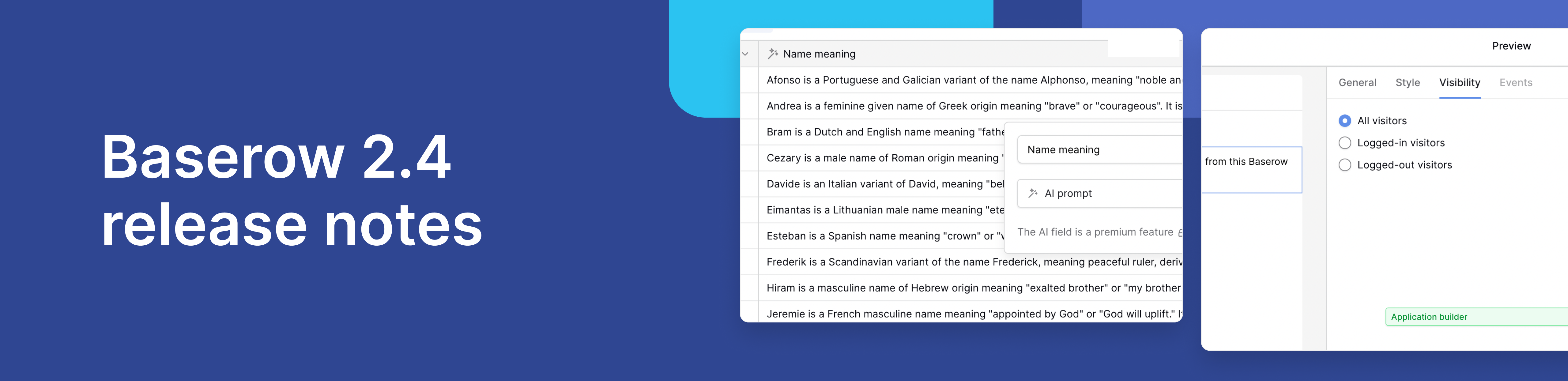
Baserow 2.4 adds Button fields, Graph elements, workflow automation, AI provider management, improved Group By views, and 30+ more updates.

Discover how Airtable and Baserow compare in features, flexibility, speed, and scalability. Compare pricing plans and hidden costs to make an informed decision!

Explore the best open-source software alternatives to proprietary products. Discover OSS tools, licenses, and use cases with our updated directory.