
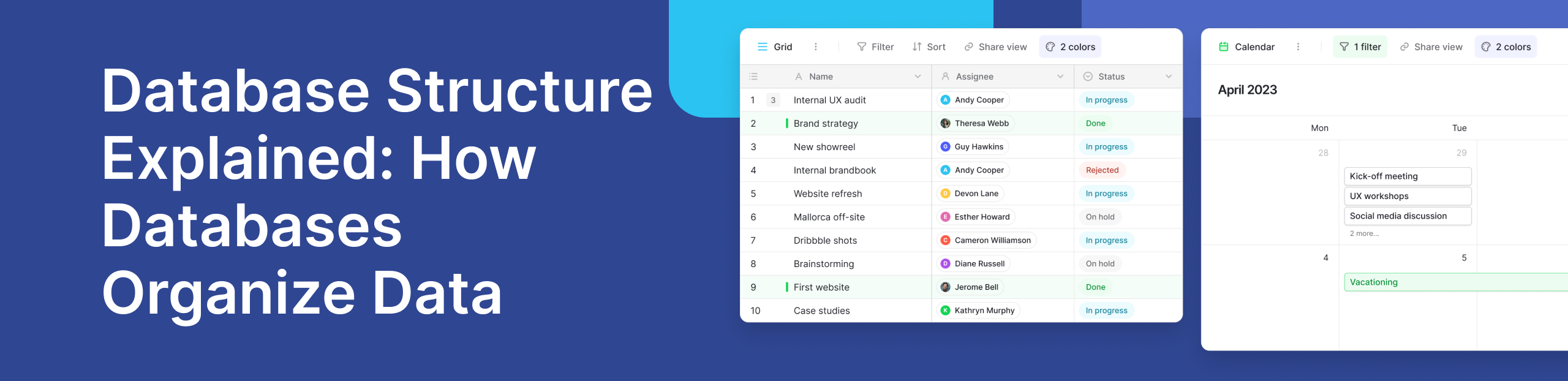
Businesses create information every day. Customer details, orders, products, projects, and invoices all need a clear place to live. But simply collecting information is not enough. Teams also need a simple way to find, update, and connect it.
This is where a good database structure matters. It defines how information is arranged so that people and applications can use it without confusion. A clear setup also helps reduce duplicate records and errors as a business grows.
Tools such as Baserow make this process more accessible by giving teams a visual way to build and work with databases, without requiring advanced technical skills.
What Is a Database Structure?
A database structure is the way information is organized inside a database. It defines where information is stored, how different records connect, and which rules control those connections.
In a relational database, information is usually arranged into tables. Each table focuses on one subject, such as customers, products, or orders. Rows represent individual records, while columns describe their properties.
For example, a customer table might contain fields for a customer’s name, email address, company, and phone number. This data structure makes it easier to organize data and retrieve the right details when needed.
The database schema acts like a blueprint. It defines tables, fields, relationships, and other rules. The exact setup will vary based on the type of database and the information it needs to handle.
If these concepts are new to you, Baserow’s introduction to databases explains how databases, tables, fields, and rows work together.
What Are the Main Parts of a Database?
Most relational databases use a few basic building blocks. Understanding them makes it easier to see how a database management system DBMS can store and manage information reliably.
Tables, Rows, and Columns
A table groups information about one subject. A business might have separate tables for customers, orders, employees, and products.
Each row represents one record. Each column stores a specific detail about that record.
Keeping subjects in separate tables prevents one large table from becoming difficult to manage. It also makes it easier to work with large amounts of information as the database grows.
Fields and Data Types
Fields define what kind of information can be stored. Each field usually has a data type that matches its purpose.
A name might use text, a price might use a number, and an order date might use a date field. Choosing the right field type helps keep records consistent and makes filtering, sorting, and calculations easier.
Different storage systems may support different field types, but the basic idea stays the same: each piece of information should have a clear purpose and format.
Primary Keys
Primary keys help uniquely identify each record in a table. For example, two customers might share the same name, but their customer IDs should be different.
This gives the system a reliable way to tell records apart. PostgreSQL documentation explains that a primary key requires values to be unique and not null, helping maintain reliable records.
Foreign Keys and Relationships
A foreign key connects information stored in one table with a related record in another table.
Imagine an orders table. Instead of storing a customer’s full contact information every time they make a purchase, each order can point to that customer in the customers table.
This approach reduces duplication and helps keep information consistent. Microsoft’s SQL Server documentation on primary and foreign keys also explains how these connections support referential integrity.
How Do Database Relationships Work?
Relationships allow separate tables to work together. They are one of the main reasons a relational database can manage data efficiently without repeating the same details in many places.
Three common relationships are:
- One-to-one: One record connects to one other record.
- One-to-many: One record connects to several records. For example, one customer may place many orders.
- Many-to-many: Several records can connect to several others. For example, an order can contain several products, while one product can appear in many orders.
Consider a simple real-world system with customers, orders, and products. Instead of placing every detail in one table, each subject gets its own table. Relationships then connect the records.
Integrity constraints help make sure these connections remain valid. For example, a system can prevent an order from pointing to a customer that does not exist.
This approach is also useful for project management. In the Baserow Community, users discuss ways to connect projects with multiple tasks using linked tables. It shows how relationships can turn separate records into a useful business workflow.
A well-designed database therefore does more than hold information. Its tables, keys, field types, and relationships create a foundation that keeps information easier to understand, update, and use as needs grow.
How to Design a Database Step by Step
A useful database starts with a clear plan. Adding tables and fields without thinking about how they work together can lead to duplicate records, missing details, and confusing workflows.
Here is a simple process to follow:
- Decide what you need to track. List the main information your team uses, such as customers, orders, products, or projects.
- Separate subjects into tables. Avoid putting unrelated information into one large table.
- Choose the right fields. Add fields for names, dates, prices, statuses, and other details.
- Create clear identifiers. Use IDs or other unique values to distinguish individual records.
- Connect related tables. Build relationships instead of copying the same information into several places.
- Set rules for important information. Constraints and required fields can improve accuracy.
- Test with real records. Check whether people can enter, find, and update information easily.
- Improve the design over time. Business needs change, so your database should be able to change too.
For a deeper look at planning tables and relationships, see Baserow’s guide on how to model your data. Teams preparing to move or expand existing systems can also explore this data modeling, migration, and scaling guide.
What Is a Real-World Example of a Database?
Consider a company that needs to track customers, orders, products, and suppliers. A designed database could separate this information into four connected tables.
The Customers table holds contact details. The Orders table records purchases and links them to customers. Products stores information such as names, prices, and stock levels. Suppliers stores details about the businesses providing those products.
This setup means a customer’s address does not need to be copied into every order. A supplier’s details also stay in one place rather than appearing beside every product.
As the company handles large amounts of information, this structure makes records easier to update and manage. It can also help reduce mistakes caused by storing the same information in several places.
How Baserow Makes Structured Data Easier to Manage
Traditional platforms such as SQL Server and Oracle Database are powerful, but working with them can require technical database knowledge. No-code tools provide another option for teams that want to create structured business systems visually.
Baserow lets users create tables, choose specialized field types, link records, and build different views of the same information. Teams can also collaborate in real time or use APIs to connect their information with other tools.
Kuma, Baserow’s AI assistant, can help users create and edit tables, fields, relationships, and formulas using natural language. This can make the early stages of building a database easier, while users still control how their information is arranged.
The approach can also help teams moving from older systems. One Baserow Community discussion explores importing linked tables from Microsoft Access and recreating relationships between them.
You can explore more practical examples in these Baserow use cases.
Frequently Asked Questions
- What are the basic components of a database?
Most relational databases contain tables, rows, fields, keys, and relationships. Together, these elements define how information is stored, identified, connected, and retrieved.
- What are the different types of database structures?
Common approaches include relational, hierarchical, network, document, and other NoSQL models. The right choice depends on the information being stored, how records relate, and how applications need to access them.
- What is the difference between a database and a database schema?
A database contains the actual information. A schema describes how that information is arranged, including its tables, fields, relationships, and rules.
- Why are primary keys important in a database?
They give each record a unique identity. This helps applications find the correct record and prevents confusion when several records contain similar information.
- What does a foreign key do?
It creates a connection between related tables. For example, an order can refer to a customer record without copying all of that customer’s details into the order.
- How should a beginner structure a database?
Start by identifying the main subjects you need to track. Give each subject a table, add suitable fields, and then connect related information. Begin with a simple model and expand it when needed.
- Can you build a database without knowing SQL?
Yes. Visual database tools allow people to create tables, fields, relationships, and views without writing SQL. This can help non-technical teams build systems while keeping their information structured.
- Can a database structure change after it is created?
Yes. Tables, fields, relationships, and rules can change as business requirements develop. Planning ahead helps, but a useful system should also support changes without forcing teams to rebuild everything.
Build a Better Foundation for Your Data
A useful database is not simply a place to keep records. Good design makes information easier to find, connect, check, and update. It also creates a stronger foundation for workflows and applications as a business grows.
If you want to create and manage structured information visually, start using Baserow and build a database around the way your team works.

Baserow 2.4 adds Button fields, Graph elements, workflow automation, AI provider management, improved Group By views, and 30+ more updates.

Discover how Airtable and Baserow compare in features, flexibility, speed, and scalability. Compare pricing plans and hidden costs to make an informed decision!

Explore the best open-source software alternatives to proprietary products. Discover OSS tools, licenses, and use cases with our updated directory.