
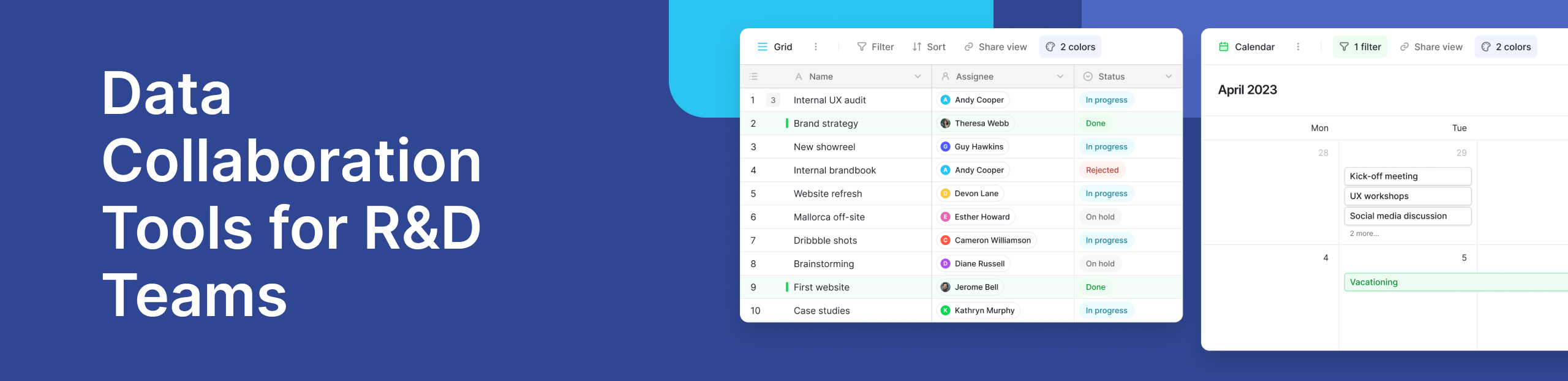
Research and development teams operate in environments where speed, accuracy, and trust in data directly impact outcomes. As organisations scale their innovation efforts, the way research data is created, shared, and governed becomes just as important as the research itself. Spreadsheets, shared folders, and disconnected tools often fail to keep pace with modern R&D workflows.
This is why many organisations now prioritise structured collaboration tools that support transparency, governance, and alignment across teams. A well-designed data collaboration tool for R&D teams helps connect people, processes, and data without slowing experimentation or compromising control.
Why Data Collaboration Is Critical for R&D Teams
R&D work rarely happens in isolation. Research teams often include scientists, engineers, analysts, and external partners working across locations and time zones. Each group contributes data that feeds into shared decisions, making enabling collaboration essential rather than optional.
Without a clear system for managing inputs and outputs, teams face duplicated work, inconsistent results, and delays in validation. Modern team collaboration depends on shared visibility into progress, assumptions, and outcomes. When everyone works from the same information, teams can move faster with greater confidence.
Structured collaboration also supports data driven decisions. When research inputs are consistent and traceable, insights become easier to validate and reuse across projects.
Common Challenges in R&D Data Collaboration
Many R&D organisations struggle not because of a lack of expertise, but because their tools were never designed for collaborative research at scale.
A frequent issue is fragmented research data spread across files, emails, and disconnected systems. This fragmentation makes it difficult to understand which dataset is current or complete. Closely related is the lack of reliable version control, where updates overwrite prior work without context or traceability.
Security is another major concern. R&D teams handle sensitive intellectual property, early-stage findings, and regulated data. Without proper data security measures, organisations risk exposure or compliance failures. Ad-hoc sharing tools rarely meet enterprise expectations for security and compliance.
Finally, many teams lack a true single source of truth. When information lives in multiple places, alignment breaks down and project momentum slows.
What Makes an Effective Data Collaboration Tool for R&D Teams
Not all collaboration platforms are suited to research environments. R&D teams need tools that balance flexibility with structure.
- Real-Time Collaboration Without Data Conflicts
Effective platforms enable real time collaboration so multiple team members can work simultaneously without overwriting each other’s contributions. This reduces bottlenecks and keeps momentum high, especially during active research phases.
Clear change tracking ensures updates are visible and attributable, allowing teams to collaborate confidently without fear of losing work.
- Secure Access and Enterprise-Grade Controls
R&D collaboration requires more than basic permissions. Teams need enterprise grade security that supports role-based access, controlled sharing, and auditability. This ensures sensitive research remains protected while still accessible to the right contributors.
Strong security and compliance features also support regulated industries, where documentation and oversight are non-negotiable.
- Versioning, Traceability, and Research Integrity
Reliable version control is critical for maintaining research integrity. Teams must be able to trace how data evolved, why changes were made, and which version informed a decision. This traceability supports peer review, reproducibility, and long-term knowledge retention.
How Collaboration Tools Support the R&D Workflow
Beyond data storage, collaboration tools play a central role in streamlining workflows across the research lifecycle. From planning experiments to reviewing results, structured systems reduce friction between steps.
A project manager gains clearer oversight when progress, ownership, and dependencies are visible in one place. Teams spend less time coordinating logistics and more time advancing research. Collaboration features such as comments, activity logs, and structured updates replace scattered conversations across email and chat tools.
Platforms designed for research also integrate easily with existing systems, supporting seamless integrations with analytics tools, documentation platforms, and internal systems.
From Spreadsheets to Structured Research Platforms
Spreadsheets are often the starting point for R&D collaboration, but they struggle as complexity grows. Large datasets, concurrent edits, and evolving schemas quickly expose their limits. Manual processes increase the risk of errors and slow decision-making.
Structured platforms provide a collaborative platform that retains flexibility while adding governance. Instead of forcing teams into rigid workflows, modern tools allow research teams to model their processes while maintaining consistency and visibility.
This shift is explored further in Baserow’s perspective on data collaboration tools for manufacturing teams, which highlights how structured systems improve coordination without reducing adaptability.
How Baserow Enables Secure and Scalable R&D Collaboration
Baserow supports R&D teams by combining structure with flexibility. It allows teams to organise research data in a way that reflects real workflows while maintaining shared visibility. With real time collaboration built in, contributors can work together without creating conflicts or silos.
Recent updates outlined in the Baserow 2.0 release notes introduce improvements around permissions, performance, and collaboration, making the platform even more suitable for research-heavy environments. These enhancements help teams scale without sacrificing control.
Baserow also supports ai powered workflows that assist with data organisation and insight generation, reducing manual effort while preserving human oversight. As a result, teams can focus more on discovery and less on administration.
You can explore how these capabilities fit into broader collaboration strategies in Baserow’s overview of collaboration tools and top platforms.
A Practical R&D Use Case Using Baserow
Consider an R&D organisation running multiple parallel research initiatives. Each initiative involves hypothesis tracking, experiment design, data collection, and result validation. Without a shared system, updates are scattered and difficult to reconcile.
Using Baserow, teams can centralise experiment plans, datasets, and outcomes in one structured environment. Researchers log findings in real time, while reviewers validate results without disrupting ongoing work. This creates a single source of truth that evolves with the research instead of fragmenting over time.
Because Baserow supports granular permissions, sensitive datasets remain protected while still allowing collaboration across departments. Teams gain clarity without introducing friction, which is critical when timelines are tight and insights need to move quickly.
Collaboration and Governance in Regulated R&D Environments
Many research teams operate under strict regulatory and ethical requirements. In these settings, collaboration must be transparent, auditable, and controlled. Informal tools rarely provide the level of oversight required to meet internal or external standards.
Modern collaboration tools address this by embedding governance directly into workflows. Access controls, activity logs, and structured data models help organisations demonstrate accountability without slowing research progress.
Baserow aligns well with these needs by supporting controlled environments that scale with organisational complexity. Its approach reflects best practices discussed in broader industry guidance on secure research collaboration, including principles outlined by organisations such as the National Institute of Standards and Technology and the OECD’s work on data governance.
Learning from the Baserow Community
Real-world adoption patterns often surface first in user communities. Within the Baserow community, teams regularly share how they adapt collaborative databases for research planning, resource coordination, and experiment tracking.
Discussions highlight a recurring theme: teams value tools that adapt to their workflows rather than forcing rigid processes. This flexibility enables smoother onboarding, faster iteration, and stronger alignment between technical and non-technical contributors.
Community-driven insights reinforce that successful collaboration is less about adding more tools and more about creating shared structure around data.
Scaling R&D Collaboration Without Slowing Innovation
As research teams expand, informal collaboration becomes harder to manage. Methods that work for a small group often fail once more contributors, datasets, and dependencies are added. Information spreads across tools, and coordination becomes slower and less reliable.
Scalable collaboration tools help teams stay aligned by clearly showing ownership, progress, and data relationships. This clarity reduces coordination effort and allows research leaders to focus on results instead of ongoing administration.
By streamlining workflows and supporting structured collaboration, platforms like Baserow help teams scale in a controlled way while still giving individual teams the freedom to work independently.
Frequently Asked Questions
- What is a data collaboration tool for R&D teams?
It is a structured platform that helps research teams collect, manage, and share data collaboratively while maintaining security, traceability, and consistency across projects.
- How do R&D teams collaborate on research data securely?
They use tools with role-based access, audit logs, and controlled sharing to ensure sensitive information is only accessible to authorised contributors.
- Why is version control important in R&D collaboration?
Version control preserves research integrity by tracking changes over time, enabling reproducibility, validation, and accountability in decision-making.
- Can collaboration tools support compliance requirements?
Yes, platforms designed for governance help teams meet regulatory expectations by embedding controls and documentation directly into workflows.
- How do modern R&D teams manage real-time collaboration?
They rely on systems that allow concurrent editing, clear change tracking, and shared visibility to reduce delays and miscommunication.
Building Smarter R&D Collaboration
Effective collaboration is no longer just about sharing files. For modern research teams, it means creating environments where data is trusted, accessible, and governed without slowing innovation.
By adopting structured collaboration tools, organisations can improve alignment, protect sensitive research, and support better outcomes. Platforms like Baserow demonstrate how flexibility and control can coexist, helping teams collaborate with confidence as they scale.
If you’re exploring better ways to manage research collaboration, you can get started with Baserow here.

Baserow 2.4 adds Button fields, Graph elements, workflow automation, AI provider management, improved Group By views, and 30+ more updates.

Discover how Airtable and Baserow compare in features, flexibility, speed, and scalability. Compare pricing plans and hidden costs to make an informed decision!

Explore the best open-source software alternatives to proprietary products. Discover OSS tools, licenses, and use cases with our updated directory.